Scott Fowler: The NTSB report on Greg Biffle plane crash got released. Somehow I feel even worse.
Published in Auto Racing
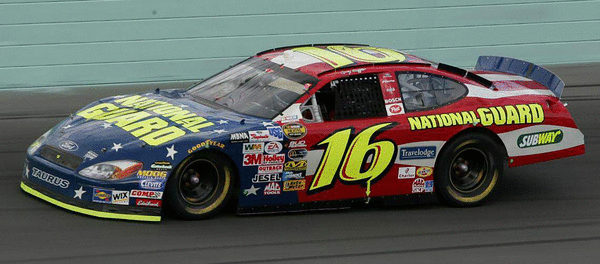
CHARLOTTE, N.C. — I read the National Transportation Safety Board’s preliminary report on the Greg Biffle plane crash shortly after it was issued Friday. Twice, in fact. Then I separately interviewed two aviation safety experts with 20-plus years of experience who also had read the report multiple times, just to make sure I understood what it said.
And after all that, you know how I felt?
Worse than before. Emptier somehow.
I don’t know what I expected from the NTSB report, but for me, there was no closure. And I doubt it brought much closure to the many others more deeply affected by this tragedy.
We at least know more now about this crash after this federal report, though we don’t know anywhere close to everything. The NTSB’s preliminary seven-page report cites several problems with the Dec. 18 Cessna Citation 550 flight from Statesville Regional Airport, which is about 40 miles north of Charlotte. But a definitive cause of the crash wasn’t revealed. That will come in the final report, which likely won’t be issued until 2027.
The preliminary report is difficult to read — partly because of the jargon, but mostly because of the pictures it paints inside your mind. There are times you want to cringe and other times you want to scream.
It brings to life the terrifying moments before the crash, as parts of the plane stopped working and the pilot took a sweeping left turn and attempted to land right back at the same Statesville airport from which he had departed just 10 minutes earlier.
Instead, the plane hit a light stanchion, sheared off the tops of some trees and burst into flames well short of the runway. There were seven people on board — former NASCAR star driver Biffle, his wife, Cristina, his two children, Emma and Ryder, and his best friend and employee Craig Wadsworth among them. Pilot Dennis Dutton and his son, Jack Dutton, were in the cockpit.
They had all been headed to Florida. No one survived.
“You have to kind of read between the lines in reports like these,” Bob Benzon told me.
Benzon would know — he spent 27 years as an investigator in charge of writing NTSB reports exactly like this one before he retired.
“It looks like they were having a pretty significant electrical problem,” Benzon said after reviewing the report. “There is failed instrumentation. They had a very shallow rate of descent. ... The NTSB will look at human performance issues.... The NTSB likes to avoid the word ‘blame,’ but it’s still going to take a lot of work to assign responsibility.”
It had been unclear for more than a month, but we do now know who the primary pilot was — Dennis Dutton, a seasoned pilot seated in the left-hand cockpit seat that signifies you’re in charge. Dutton was certified to fly the plane with the limitation “CE-500 Second in Command Required.”
In other words, he was supposed to have a co-pilot who was also certified to fly that Cessna.
Dutton’s 20-year-old son, Jack, was in the right-hand seat of the cockpit. But while Jack Dutton had some piloting experience, planned to follow in his father’s footsteps and was in the professional flight program at Auburn, he wasn’t yet certified to be a co-pilot of that Cessna.
As the NTSB report states plainly: “The right seat passenger was not qualified to perform second in command duties.” (Biffle often piloted helicopters, most famously during his laudable work in the aftermath of Hurricane Helene. But he also wasn’t certified to fly the Cessna).
So did not having two experienced pilots in the cockpit cause the plane to crash?
I posed this question to Anthony Brickhouse, who was once an NTSB investigator. Brickhouse then became a professor at Embry-Riddle Aeronautical University in Daytona Beach, Fla., for 23 years and is now a U.S.-based aviation safety consultant.
“I’m not going to say that’s why they crashed,” Brickhouse said. “It could be a contributing factor. … You had a very seasoned pilot who was certificated to fly the aircraft, and then you have a private pilot who is relatively inexperienced and definitely inexperienced in jet aircraft. And if you have issues going on, that pilot (Jack Dutton) isn’t going to be extremely helpful, because they just don’t have the experience. They don’t have the knowledge.”
But, Brickhouse emphasized, the lack of an experienced co-pilot was only one factor. There are still many questions the report doesn’t answer. “Planes make emergency landings all the time that don’t end in tragedy,” Brickhouse said.
The Cessna also had some instrument failures at times, and the cockpit voice recorder largely went out for three minutes and 55 seconds before starting to work, in a limited way, once again. Benzon said this was uncommon in his experience.
“As far as the CVR degrading, that’s unusual,” Benzon said. “Generally, it either works or it quits. It doesn’t quit and then come back on.”
The left engine initially didn’t start and, once it did, may have been producing more power than the right. Visibility also kept decreasing, although temperatures were well above freezing.
“We’re having some issues here,” Jack Dutton said on the radio, about two minutes before the crash.
Jack Dutton briefly took over control of the aircraft from his father at around 10:11 a.m. — the flight departed at 10:06 a.m. and crashed at 10:15 a.m.
Benzon said it was reasonable to assume — although not certain — that the son took over the controls from his father at that time because his father was trying to troubleshoot. Dennis Dutton re-assumed control of the plane shortly afterward, though, and was flying it at the time of the crash, according to the NTSB report.
Brickhouse said the report shows that the crash — like most crashes — wasn’t caused by one issue but instead by a cascading series of problems.
“I really can’t pinpoint one thing,” he said. “Just from the preliminary report, there’s at least four or five different things worth looking deeper into. And that’s most accidents. It’s never just one thing. It’s always a series. And typically, if you remove one of those negative factors, you probably don’t have an accident. It’s literally that close.”
Instead, seven people died, and no one in the NASCAR community is anywhere close to over it.
I was among the hundreds of people who went to the memorial service in Charlotte on Jan. 16. It was filled with laughter, tears and a lot of people wondering how this unimaginable tragedy ever happened.
Even now, after this report, we still don’t really know that.
And when we do know, how much difference will it really make?
©2026 The Charlotte Observer. Visit charlotteobserver.com. Distributed by Tribune Content Agency, LLC.




Comments