Jamaica tourism reopens after devastating Hurricane Melissa. It wasn't easy
Published in Weather News


Three weeks after Jamaica was battered by the worst hurricane to hit the island on record, roads were still clogged with debris, thousands remained without electricity, and at Jakes Hotel on the island’s hard-hit Treasure Beach, brother and sister Jason and Justine Henzell were in a quandary.
As they worked to help farmers and fishermen in their tight-knit community recover from Hurricane Melissa’s Oct. 28 devastation, the siblings were also grappling with whether to reopen the doors of their iconic hotel. There had been damage to some of the seaside cottages, but some rooms remained intact.
“It’s a very fragile balancing act,” Jason Henzell said. “You want to admit that things went sideways. But I also believe that we need to build back a very genuine story that Jamaicans are grateful for life, grateful for the opportunity to be seeing other people coming in.”
On Monday, seven weeks after the Category 5 storm made landfall, Jamaica officially reopened for tourism. The storm wiped out nearly a third of the country’s wealth, according to the United Nations, and left nearly five million tons of debris scattered across six parishes. But even with losses amounting to as much as 32% of its GDP Jamaica is ready, officials said.
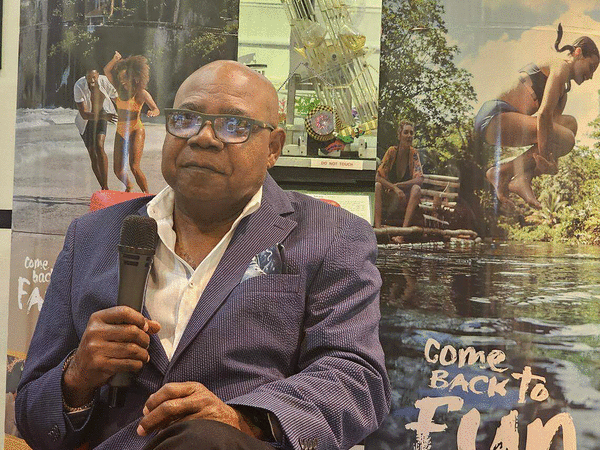
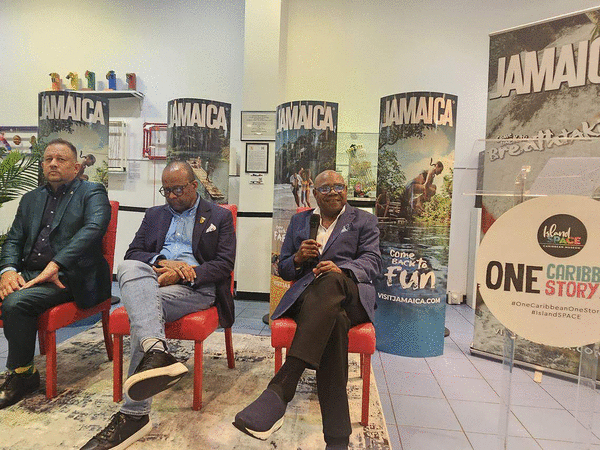
“Tourism is not a social activity for us. Tourism is not just a recreational activity. For us, tourism is not about a vacation person,” Tourism Minister Edmund Bartlett said earlier this month as he visited South Florida to ask for the diaspora’s help luring tourists back to the island. “For us, tourism is the economic lifeblood of Jamaica, and so to open the industry is not a light matter. To open the industry is to bring back life into the country.”
It is estimated that climate-related disasters such as hurricanes and droughts could cost vulnerable island economies in the Caribbean billions of dollars each year. And with that come tough decisions, official acknowledge, especially once disaster strikes.
With over 60% of Jamaica’s foreign direct investment derived from tourism and the country still reeling from Melissa’s impact, incouding 45 deaths, Bartlett said the decision to reopen to tourists was not made lightly.
There was “trepidation,” he conceded, as discussions about reopening unfolded against a backdrop of thousands of workers still without water, electricity, food and in some cases homes.
“It worried them,” Bartlett said of those involved in the talks to reopen. “But what they saw, in the spirit of the people, of the workers, was amazing. It was how the workers themselves left their situation to actually come to the hotels to help them clean up and to fix up.”
As he toured hotels and resorts in Negril, Montego Bay and Ocho Rios,ahead of Monday’s relaunch, Bartlett said he was “amazed” by the comments he heard from workers, among the 300,000 people employed by the tourism industry.
“They said that the choice they had was either we suffer and die here, or we come and do something to live off. And they chose the latter,” he said. “So yes, there was that tugging of decisions in your mind: ‘Do I open or do I not?’ And the balance of everything was you had to open.”
Melissa did significant damage at tourist destinations like Montego Bay and Treasure Beach. While 80% of customers have had their electricity restored, many people on the hard hit western areas of the island will have to go through the Christmas holiday without.
Still, the government has been touting recovery efforts, from the quick reopening of Montego Bay International Airport and major cruise ports, to public-private partnerships to help tourism workers get materials to rebuild their homes to mortgage relief for Jamaicans affected by the storm.
“One of the reasons that you had to hope was that only a third of Jamaica was really affected” Bartlett said. “We’re talking about maybe 30, 40% of the total workforce that will be affected, but there’s another 60 to 70% wanting to continue to do their work, because they can go to work, and their facilities were not affected,”
Volunteer effort
After Melissa, the Henzells, like everyone in the hard-hit areas, focused on identifying needs and getting help.
“It’s all about keeping Jamaica’s economy as healthy as it possibly can be, right? And tourism is a big part of that,” Justine Henzell said. “And there is no tourism without a visitor. So that’s how they can contribute to us.”
Joe Angio and his partner were among those who heeded the early call. They had made reservations in July to visit Treasure Beach around Thanksgiving, booking a stay at Jakes. After watching coverage of Melissa’s destruction from his Brooklyn home, Angio knew the damage would be severe. Still, he wanted to go.
He wrote Jason Henzell and said, ‘We’ll come for you to put us to work. We’ll volunteer to help you do whatever, if it’s picking up a hammer, digging ditches,” he said.
They were just on the verge of booking a leisure trip to Mexico, Angio said, when he finally heard back from Henzell, who asked him if he was serious,
“We brought a couple of big duffel bags, toiletries, solar-powered charges, lanterns,” said Angio, a longtime magazine editor. “We were prepared to stay in a relief tent or something. We didn’t know what we were going to be doing.”
The couple ended sleeping in a generator-powered cottage, and over their 10-day stay volunteered to work with World Central Kitchen and the Henzells charitable foundation. One day, they spent four hours handing out vouchers to farmers who suffered damage from Melissa’s 150 mph winds and rains.
Angio, who had given money after Hurricane Beryl battered the same area last year, said the experience felt different.
“Writing a check felt easy,” he said. “But bringing a donation and saying, ‘Put us to work’ giving your time — that felt good.”
Still, the devastation was stark. Driving through Black River at the end of the visit, Angio said the area “looked like Hiroshima after a bomb.”
He said the country’s decision to reopen its tourism is a delicate balancing act.
“What Jason and others impressed upon me, on us while we were there, is: ‘This is good for us. Just being here is really helpful to us,’” he said.
That sentiment has given new meaning to the country’s 1970s tourism marketing slogan, “Come back to Jamaica,” as Bartlett and other government ministers tell visitors that coming back is the best way to help with the recovery.
Tourism is 35% of Jamaica’s GDP
Jamaica last year welcomed more than 4.3 million tourists, who poured more than $4 billion into the economy. The sector contributes around 35% of Jamaica’s GDP and supports thousands of jobs across hotels, attractions, transportation, agriculture, manufacturing and the creative industries, according to data from the tourism ministry.
“When a hurricane damages hotels, it is not only buildings that suffer,” Bartlett said at a meeting of the Caribbean Tourism Organization. “It is the hotel worker, the taxi operator, the farmer who supplies fresh produce, the fisher folk who supply seafood, the craft vendor and the musician.
“When tourism restarts, income returns, hope returns and dignity returns,” he added. “We’re saying that Jamaica tourism is ready.”
©2025 Miami Herald. Visit at miamiherald.com. Distributed by Tribune Content Agency, LLC.






Comments