Who do Salvadoran troops answer to if they aren't part of the UN force in Haiti?
Published in News & Features
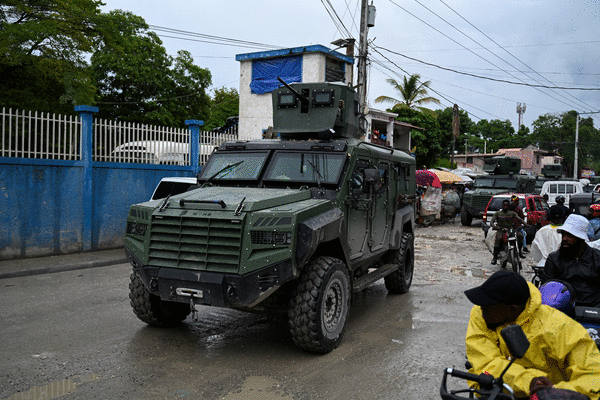
The United Nations is distancing itself from El Salvador’s unprecedented military buildup in Haiti, confirming that the vast majority of the Central American nation’s troops are operating outside the Gang Suppression Force authorized by its Security Council and beyond the mandate and reporting of its U.N. Support Office.
The Miami Herald first reported the arrival of Salvadoran reinforcements and plans by President Nayib Bukele for a military deployment that would surpass the size of the international armed force already in the country, with troops reporting to a Salvadoran commander in Port-au-Prince rather than the Mangolian major general in charge of the multinational mission.
On Monday, Haitian Prime Minister Alix Didier Fils-Aimé visited the Salvadoran base, located not far from the U.S. Embassy. On Tuesday as journalists awaited a press conference at this office, several Salvadoran soldiers walked into the room.
The buildup of Salvadoran troops has raised concerns about the legal framework governing the operation, the chain of command and who would be responsible for abuses and civilian casualties by troops operating outside the U.N. authorized force
“The U.N. Support Office is there to provide logistical and operational support to personnel from the Gang Suppression Force and also on the applicable Human Rights Due Diligence Policy mandate,” said Stéphane Dujarric, spokesman for the office of the secretary-general.
The Salvadoran troops’ deployment was prompted by the Oct. 18 disappearance of four aviation technicians from the Armed Forces of El Salvador who were deployed under the GSF. The men were returning to camp from a visit to a supermarket when they were ambushed by armed gang members east of Port-au-Prince. They’ve been unaccounted for since.
Bukele over the weekend confirmed that in addition to his 2,500 troops in Port-au-Prince, he has also deployed “attack helicopters.” The choppers arrived on Oct. 29, the president said, responding to an open letter by a diaspora advocacy group accusing Salvadoran forces of bombing civilians near Port-au-Prince. In the letter addressed to U.N. Secretary-General António Guterres, the group claimed that “children are being killed not by gangs, but by foreign bombs.”
“Bombs? Our mission doesn’t even have bombs at its disposal,” Bukele said in a post on X. He noted that the “report” was published a day before his helicopters even arrived in Haiti and said they had not flown a single mission as of Saturday.
“These NGOs lie with impunity, while wielding enormous influence over international organizations,” he said in reference to the group calling itself United Nations Association Haiti. The group is not affiliated with the U.N.
“They are nothing more than lobbying firms for criminals and cartels, masquerading as humanitarian organizations,” Bukele added.
Bukele that same day also confirmed comments by President Donald Trump who was asked by reporters about a conversation with the Salvadoran leader over his deploying troops to Haiti.
“I did speak to him. He said that he has a big problem with Haiti,” Trump said. “They killed some of his people. I said, ‘You’re running your country. You have to do what you have to do.’”
Under U.N. rules, military personnel deployed under international missions are required to undergo human rights training. Additional safeguards have been put in place for the GSF, which was first approved by the Security Council last September for a year and was recently extended for six months after the U.S. and Panama drafted a resolution. The safeguards are to ensure that military personnel deployed under the anti-gang force do not engage in abuses and civilians are protected.
The Salvadorans were deployed without undergoing that requirement and their arrival preceded a formal signed agreement with the Haitian government.
Guterres’ office emphasized that despite its lack of direct oversight of the Salvadorans, they are not exempt from obligations under international law.
“We reiterate that all security operations conducted in Haiti, whether under the framework of the GSF or by national authorities and their partners, must be carried out in full accordance with applicable international law, including international human rights law and international humanitarian law,” Dujarric said.
“Respect for these obligations, as well as transparency and accountability, remains essential to maintaining international support and ensuring the protection of the population.”
Dujarric also confirmed that the U.N. had received a letter dated Nov. 1 and bearing the signature of Wilson Joseph of “Gwoup Rebel 400” addressed to the attention of the secretary-general. Joseph is the real name of Lanmò San Jou, head of the 400 Mawozo gang, which is part of the Viv Ansanm coalition that was designated last year as a Foreign Terrorist Group by the Trump administration.
In the letter, the gang leader asks for an international delegation to be dispatched to Haiti to facilitate a dialogue in the Cul-de-Sac Plaine where clashes between armed gang members and security forces have forced people to flee their homes. Some four gangs operate in parts of the plain.
While Joseph’s 400 Mawozo gang largely operates in Croix-des-Bouquets, Chen Mechan, headed by a Claudy Célestin, also known by the alias Stevenson Pierre, controls territory in neighboring Santo. Wilson said that the clashes “are causing serious concern” and said he fears civilians will be caught in the crossfire.
Joseph confirmed the letter’s authenticity in an interview with the Associated Press. He also told AP that the Salvadoran technicians are dead, killed during the attack in the territory of Chen Mechan, whose name translates to “Mean Dog.” The Salvadoran government believes the men are still alive.
In the two-page letter, the gang leader said he had waved “the white flag,” since Aug. 20, and directed comments to Bukele. Given the president’s “vengeful remarks, expectations, and threats, I fear this situation will lead to an escalation of violence and a logic of reprisals, of which the Haitian people would be the first victims,” Joseph said.
This is not the first time the gang leader, who bears responsibility for the surge in violence that has led to more than 5,700 people being killed or injured from January to mid-September, has waved a white flag. The last one only lasted a few days.
Dujarric said confirmation of receipt of the letter “does not constitute endorsement of its contents, recognition of its author, or a position by the United Nations.”
“We want to underscore that the United Nations remains concerned that communities continue to bear the brunt of the situation in Haiti,” he added. “We continue to emphasize the importance of complying with all applicable international law, protecting populations, and prioritizing the pursuit of peaceful solutions in Haiti.”
On Monday, the U.N.-backed GSF and Haiti National Police carried out an hours-long operation in the Cul-de-Sac Plaine, where the aviation technicians were believed to be held. The operations did not lead to the men, but the troops barely came under fire, a source said, underscoring that amid the stepped up offensive, gangs are falling back and retreating.
©2026 Miami Herald. Visit at miamiherald.com. Distributed by Tribune Content Agency, LLC.


Comments