As Sen. Chris Murphy recovers from a stroke, doctors explain the condition
Published in News & Features
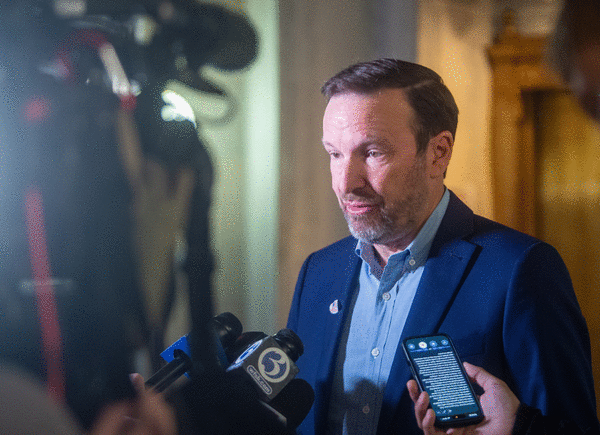



U.S. Sen Chris Murphy continues to respond to treatment after having a stroke, according to a statement from a spokesperson for Murphy. The spokesperson declined to offer any additional information Monday on the senator’s condition.
The 53-year-old Connecticut senator experienced numbness in his arm Saturday afternoon while at his son’s hockey game, according to Allison Herwitt, the senator’s chief of staff in a statement Sunday.
Herwitt said in the same statement that after evaluation at a local hospital, Murphy was transferred to John Hopkins Hospital for further monitoring and “is responding well to treatment” and that doctors were “optimistic he will make a full recovery.”
Murphy is the fourth U.S. senator to suffer from a stroke in the past few years.
Sen. Ben Ray Lujan, Democrat of New Mexico experienced a stroke in 2022 along with Sen. John Fetterman, a Pennsylvania Democrat who, according to the Associated Press, attributed his stroke the same year to a blood clot triggered by atrial fibrillation. And Sen. Chris Van Hollen, a Maryland Democrat, suffered a minor stroke in the same year.
A staunch critic of President Donald Trump’s administration and the Iran War, Murphy recently traveled overseas to receive a firsthand account of damage from the war that he has said the administration is covering up. He said he was blocked from seeing a key American air base in the Middle East during that official Congressional trip.
In a recent statements about a briefing on potential U.S. military plans for the Iran War, Murphy expressed deep worries about what the war plan would entail if the U.S. restarted military operations.
“I will just say this: their plan is insane,” he said. “It will lead to devastating escalation and the likely destruction of our commitment to the rule of law.”
As the midterm elections approached, Murphy was campaigning for candidates in the state as well as Democrats in nearly a half dozen states with marquee Senate races that could affect which party holds the majority, the CT Mirror reported.
Several neurologists in the Hartford region, who are not overseeing the senator’s care, said more younger people below the age of 54 are having strokes, due in large part to the increase of risk factors tied to the condition, including high blood pressure, high cholesterol, atrial fibrillation (irregular heartbeat), diabetes and obesity.
Strokes among adults ages 20 to 54 nearly doubled over three decades, “even as short-term survival after stroke improved,” according to a large U.S. population study released last month in the American Academy of Neurology.
A stroke is a blockage of the blood vessel in the brain or when a blood vessel bleeds in the brain, causing damage.
Stroke is the fifth leading cause of death in the U.S., with 795,000 cases every year, and a major cause of long-term disability for adults, according to the American Medical Association. Based on Connecticut hospital emergency department visits and hospital discharge data from 29 participating stroke centers there were 8,914 stroke/transient ischemic attacks in 2025, according to the Connecticut Department of Health.
Dr. Rebecca Blumenreich, neurologist and stroke specialist at Yale School of Medicine, said not everyone who has a stroke has all of the risk factors.
“You can certainly see people in middle age and even younger with some of these risk factors,” she said. “And the longer people have them, the more of a toll they can take on the body and predispose them to a stroke.”
Dr. Rachel Forman, associate professor of neurology at the Yale School of Medicine, said the leading cause of strokes is high blood pressure.
“The thing about high blood pressure is people often don’t know they have had it until they’re coming in with a stroke,” she said.
Risk factors of stroke
Dr. Priya Narwal, medical director of the stroke program at UConn Health, said the most common risk factors associated with stroke in most people include uncontrolled high blood pressure, diabetes and high cholesterol.
While stress is not a direct cause of strokes, it can contribute to the development of a stroke, according to Narwal.
“If someone’s under a lot of stress and their blood pressure is consistently high and it’s not being addressed appropriately that can contribute to an increased stroke risk,” she said. “But also we have to remember that there are other things that may cause a stroke in someone as young as the senator which could be things like blood clotting disorders or a hole in a heart where a clot can pass through and go to the brain.”
Blumenreich agreed, adding that a person with high stress is less likely to eat healthy and more likely to develop things like high blood pressure.
“So, having a lot of stress will lead to those risk factors, which can lead to strokes,” she said.
Murphy traveled throughout the state and back and forth between Washington, D.C., and his home in Hartford, in addition to traveling overseas for congressional missions.
Blood clots in the legs from frequent air travel are a “rare causes of stroke,” according to Blumenreich.
No one stroke looks the same
In order to assess the cause of a stroke, Narwal said testing is conducted to look at a patient’s heart and their brain.
Blumenreich said a stroke tends to happen abruptly and no one stroke looks the same.
“People will experience a sudden onset of their symptoms,” she said, depending on where in the brain the stroke hits.
Symptoms of a stroke include balance loss, eye vision changes, facial drooping, arm weakness and speech difficulties.
She said if a stroke occurs in the language center of the brain, then people will have speech difficulties, or if in the frontal lobe of the brain that controls movement, they may have trouble moving either their whole body or single side. If a stroke occurs in the sensory part of the brain, they may experience numbness and tingling, Blumenreich said.
“The most important thing is to call 911 as soon as you’re experiencing a stroke, so you can get to the hospital as fast as possible,” she said.
Blumenreich said there are different severities of strokes dependent on the size and location of the stroke.
“So sometimes we can have a really small stroke, but it can be in a really important part of the brain and that can really cause a lot of impairments,” she said.
At the same time, Blumenreich said an individual could have a moderate size stroke in the part of the brain that doesn’t cause as significant impairments.
“Stroke can hit somebody differently even if it is in the exact same location,” she said. “It can look different from one person to the other.”
Recovery
Blumenreich said it is hard for doctors to say how a person is going to recover from a stroke until they get a sense of their trajectory over the first days, weeks and months “because each person, depending on all the factors of the stroke and all their individual factors, will have a different trajectory for their recovery.”
Forman said when a major stroke occurs, a large part of the brain is damaged, causing visible effects. In the case of a minor stroke, which is often referred to as a transient ischemic attack or a warning stroke, the person doesn’t suffer lasting effects.
“All strokes are just as serious,” she said. “We have to figure out why they happened. Unfortunately once you do have a stroke or TIA you are at higher risk of having another one.”
©2026 Hartford Courant. Visit at courant.com. Distributed by Tribune Content Agency, LLC.





Comments