Chicago aldermen open budget hearings questioning if Mayor Johnson's plan is truly balanced
Published in News & Features
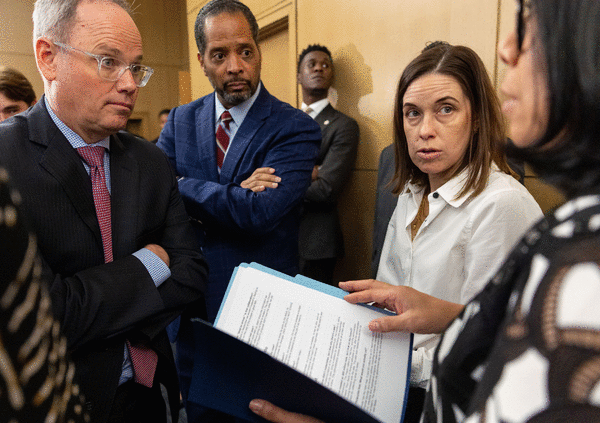
CHICAGO — Ald. Anthony Beale tilted his head forward at his wooden desk Monday morning, peering over the spectacles that had slid down his nose for an opening salvo in City Hall’s budget negotiations.
Beale, the 9th Ward alderman, stared one by one at Mayor Brandon Johnson’s top finance leaders, feet in front of him — budget director, CFO and comptroller. He did nothing to hide his disbelief as he launched the City Council’s 10-day, department-by-department interrogation of the mayor’s budget with a question sure to elicit an answer he would deem false.
“Do you all stand by this as being a balanced budget?” he asked each with a long, doubtful look.
The tone lingered as aldermen began to publicly tear into Johnson’s plan, an early sign of Johnson’s daunting road to winning critically needed votes.
But amid an onslaught of incredulity Monday from many of the same aldermen who bucked Johnson’s budget last year, the mayor’s finance team defended his $17.6 billion spending plan.
“This is a balanced budget built upon sound revenue and expenditure projections that close the (budget gap) responsibly through prudent organizational improvements, coupled with data-proven structural revenue solutions,” acting Budget Director Jonathan Ernst told aldermen.
Ald. Brendan Reilly, 42nd, asked Ernst why the city again proposed a head tax to bring in over $100 million when an aldermanic majority indicated it will once more reject it. Ernst pinned the move on public will.
“Through every interaction we’ve had with them,” he said, “they feel like they are being taxed more than businesses.”
Reilly responded by asking if the “resounding” calls came from interest groups or the mayor’s “budget echo chambers,” mocking feedback Ernst cited from Johnson’s public budget engagement events.
Another controversial budget item, the mayor’s plan to borrow $480 million to pay for police misconduct settlements, mostly for deals already approved by the City Council, would be handled in “the most fiscally responsible manner possible,” Chief Financial Officer Ashlee Gabrysch told aldermen. The city would repay the debt over five to seven years, and the first slice of that borrowing — $350 million in 2027 — would cost around $190 million in interest, she added.
Johnson’s team and aldermen clamored over how credit rating agencies might view the borrowing and other key proposals as the city hovers close to “junk” status that could make it far more expensive to borrow.
Shortly after Johnson’s budget speech last week, Scott Nees, an S&P ratings analyst, criticized the borrowing for using debt to cover operating costs. Analysts would be looking for “the council’s appetite” for cuts or efficiencies, given Johnson’s proposal for closing the gap was “notably revenue-centric and includes some conspicuously nonstructural revenues,” he said.
Johnson’s comptroller, Michael Belsky, responded Friday by touting almost $900 million in spending efficiencies in Johnson’s first term and stating settlement costs are not operational, but instead temporarily elevated as the city tries to reduce long-term risk.
Aldermen also questioned Johnson’s finance team Monday on his plans to add a 15-cent tax on bags used in package deliveries, such as plastic Amazon bags, and to use a $75 million payout tied to the sale of the city’s parking meter deal to help make an already planned additional pension payment.
Those and other critiques could force City Hall to make new cuts or add revenue just as Johnson’s team in Springfield explores state sign-off to levy several new taxes.
According to a letter obtained by the Tribune, the mayor’s state legislative affairs director, John Arena, briefed other leaders in the Metropolitan Mayors Caucus on several pushes Johnson hopes to make in the upcoming veto session later this year or the lame duck session early next, none of which are baked into his 2027 budget.
A 1% Seattle-style payroll expense tax charged on employers with at least $8 million in annual payroll and high-paying employees could net $140 million, Arena’s letter said, while changes to taxes on noncigarette tobacco products have broad support and have been passed by the city before, but face legal challenges. A 5% occupation tax on businesses like StubHub for resold tickets and permanent seat licenses could net $39 million, and allowing a $1-per-order charge on deliveries would raise an estimated $121 million, the letter said.
Meanwhile, aldermen questioned Monday how much Johnson’s budget plan marks a structural reform. Pressed about the split between one-time and structural fixes, Gabyrsch, previously a Fitch Ratings analyst, said Monday that despite Johnson’s claim the budget is 76% structural, she puts the number at 56%. The difference, she said, is due to her view that the police settlement borrowing plan should be included as part of the city’s budget gap.
“Not surprised that the mayor may be a little disingenuous here,” Ald. Marty Quinn, 13th, responded.
_____
©2026 Chicago Tribune. Visit chicagotribune.com. Distributed by Tribune Content Agency, LLC.






Comments