G7 to release up to 100 million barrels of diesel, crude
Published in News & Features
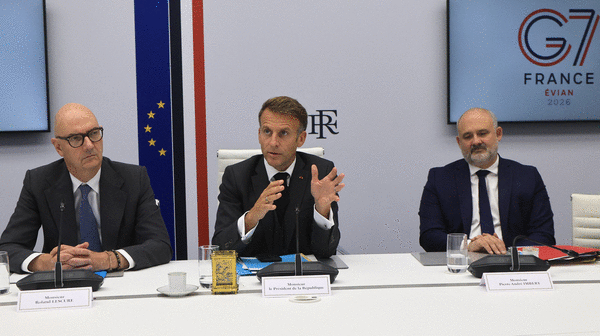
The Group of Seven nations and its partners plan to release as much as 100 million barrels of emergency oil and diesel stocks, capping a week of mounting pressure from the Trump administration to bring down soaring fuel prices.
The release, coordinated by the International Energy Agency, will take place over the next four months, with an initial focus on diesel, French President Emmanuel Macron said Friday. The move is intended to “send a clear signal to the markets,” he said.
European diesel futures slumped more than 8% before recovering slightly while U.S. diesel futures fell as much as 5.6%. Brent crude futures ended the day little-changed.
The deal will help alleviate concerns over President Donald Trump’s earlier threats to implement a U.S. diesel export ban, with G7 nations reaffirming their commitment to “refrain from export restrictions on energy and energy products” between member countries. A U.S. ban risked triggering a global supply crunch, with potentially severe economic consequences for Europe and Latin America.
Diesel is crucial for transportation, farming and industry, and prices have surged as the wars in Iran and Ukraine disrupt supplies. The soaring cost has become a political concern for Trump ahead of November’s U.S. midterm elections.
While more fuel supply is welcome news for consumers, the latest release only offers some short-term relief, and isn’t a long-term solution to the pressure on fuel availability globally.
Even though oil exports through the Strait of Hormuz have recovered close to their pre-war levels in recent weeks, the volume of oil products such as gasoline and diesel from the Persian Gulf remain severely constricted. Furthermore, Ukraine’s sustained attacks on Russian refineries has led the Kremlin to ban diesel exports through October.
In practice, the amount of fresh supply announced Friday may be a fraction of the headline figure because substantial volumes remain available under an earlier release plan, according to two European diplomats who asked not to be identified discussing sensitive matters. A G7 statement didn’t specify how much crude and diesel would be released or provide a breakdown of new commitments and previously pledged supplies.
The IEA already coordinated a 400 million-barrel reserve release in March soon after the Iran war broke out, but Trump has criticized Europe for not making those barrels available quickly enough. The pressure intensified this week, prompting emergency talks among European officials on Thursday as the European Union sought a coordinated response to Washington’s demands.
About a third of the original release had yet to reach the market, IEA Executive Director Fatih Birol said Tuesday. As of that day, Germany had yet to release about 77% of its pledged stocks, while Spain had made available only about a third of its commitment. The U.S., by contrast, approved another 40 million barrels from its Strategic Petroleum Reserve this week, completing its contribution to the March agreement.
The plan envisages a “substantial” release of diesel stocks within 20 days, while the IEA will discuss additional diesel releases if necessary, according to the G7 statement. The latest release will include barrels pledged but not yet made available under the March agreement, according to people familiar with the matter.
“We have all committed together to releasing these strategic reserves in the proportions I mentioned, with a focus on diesel,” said Macron, the current chair of the G7. “We are all committed to ensuring there are no export bans, and President Trump, in particular, was very clear on this point.”
Trump said in a social media post on Friday that he welcomed the latest action.
“Europe has just agreed to release a massive amount of their heavily stocked Diesel Oil,” Trump said. “The process will begin immediately.”
At a meeting on Friday, EU ambassadors discussed backing the release on two conditions: that it wouldn’t jeopardize strategic reserves and that the U.S. would commit to avoiding energy-export bans, according to a person familiar with the matter, who requested anonymity because the conversations are private.
European diesel’s premium over crude oil, a closely watched measure of market strength, slumped as low as $69 a barrel, down from $76.77 on Thursday, fair-value data compiled by Bloomberg show.
The prospect of additional diesel supplies has hit European refining margins particularly hard, with margins falling about 10%, compared with roughly 5% in the U.S., according to Rebecca Babin, senior energy trader at CIBC Private Wealth Group. Reduced European demand for imported diesel could also weigh on U.S. exports and margins, while additional supplies may curb refiners’ demand for crude, she said.
“It can shift some U.S. exports into other markets or back home,” said Joe DeLaura, global energy strategist at Rabobank. “It’s a short term fix to kick the can down the road another one to two months.”
Diesel has surged as high as $6.53 a gallon at the pump in the U.S., squeezing farmers. In Europe, futures prices have at times climbed above $200 a barrel, a level traders say is high enough to put pressure on demand.
Europe has few alternatives to emergency reserve releases to bolster supplies, with China canceling some October fuel loadings and the wars in Iran and Ukraine continuing to disrupt markets.
(Alan Katz, Alex Longley, Rachel Graham, Nayla Razzouk, Will Kubzansky, Devika Krishna Kumar, Lorelei Smillie and Skylar Woodhouse contributed to this report.)
©2026 Bloomberg L.P. Visit bloomberg.com. Distributed by Tribune Content Agency, LLC.






Comments