Larry Nassar was never on state's sex offender registry, Michigan State Police says
Published in News & Features
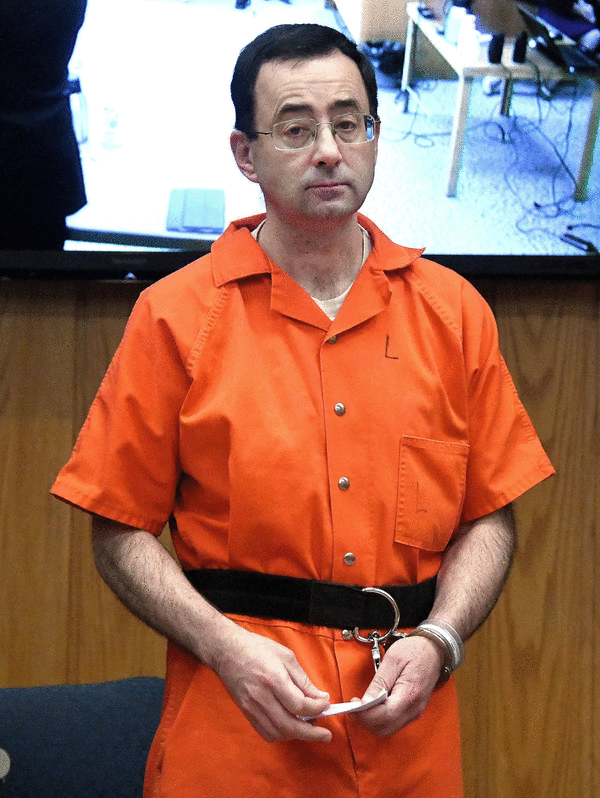
LANSING — Michigan law enforcement officials said Friday that serial sexual abuser Larry Nassar was never on Michigan's public sex offender registry, contrary to viral reports that indicated he had been removed from the list.
Only sex offenders living in Michigan are required to comply with and appear on the state's sex offender registry, state police noted. Nassar has been housed in federal, out-of-state prisons since he pleaded guilty to child pornography charges in 2017. He is currently housed at FCI Lewisburg in Pennsylvania, according to federal prison records.
A viral social media post and subsequent news reports this week reported that Nassar had been removed from the sex offender registry because of a recent Michigan Supreme Court ruling.
"Information suggesting that convicted sex offender Nassar was removed from the Sex Offender Registry (SOR) by the Michigan State Police (MSP) because of the Smith decision is incorrect," said Lori Dougovito, a spokeswoman for Michigan State Police.
Nassar's initial federal conviction in 2017 on child pornography charges carried a 60-year sentence. If the 63-year-old former Michigan State University and USA Gymnastics doctor survives that sentence, he then must serve 40 to 175 years in Michigan prisons on seven state-level sexual assault charges in Ingham County. He also faces a 40-year to 125-year prison sentence in Eaton County on additional sexual assault charges.
If Nassar ever returns to a Michigan prison, he would then be registered in the public sex offender registry, according to the Michigan State Police.
"Should the offender later domicile (including being incarcerated), temporarily reside, work, or go to school in Michigan, they would be expected to register and be placed on Michigan’s public SOR if still required under SORA at that time," said Dougovito, referencing the state's Sex Offender Registration Act (SORA).
The clarification on Nassar's status came after the Eaton County Prosecutor's Office, run by Republican attorney general candidate Doug Lloyd, posted online that Nassar and several other offenders in the county were among the more than 20,000 individuals removed from the Michigan sex offender registry under a recent Michigan Supreme Court order.
"The Michigan Supreme Court’s decision to eliminate SORA requirements for these offenders is deeply concerning," a Sept. 27 post from the Eaton County Prosecuting Attorneys' Office said. The post noted that two of the sitting justices, both Democratic-nominated candidates, were running for reelection.
The post was quickly reported on by a variety of news outlets, which pointed to the recent Michigan Supreme Court opinion removing individuals whose crimes predated 2011 from the sex offender registry.
Lloyd's office issued a news release Oct. 2, after Detroit News reporting, apologizing for the error but maintaining the belief that Michigan law requires offenders to be registered after a state conviction, regardless of where they’ll eventually be housed. He noted that other offenders convicted in Eaton County, even apart from Nassar, were removed under the Supreme Court opinion.
“We have a responsibility to make sure victims are protected and rules are followed,” Lloyd told The Detroit News.
The viral reports were distressing for survivors and puzzling for those involved in Nassar's case because some of his convicted offenses occurred after the 2011 cutoff date established by the recent court opinion, said Angie Povilaitis, the lead prosecutor in the state case against Nassar.
Even if Nassar were already on Michigan's sex offender registry, it does not appear the details of his convictions would have fit the Supreme Court parameters for removal.
"Every time Larry Nassar’s name and case is brought up, it results in anguish and harm and trauma to the victims," Povilaitis said. "And it's unfortunate that it's being brought up in this context because victims are again reminded of Larry Nassar and his abuse and all they’ve gone through."
Shannon Smith, Nassar's former attorney, said the allegations that he was removed from the registry were "unnecessarily inflaming" for those involved in the case.
On Sept. 11, the Michigan State Police removed more than 20,000 of the 43,000 offenders from the sex offender registry after the Michigan Supreme Court ruled that changes to the state's Sex Offender Registration Act could not be applied retroactively to individuals who committed their crimes before those changes were adopted.
The law was first passed in 1994, but was amended in 2011 and 2021.
"... the 2021 SORA may not be retroactively applied to registrants whose criminal acts subjecting them to registration occurred before enactment of the 2011 SORA amendments, and severance or revival of prior versions of the SORA is not appropriate," the 6-1 Democratic-majority Supreme Court wrote.
Over the years, the Michigan Sex Offender Registration Act has been the target of state and federal civil rights challenges, alleging the statute was overbroad and applied inappropriately to individuals convicted before its existence and that its overly strenuous rules made it difficult for individuals to find housing.
The Michigan Legislature has had several chances to revise the Sex Offender Registration Act to align with court decisions, but it has either punted on the issue or adopted changes that the courts later overturned.
In an Oct. 1 statement, the American Civil Liberties Union of Michigan, which filed an amicus brief in the case that led to the highest court decision, emphasized that the punishment cannot be retroactively increased, as the Legislature did with amendments to the Sex Offender Registry Act. That position, the ACLU said, has been upheld both by the Michigan Supreme Court and a federal district court.
"Furthermore, the registry serves no purpose when someone is behind bars," said Miriam Aukerman, the ACLU of Michigan's director of strategic litigation. "People convicted of serious sex offenses go to prison for a very long time. In the most serious cases, the incarceration term may well be either life or a sentence so long that the person will die in prison. For people who are released, there are various forms of post-release supervision."
Nassar also is not listed on the national sex offender public registry, which works with state registries to compile its list.
Putting the question of Nassar's removal aside, Povilaitis said that, as a former prosecutor who pursued serial rapists who may one day leave prison, the fact that 20,000 names were removed from the registry still is of incredible concern.
"There are a number of individuals who will fall into that category in the coming years and decades," Povilaitis said.
©2026 The Detroit News. Visit detroitnews.com. Distributed by Tribune Content Agency, LLC.






Comments