Iran-Gulf talks delayed as Saudi Arabia counters Houthi attacks
Published in News & Features
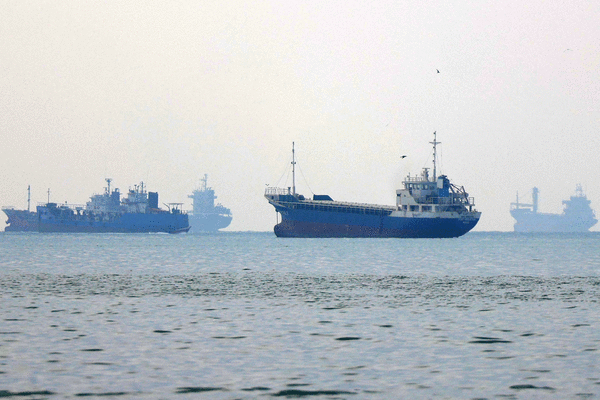
A meeting between Iran and several Gulf Arab nations over a temporary shipping lane through the Strait of Hormuz was postponed, highlighting tensions with the Islamic Republic.
Talks were set to take place in Oman on Monday but was delayed “for now” after a request from Saudi Arabia, according to Iran’s foreign ministry. That was partly down to the kingdom’s frustration over continued attacks on its territory by Iran-supported groups such as the Houthis, said one person familiar with the matter, asking not to be identified by name discussing sensitive matters.
“Saudi Arabia’s request to postpone the regional summit and attribute it to developments in Yemen is a diversion from the root causes of this crisis,” Iran’s foreign ministry said Monday.
The Saudi government didn’t immediately respond to a request for comment.
Brent crude prices have topped $108 a barrel in recent days due to fears that a prolonged war in the Middle East will further constrain supplies of fuel such as diesel.
On Monday, President Donald Trump appeared to suggest the U.S. was open to new talks aimed at ending the broader war, saying in a social media post that “Iran wants to make a deal, quickly and badly,” a claim he has made repeatedly since the war began without offering evidence. Trump added that he “will determine whether or not the U.S.A. will choose to engage” and suggested the U.S. was “open” to the idea.
Badr Albusaidi, the foreign minister of Oman, which has been negotiating with Iran for weeks over the management of maritime traffic through the strait, said late Sunday the decision to postpone the regional Gulf talks was taken “in the interests of consensus.”
The meeting would have been the first between Iran, members of the Gulf Cooperation Council and Iraq since the U.S. and Israel started the war with the Islamic Republic in February.
Yet, the escalating fighting between Saudi Arabia-backed forces and the Houthis, a group based in neighboring Yemen, complicated the plans.
The kingdom’s energy infrastructure towns in the south west have come under heavy attack from the Houthis this month. In addition, Saudi Arabia’s key East-West oil pipeline was shut last week after multiple drone attacks from Iraq, according to the government. Several Iran-backed militias operate in Iraq.
Yemen’s Houthis said they targeted a Saudi airbase in Khamis Mushait on Monday, according to statement. Riyadh, which earlier issued an alert for potential danger in the south-western city, has not confirmed any targets.
In the days ahead of the planned meeting, it wasn’t clear which nations would attend. Bahrain had ruled out participating, citing recent Iranian-backed attacks on Gulf sites.
Gulf states were targeted by thousands of missile and drone attacks in Iran’s retaliation against U.S. interests in the region. Despite their anger, they have kept diplomatic channels with Tehran open and one of their main aims is to fully reopen the Strait of Hormuz, through which they normally ship the bulk of their oil and natural gas exports.
The meeting in Salalah would have seen participants discuss a proposal from Oman and Iran. Broadly, that deal would give Iran the right to determine which ships can enter the Persian Gulf and possibly charge them fees of some kind.
While the GCC bloc — a group of six including the United Arab Emirates and Qatar, as well as Saudi Arabia and Oman — have said they want free passage for vessels, they may accept a temporary deal that would fall short of that but still see shipping traffic pick up.
Tehran had indicated any deal wouldn’t amount to a full reopening and it would still decide on which ships could cross the strait. Iranian Foreign Minister Abbas Araghchi had described the proposed meeting as an “important event” and a step toward building trust.
Soaring prices at the pumps pose a problem for Trump’s Republican Party with just over 50 days to go before midterm elections. On Monday, Trump said in a post that Ukraine had agreed to stop attacking Russian energy facilities, and that Moscow had agreed to do the same, causing elevated diesel futures to pare gains — though there was no public confirmation from either country.
Asked earlier Sunday about a possible meeting of Gulf nations with Iran, Trump told reporters, “I don’t care. That’s up to them. That’s fine.”
U.S. Energy Secretary Chris Wright had also downplayed the chances of a Hormuz deal during an interview Sunday. He said markets will need to continue relying on transit that he estimates is supplying 10 million barrels a day of crude and oil products through the Strait of Hormuz.
Together with bypass pipelines, that means “we’re back to two-thirds or north of two-thirds of the previous flows,” Wright said. “So the world oil markets are tighter than we’d like today, but they’re not overly tight.”
The U.S. and Iran exchanged strikes on oil tankers in the Persian Gulf earlier this month. Tensions flared again in the Strait of Hormuz over the weekend, with U.K. Maritime Trade Operations saying Sunday a fire broke out on a ship hit by a projectile the day before.
Iran’s state-run IRIB reported an “enemy strike” on a commercial vessel off Iran’s Qeshm and Hengam islands that killed one person.
_____
(With assistance from Iain Marlow.)
©2026 Bloomberg L.P. Visit bloomberg.com. Distributed by Tribune Content Agency, LLC.






Comments