What is Zionism? The different meanings of a contested term
Published in News & Features




Haverford, a small liberal arts college in Pennsylvania, has become the latest U.S. school to settle a lawsuit over how it handled allegations of antisemitism. In a statement on Aug. 7, 2026, its president, Wendy Raymond, wrote that “all students including those who identify as Jewish, and/or Israeli, and those who support Zionism: that is, the right of the Jewish people to self-determination and statehood in the land of Israel, are welcome and enjoy equal access to the College and all of its educational programs and activities.”
This statement is not unusual. After the Hamas-led attacks in southern Israel on Oct. 7, 2023, and the start of Israel’s war in Gaza, the United States saw a wave of campus protests against Israel. Those protests led to a surge of complaints about campus antisemitism, and numerous lawsuits and federal civil rights investigations.
Most of these allegations concerned the alleged mistreatment of Jewish students and faculty who identify as Zionists, or merely refuse to denounce Zionism. That has led some administrations, such as Haverford’s, to explicitly affirm that it is forbidden to harass or otherwise discriminate against students who support Zionism – since such behavior has become increasingly common on some campuses in recent years.
As a scholar of Israel studies who teaches about Zionism, what strikes me when I read such statements is how narrowly they define it, reducing Zionism to a single belief in “the right of the Jewish people to self-determination and statehood in the land of Israel.”
This ignores the fact that there are multiple “Zionisms,” rather than a singular “Zionism,” and that the term has more than just one meaning. It is, at best, oversimplified to describe Zionism only as the belief in the right of Jews to have a Jewish state.
To be sure, this is how mainstream American Jewish organizations define Zionism. The vast majority of Jewish Americans also think that the “right of the Jewish people to have a Jewish state” is a Zionist belief, according to a March 2025 survey by the Jewish Federations of North America.
Nearly 9 in 10 American Jews said they believed that Israel has the right to exist as a Jewish and democratic state. Yet only around a third identified as Zionists. Why, then, do these Jews not consider themselves Zionists?
This may be because many Jewish Americans think Zionism includes other beliefs, too – beliefs that they do not share. For example, in the same survey around a third thought that “Believing Israel has a right to the West Bank and Gaza Strip” is part of Zionism. Around a quarter believed that “Supporting whatever actions Israel takes” is also part of Zionism.
They are not necessarily wrong. Reducing Zionism to a single abstract principle ignores the fact that it is a diverse ideology that has changed over time and become the official ideology of the state of Israel.
Since modern Zionism emerged in the late 1800s, it has included many different ideas about Jewish identity, history, politics, culture and religion – ideas that Zionists have fiercely debated.
During the early decades of the Zionist movement, for example, political Zionists emphasized the need for Jewish statehood as a solution to rising European antisemitism. Cultural Zionists, on the other hand, sought a solution to increasing Jewish assimilation. They wanted to reinvigorate Jewish identity by having a Jewish homeland – not necessarily a state – where a modern Hebrew culture could be created and flourish.
There was even disagreement among Zionists over whether the historical “Land of Israel,” or “Eretz Yisrael” in Hebrew, had to be the location for Jewish self-determination. In 1903, for example, Theodor Herzl, the founder of the Zionist movement, supported the British government’s offer for Jews to settle in parts of East Africa then under the control of the British Empire.
In the 1920s and ’30s, some Zionists in Mandatory Palestine, a territory then under British administration, advocated for a binational Jewish-Arab state. It was not until 1942, as the Holocaust was underway in Nazi-occupied Europe, that the Zionist movement officially declared that it sought a Jewish state.
After Israel’s establishment in 1948, its first prime minister, David Ben-Gurion – a left-wing “Labor Zionist” – argued that the mission of Zionism was not complete. In his view, it still required the “in-gathering of the exiles”: the immigration of all Jews to Israel. For Ben-Gurion, the only true Zionists were those who chose to live in Israel, which is what many Israeli Jews continue to believe.
Most Jews living in wealthy Western democracies, however, have preferred to stay where they are and support Israel from afar. Their notion of Zionism, dubbed “diaspora Zionism,” has dispensed with the demand that Jews should live in Israel.
The liberal Zionism that remains popular in the Jewish diaspora, at least among older Jews, has little in common with the revisionist Zionism of right-wing Israeli leaders like Prime Minister Benjamin Netanyahu, which is committed to maintaining Israeli control over the entire West Bank.
Liberal Zionism shares even less with the religiously inspired messianic Zionism of extremist Jewish settlers in the West Bank, or the Christian Zionism of evangelical Protestants, such as current U.S. Ambassador to Israel Mike Huckabee. For these religious Zionists, whether Jewish or Christian, Zionism involves the fulfillment of God’s wishes, which they believe requires Jewish sovereignty over all of the biblical Land of Israel.
What “Zionism” means, therefore, has never been definitively settled. It has always been contested by Zionists themselves, who are divided into different streams. Although there is less ideological diversity among Zionists today than in the prestate period, there are still deep disagreements, particularly between religious and secular Zionists.
Moreover, Zionism is more than an ideology. In the eyes of Zionism’s critics, it is what the Israeli state does in its name.
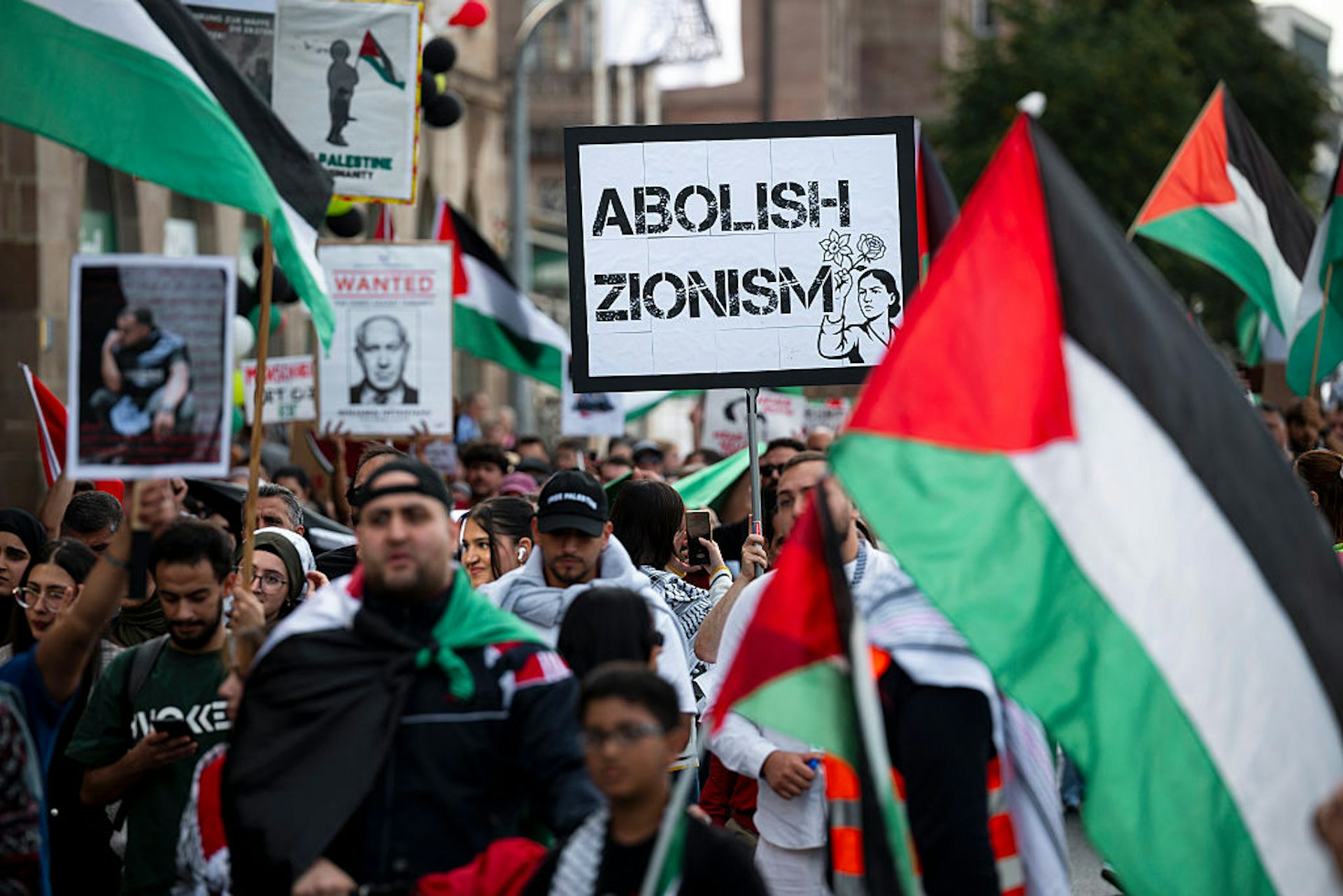
This is how Palestinians tend to think of Zionism. For them, Zionism is defined in terms of its outcomes for Palestinians, which have included displacement, dispossession, destruction and the denial of their rights. This is why Palestinians and many of their supporters adamantly oppose it.
In the minds of most Jews, by contrast, historically Zionism in practice has meant Jewish liberation and sovereignty, a safe haven from persecution, a revival of the Hebrew language, and a renewed sense of collective pride, especially after the Holocaust.
These clashing ways of understanding Zionism help explain why it has become one of the most hotly contested terms in today’s political vocabulary. It means different things to different people in different locations.
This article is republished from The Conversation, a nonprofit, independent news organization bringing you facts and trustworthy analysis to help you make sense of our complex world. It was written by: Dov Waxman, University of California, Los Angeles
Read more:
Jewish critics of Zionism have clashed with American Jewish leaders for decades
Jewish denominations: A brief guide for the perplexed
Antisemitism on campus is a real problem − but headlines and government‑proposed solutions don’t match the experience of most Jewish students
Dov Waxman is currently the scholar in residence at the Nexus Project.







Comments