Immigrants detained in Colorado by ICE's 'deportation machine' reach for once-rare legal lever
Published in News & Features
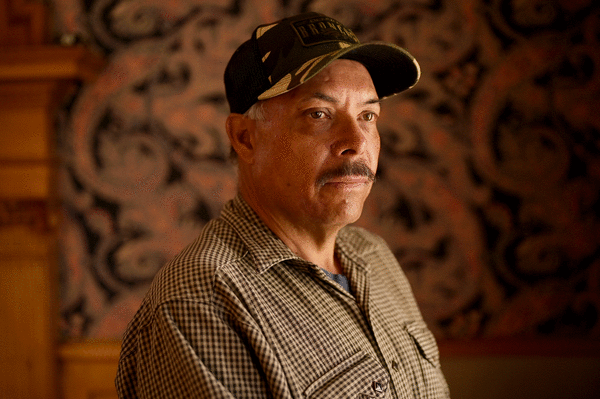
DENVER — Manuel’s months in a federal detention center began when his brother’s dog got loose.
Manuel went after the dog in their Colorado Springs neighborhood. A stranger ran with him, trying to help, and when they reached the startled animal, the dog bit the stranger.
Law enforcement showed up. Manuel was given a court hearing for the dog bite.
The case was later dismissed. But when Manuel left the courthouse in September, he said two cars followed him. The 23-year-old stopped for gas and was quickly surrounded by federal agents from Immigration and Customs Enforcement.
The undocumented immigrant, who had come with his parents from Mexico when he was 3 years old and had never been in trouble with the law before the dog bite, was detained in the state’s only immigration facility in Aurora for the next two months.
“It was not very pleasant,” he said. He spoke on condition that he only be identified by his middle name to speak candidly about his experiences with the federal government. “I’ve never been in trouble before. It really takes a toll on you mentally.”
As federal authorities pursue President Donald Trump’s goal of arresting and deporting millions of immigrants without legal status, they moved last summer to block longtime U.S. residents from requesting bail in immigration cases, and they have kept others, who would have been released under previous administrations, detained indefinitely.
Caught in that cycle, Manuel was only released after his attorneys filed — and a judge granted — a habeas petition in federal court.
Once a technically complicated legal rarity used to challenge improper incarcerations, habeas corpus petitions have become the predominant avenue for immigrants seeking release from detentions that increasingly end only with a deportation order.
With bail sharply curtailed and other avenues of release all but closed off, Colorado has seen an explosion of habeas cases: In the first 100 days of 2026, more than 370 detained immigrants have asked federal judges to either grant them bail hearings denied by ICE, or to release them altogether. The surge is an unprecedented increase from 2025’s total of 104 and 2024’s total of a bare dozen.
In his first 19 years as a lawyer, Denver immigration attorney Hans Meyer said he’d filed six habeas cases. In the past six months, his firm filed 60. When ICE first moved to withhold bail from a broad swath of detainees last summer, few people in detention were aware that filing habeas petitions was an option.
“The first three months, very few people understood the issue,” Meyer said. “For the next three months, people might know it was an option, but didn’t know much more. But now people in detention always go to habeas first.”
So significant is the crush that attorneys from the U.S. Department of Homeland Security, which oversees ICE, have stepped in to help federal prosecutors deal with the cases. The highest-ranking federal prosecutor in the state, U.S. Attorney Peter McNeilly, has also personally handled some of the petitions. It’s the only time this century that a U.S. attorney has made personal appearances on such cases, The Denver Post found.
The U.S. Attorney’s Office for the District of Colorado declined to comment for this story. Jeffrey Colwell, the clerk for the U.S. District Court in Denver, confirmed The Post’s case data.
“It does put a significant burden on our judges and chambers,” he said. “It’s 300-plus cases that we haven’t historically seen.”
In an unsigned statement, the Department of Homeland Security said it abides by court orders and was unsurprised by the habeas surge, claiming “no lawbreakers in the history of human civilization have been treated better than illegal aliens in the United States.”
Peering inside the ‘deportation machine’
Habeas petitions have been a part of American law since the nation’s founding, and they’ve been used in immigration proceedings in past years, too.
They’re used generally to challenge someone’s detention or incarceration, though not necessarily the underlying case that led to that confinement. Immigrants who are released or given bail hearings through habeas cases are still subject to deportation proceedings — like Manuel, whose immigration case remains underway.
But these petitions offer an avenue out of detention, and their prominence is surging, particularly as immigration courts — which fall under the authority of the federal government — bend to the Trump administration’s goals.
The assumption that immigration courts can resolve detention questions “no longer holds,” the American Immigration Lawyers Association wrote last month. Instead, immigration lawyers are taking their arguments out of immigration hearings and into federal court, where appointed judges can’t be removed on a whim. Indeed, they’ve shown a “striking willingness to intervene” in detention cases, the association wrote.
Because habeas cases are complicated — but the need for them is now enormous — immigration attorneys have also worked to train more lawyers on how to file them. Laura Lunn, of the Rocky Mountain Immigrant Advocacy Network, said she’s hosting a “massive training” at the end of April with the Colorado Bar Association to bring non-immigration lawyers up to speed on writing and filing habeas petitions.
For this story, The Post reviewed scores of habeas petitions and hundreds of pages of court filings, along with publicly available arrest and court data detailing ICE practices. If the Trump administration’s immigration crackdown is a “deportation machine,” as Meyer describes it, then the habeas petitions provide a glimpse into that machine’s inner workings. The filings describe both how immigrants end up in detention as well as the efforts that Trump officials have undertaken to keep them detained.
One man was arrested at an Ace Hardware. A Colombian father was arrested in Lakewood the same day he and his wife were set to close on a house. Several said they were arrested after they showed up for routine immigration check-ins at ICE offices in Colorado. A man from Guinea arrived at his case worker’s office to have his ankle monitor removed and found ICE agents waiting for him instead.
One man showed up for work at the U.S. Air Force Academy, where he was directed to wait for a new ID badge in a side room, his lawyers later alleged. ICE agents came instead.
Upending nearly three decades of federal law, Manuel and many of those who’ve filed habeas petitions were denied bail during their detention proceedings. That about-face is the primary cause of the habeas crush: Since the mid-1990s, federal immigration authorities and the court system that oversees them would release immigrants who had no criminal record and were arrested within America’s interior.
Under the Trump administration, however, ICE and the courts have moved to keep those immigrants in custody, denying them bail under a separate federal law previously reserved for people arrested at the border.
The federal law that ICE is now employing to block many immigrants from bail also requires mandatory detention — which attorneys argue is the point. Detention centers are like prisons, and 65% of immigrants arrested in Colorado over the past year have never been convicted of a crime. They’re likely not used to facilities like the one in Aurora, where the lights stay on at all times and the food, Manuel said, is often soggy or inedible.
Without access to bail, many detainees choose to leave: Aurora has seen a jump in deportation orders in the past year, including an unprecedented surge in immigrants asking for immediate removal.
Surging cases tied to size of Aurora facility
The increase in Colorado habeas filings is also partially driven by the size of the Aurora detention center, which can hold more than 1,500 people at any one time. It’s one of the largest facilities in the United States and attracts arrestees from across the country — meaning more people seeking release.
Attorneys for a Maryland man said he was arrested after ICE checked license plates in his neighborhood and discovered he had a “derogatory immigration history.” A teenager in New York, brought to the U.S. as a minor, was arrested after he got into a fender-bender in a snowstorm. Several men were arrested during traffic stops in Florida. All eventually were brought to the detention center in Aurora.
The filings detail myriad other ways the Trump administration has sought to keep immigrants detained.
When bail is granted, ICE appeals, prolonging detention for 90 more days. Some people with years-old removal orders have been re-arrested. For years, deportations could be indefinitely delayed if an immigrant successfully argued that they’d be tortured or persecuted if they were returned home. They would often be released and told to check in regularly with federal authorities.
Now, however, ICE will hold those individuals — who are often religious or political minorities, or members of the LGBTQ+ community — while they try to find another country to send them.
The Post reviewed more than a dozen habeas petitions filed in recent months by those immigrants detained in Colorado. Several detainees were transgender and feared they would be harmed or killed if they were returned home. One gay man from a country in North Africa was nearly deported to Cameroon, where same-sex activities are criminalized, before his habeas petition was granted.
If another country won’t take the detainees, then they languish in detention.
For those cases, as well as for detainees seeking bail, “habeas is the only way that most folks are getting out of detention, and more folks are being both arrested and held in detention than ever before,” said Shira Hereld, an attorney with the Rocky Mountain Immigrant Advocacy Network.
Indeed, immigration arrests in Colorado surged nearly 300% during Trump’s first year in office. The Aurora detention center has also flexed to its maximum capacity, and by the end of 2025, the facility regularly housed more than 1,400 people at a time.
Federal judges push back
As the flood of habeas petitions washed into federal courtrooms in Denver, judges have repeatedly rejected ICE’s effort to rewrite federal law and have ordered bail hearings or the immediate release of immigrants. They’ve also ordered the release of some people held indefinitely while ICE searches for a country to take them.
Of the more than 100 habeas petitions that have already been closed this year, a federal judge rejected only one, The Post found, while a few dozen more were duplicates or were dismissed voluntarily.
One attorney wrote to a Colorado judge that ICE’s position has been rejected more than 1,500 times nationwide. In their petitions, some attorneys have taken to listing the individual habeas cases that the Trump administration has lost, a tally that stretches over multiple pages.
In its unsigned statement, the Homeland Security Department said it was “applying the law as written. If an immigration judge finds an illegal alien has no right to be in this country, we are going to remove them. Period.”
In January, U.S. District Judge R. Brooke Jackson wrote that “the court has concluded, many times over,” that ICE’s interpretation was incorrect. In March, U.S. District Judge Regina Rodriguez granted another petition and wrote that she was “once more (joining) the chorus of courts in this district and around the nation that have overwhelmingly rejected (ICE’s) position.”
“Sometimes it is difficult to arrive at conclusions or resolve issues, due, perhaps, to an issue’s complexity, or the lack of guidance available to help resolve it,” U.S. District Judge Charlotte N. Sweeney wrote in another case from January. “Neither circumstance is present here.”
Still, the lower-court rulings have not shifted ICE’s posture, and immigrants arrested in Colorado are still routinely denied bail.
A class-action lawsuit challenging the practice, filed by Meyer, the Denver immigration lawyer, and the American Civil Liberties Union of Colorado, earned an initial favorable ruling but is now awaiting a higher court’s intervention. A judge in California struck down ICE’s new bail policy in December, but that ruling has also been held up as a higher court considers it. Another federal appeals court has backed the policy.
The regional rulings point to a prolonged legal battle.
“This is an alley knife fight,” Meyer said. “It’s going to play out circuit court by circuit court, and then end up at the Supreme Court.”
Until the Supreme Court weighs in, “we’re all running around like chickens with our heads cut off every day,” Lunn said, “because the law changes every day depending on which court rules. And we’re having to bring individual challenges for each and every client when the fundamental issue is these massive policies that impact everybody across the country.”
‘A dream that ended up becoming a nightmare’
In the meantime, the number of habeas cases filed in Colorado will only grow. For people like Javier Campos, it offers the only way out.
In July, ICE agents pulled Campos over in Aurora and arrested him. He spent nearly 100 days in the Aurora detention center before he was released last fall. He lost weight because the food was inedible, he said in an interview. He struggled with Bell’s palsy, a neurological condition that causes paralysis in facial muscles.
Through a translator, Campos described his experience in the immigration system as “disgraceful.” A citizen of Mexico, he’d been in the U.S. for 30 years. He worked in the construction industry. He had a wife, and four children who were U.S. citizens. In another time, detention would have been unlikely, and bail a given.
He was initially granted bail in August — $10,000, a sum far higher than what was typical in previous years, immigration lawyers said. Attorneys for the Department of Homeland Security immediately appealed, blocking Campos’ release for three more months. That prompted the habeas filing.
He was finally released shortly before Thanksgiving, but his immigration case continues.
“A lot of the people would just give up their rights and leave because it gets really difficult to not have money to pay for an attorney,” Campos said. “A lot of people would just give up and leave and be deported. It was very sad seeing the things that went on there because a lot of guys came here for a dream that ended up becoming a nightmare — such a bad nightmare that it would cause stress and nightmares we couldn’t wake up from.”
©2026 MediaNews Group, Inc. Visit at denverpost.com. Distributed by Tribune Content Agency, LLC.






Comments