'Same old story': Cubans in South Florida skeptical after Díaz-Canel confirms US talks
Published in News & Features
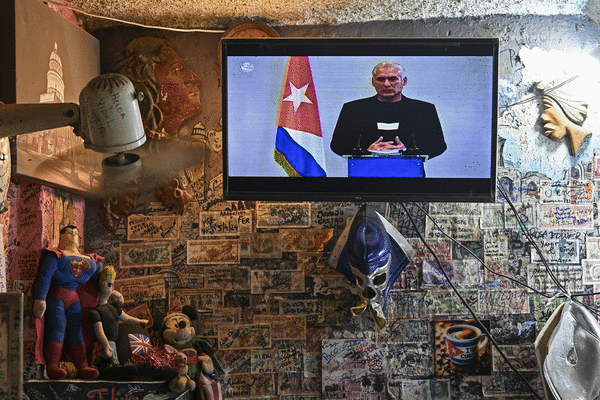
MIAMI — As news spread Friday that Cuban leader Miguel Díaz-Canel had confirmed that Havana is in the midst of talks with the Trump administration, the mood among many Cubans in South Florida ranged from cautious hope to anger and skepticism.
Cuba’s confirmation the of the talks come as the country faces a profound economic and energy crisis, with widespread blackouts and shortages of food and medine across the island.
“It’s going to be the same old story,” said Guadalupe Varela, 71, who has lived in the U.S. since 1981 and lives in Hollywood. “If Díaz-Canel leaves or even if they replace him but keep the same leaders of the regime, the oppression, destruction and poverty in Cuba will remain. The same thing that happened in Venezuela will happen in Cuba: absolutely no change.”
Varela said he believes the island’s leadership will not change even if the government reshuffles its top officials: “It is the same little group, the same old trash, and Cuba is never going to change.”
During his remarks about the ongoing dialogue with Washington, Díaz-Canel spoke about expanding economic activity and businesses on the island. But Varela said he is skeptical those plans could succeed given the current conditions in Cuba.
“What kind of businesses can they create when there isn’t even food for the people?” said Varela, a retired truck driver who worked as a farmer in Cuba before emigrating. He argued that comparisons with other countries in the region are misleading.
“Cuba is not Venezuela,” he said. “Venezuela can talk about business because it has oil and gold. What does Cuba have?”
If the government truly wants economic activity, Varela said, it should start by allowing farmers to produce food without state control.
“They would have to let farmers work the land without robbing them,” he said, recalling what he described as the government’s treatment of his father’s farm in Villa Clara during the agrarian reforms of the 1980s.
Varela said the memories still affect him. “I get goosebumps remembering how we worked the land — harvesting crops, making cheese, raising pigs — only to see the government pay us almost nothing and then resell the products three or four times more expensive,” he said.
For him, the possibility of negotiations with the United States offers little hope.
Varela’s stance found quick echoes in South Florida on Friday.
Reinaldo Núñez, a Hialeah resident who has lived in the city since 1980, said he believes the Cuban government is using negotiations with Washington as a delaying tactic similar to strategies he says have been used in Venezuela.
“They try to delay, hoping to get help from Russia or China. I don’t have any hope in these conversations,” Núñez said. He identifies as a Republican and was cautious about criticizing President Donald Trump’s decision to initiate talks with Havana, but he said many Cuban exiles don’t feel the same way as policymakers in Washington.
“As citizens, we think very differently from those in power,” he said. “I understand they want to avoid deaths, but every revolution involves bloodshed.”
Núñez said he was nearly nine years old when the Cuban Revolution came to power in 1959, and added he believes negotiations will not bring change.
“There is no fixing these systems,” he said. “The only solution is to force them out.”
Bryan Calvo, the mayor of Hialeah — the city with the largest Cuban exile communiy in the United States — thinks the talks between the administration and the Cuban government will ultimately lead nowhere.
“It’s more of the same,” Calvo said. “What needs to happen is for those people to be removed.”
Calvo’s view reflects the long-standing position among many Cuban exiles who oppose dialogue with Havana. He argues negotiations are unlikely to produce meaningful change.
The message from the exile community is that the U.S. cannot negotiate with the Cuban regime, he said. “What is needed is military action or pressure strong enough to force change.”
Other Cuban Americans in Miami noted that the Cuban government’s approach leaves its own people in the dark.
Alejandro Ríos, a cultural analyst and writer based in Miami, said that by excluding the Cuban people from the negotiations, the government continues a long-standing strategy of keeping the public uninformed.
“They continue to ignore the victims, who are not part of the dialogue,” Ríos said, noting that people on the island have been protesting in the streets every night for more than a week. Still, he said, the talks between the Washington and Havana are “a step forward.”
Ríos added that the island’s leadership shows it is ignoring the Cuban people when it rejects meaningful change. In Díaz-Canel’s words, he said, “the arrogance of Fidel Castro survives.”
“Just as they won’t reach out to suffering Cubans at home, they won’t reach out to the exile community,” Ríos said. “They have failed; it’s 67 years of torment. Pack your bags and leave.”
‘A daily struggle’
Inside Cuba, Díaz-Canel’s appearance was met with indignation because to some Cubans it represented “more of the same.” The delayed acknowledgment of talks with the United States — after officials at the Foriegn Ministry had denied them for weeks — drew particular derision.
“It’s a relief to know there are talks,” said one person, a mother of two, who asked not to be identified to speak freely. “They also admitted there is no oil and the entire Central Committee was present for that little speech.”
For the 57-year-old Cuban woman, life on the island is a daily struggle. “You have to buy everything on the black market, there’s no transportation, no university. My children haven’t been able to go to school or to work,” she said.
“We move between hope and unease; we don’t know what will happen, but everyone I know is waiting for ‘something’ to happen, and that ‘something’ keeps us going,” she added, as she tries to help elderly family members.
No foreign press
For Cubans outside the island, the most significant takeaway was the explicit acknowledgment of what many already knew, but the Cuban government denied: that it is holding talks with the United States.
“They again blamed the blockade for all their ills and kept lying about what they have achieved,” said Jorge Luis Diaz, 57, who lives in Ottawa, Canada.
Some exiles criticized aspects of Díaz-Canel’s speech, including that no foreign media was invited to his press conference in Hvana Friday morning. Only journalists from the official press were present, and it was apparent to some that the questions had been given to Díaz-Canel in advance.
The Cuban leader also did not address the fundamental issue that people—especially inside Cuba—are waiting for: economic changes needed to face the humanitarian crisis. Díaz-Canel shifted responsibility for addressing the most urgent matters to Prime Minister Manuel Marrero and to Óscar Pérez-Oliva Fraga, vice prime minister of Cuba and a member of the Castro family. Díaz-Canel said both ministers would address the issue in a public appearance on Monday.
Norges Rodríguez, director of the independent Cuban outlet YucaByte, noted that the speech showed they Cuba’s leaders have no solution for the country’s problems and that they will accept whatever the United States says.
He said Cuba’s announcement Thursday evening that it will 51 prisoners was being done under pressure from the U.S.
“Political prisoners have always been bargaining chips in scenarios like this,” Rodríguez said, noting that Cuban authorities have continued to arrest those who speak out against the government.
Return of Cubans?
Rodríguez also said he was struck by Díaz-Canel’s call to the Cuban community abroad during Friday’s conference. Many Cubans are barred from entering the island because of their activism, as is Rodríguez’s own case. Others do not wish to return, although many others have told him they are willing to help from the cities abroad where they now live, he said.
“I was in Estonia about five years ago and saw how they transformed from a communist country to one of the most advanced in technology,” Rodriguez, a telecommunications engineer by training, said.
“In Cuba you have to start from zero,” he added. “I want to return if that changes; I don’t know what country we would find, but I would like to help with what I’ve learned in technology.”
©2026 www.detroitnews.com. Visit at detroitnews.com. Distributed by Tribune Content Agency, LLC.




Comments