Trump and Iran strike defiant tone as oil markets see little relief
Published in News & Features
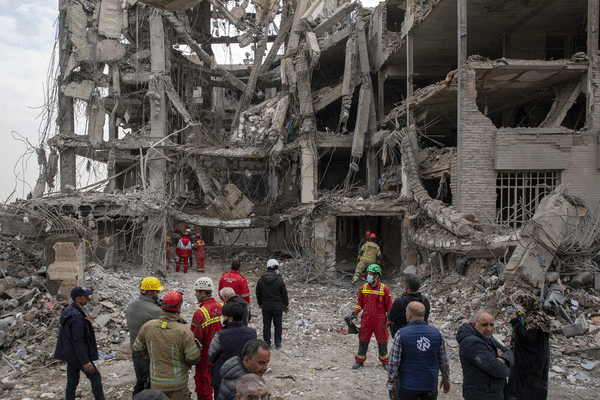
President Donald Trump and Iran’s new supreme leader both struck defiant tones on the 13th day of the war, offering little relief to energy markets despite fresh U.S. efforts to curb oil prices.
The American president said in a social media post Thursday that preventing Iran from having nuclear weapons and threatening the Middle East is “of far greater interest and importance to me” than the cost of oil.
Mojtaba Khamenei said the Islamic Republic would seek to ensure the Strait of Hormuz remains effectively closed. In his first public comments since succeeding his father, he added that Tehran would look to open other fronts in the war if the U.S. and Israel persist with their attacks.
Oil prices rose more than 9% on Thursday with Brent crude ending the session above $100 for the first time since August 2022. U.S. crude futures also settled at the highest levels in more than three years.
The blockage of the Strait of Hormuz has disrupted millions of barrels a day of supply and caused what the International Energy Agency described as the biggest hit to global production on record. A series of moves from the Trump administration and other governments aimed at lowering energy costs also did little to dent oil’s rally.
The Trump administration plans to issue temporary waivers for a century-old maritime law requiring American-built ships be used to transport goods between U.S. ports as part of its effort to stop surging oil prices, Bloomberg reported.
On Thursday evening, the U.S. announced a second authorization for buyers to take Russian oil cargoes already at sea to help ease prices. Treasury Secretary Scott Bessent, in a social media post, said the move was designed to be a “narrowly tailored, short-term measure” that “applies only to oil already in transit and will not provide significant financial benefit to the Russian government.”
Although Trump has cited the overthrow of Iran’s leadership as a motive for the military campaign, Israeli Prime Minister Benjamin Netanyahu said Thursday that there was no guarantee that the government that has ruled the country for 47 years would be toppled, even in its now weakened state.
“A regime is ultimately brought down from within,” he told reporters in his first press briefing since the war began.
There’s little sign that the war in the Middle East is anywhere close to a deescalation after almost two weeks of clashes. Israel launched a fresh wave of large-scale strikes across Iran on Thursday, while the Islamic Republic stepped up attacks on Dubai and shipping assets.
French President Emmanuel Macron announced on X that one of his country’s soldiers had been killed during an attack in the Erbil region of Iraq. Macron added that several other French soldiers had been wounded. Seven U.S. service members have died in the war.
Also on Thursday, rescue operations were underway after a KC-135 refueling plane crashed in western Iraq. The episode involved another aircraft, which landed safely, according to a press release, which said “this was not due to hostile fire or friendly fire.”
Iran has likely begun laying mines in the Strait of Hormuz, U.K. Defense Secretary John Healey told reporters. Iran’s deputy foreign minister denied that his country was doing so, according to the AFP.
Three commercial vessels were struck in the Arabian Gulf in the past 24 hours, the U.K. Maritime Trade Operations said in a notice, highlighting the risk that maritime disruptions to transport are expanding.
“Studies have been conducted into opening other fronts where the enemy has little experience and would be highly vulnerable, and their activation will take place if the state of war persists,” Khamenei said.
The new supreme leader, a 56-year-old hard-line cleric, was appointed after his father, Ali Khamenei, was killed in early U.S. and Israeli attacks on Feb. 28.
Dubai authorities reported at least two strikes Thursday morning after residents received missile alerts overnight, underlining the threat to the financial and tourist hub long seen as a safe haven. Kuwait reported several drones fired at its international airport, resulting in material damages.
U.S. officials told lawmakers that the first six days of the war with Iran cost more than $11.3 billion, a person familiar with the matter said, in the most detailed assessment yet of campaign’s expense.
The U.S. and Israel have been attacking Iran with airstrikes since Feb. 28. U.S. Central Command reported about 6,000 targets struck since the start of military operations. Tehran has responded with missiles and drones fired across the Gulf. Besides jolting energy and financial markets, the conflict has resulted in thousands of flight cancellations and disrupted the flows of fertilizer and other goods.
Israeli Defense Minister Israel Katz said the military is preparing to expand its operations in Lebanon, where it’s been fighting a parallel campaign against the Iran-aligned Hezbollah militia.
Around 2,500 people have been killed across the Middle East since the war began, official tolls and those from nongovernment agencies show.
The Strait of Hormuz — through which about a fifth of the world’s oil and natural gas flows — has been all but impassable since the opening salvos of the war. Saudi Arabia, Iraq, Kuwait and the United Arab Emirates all have had to curb crude production.
Ports in Oman and on the UAE’s east coast — both outside the narrow waterway — are being used as emergency gateways for goods bound for the region. The U.S. Navy could start escorting tankers through the strait by the end of this month, Energy Secretary Chris Wright said.
The International Energy Agency warned on Thursday that the current oil supply disruption is the largest in the history of the oil market, underscoring days of wild price swings. The war has hit 7.5% of global output and an even bigger swath of exports, it said.
Back-channel talks between Tehran and U.S. allies are nowhere close to finding a way to reopen the Strait of Hormuz, people familiar with the matter said.
“There’s no plan, there’s no endgame” for the U.S.-Israeli campaign, Richard Dalton, former U.K. ambassador to Iran, told Bloomberg Radio. “It appears that as the ripples spread, the United States is losing control.”
U.S. adversaries have shown deepening ties as the war continues to widen. Russia is providing Iran with various forms of intelligence — including satellite imagery and drone targeting tactics — in an effort to help Iran hit back, according to people familiar with U.S. and Western intelligence.
On Wednesday, Trump tried to reassure Americans and traders about energy prices, saying a massive release of a record 400 million barrels in emergency oil reserves approved by the IEA would ease price pressures. His comments and the announcement of the release did little to calm volatile markets.
The U.S. national average cost for a gallon of gasoline is at $3.60, its highest since May 2024, American Automobile Association data show.
At least 1,825 Iranians have been killed so far, according to the Human Rights Activists News Agency. As many as 3.2 million Iranians have been temporarily displaced, the UN’s refugee agency said on X.
About 47,000 American citizens have returned to the U.S. since Feb. 28, the State Department said Thursday.
There have been several deaths in Gulf countries and Israel. And 634 people have been killed by Israeli strikes in Lebanon, which began on March 2, the Lebanese state-run National News Agency said. The Israeli military said that command posts of the militant group Hezbollah had been hit, Agence France-Presse reported on Thursday.
_____
(With assistance from John Bowker, Eric Martin, Devika Krishna Kumar, Romy Varghese and Laura Davison.)
_____
©2026 Bloomberg L.P. Visit bloomberg.com. Distributed by Tribune Content Agency, LLC.






Comments