Colombian candidates retreat as violence shakes 2026 election
Published in News & Features
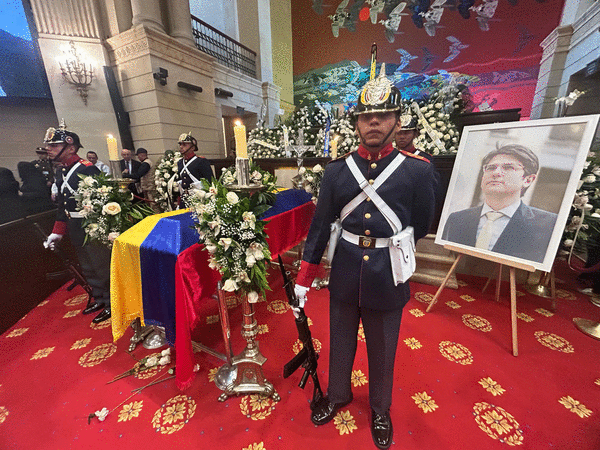
One of Latin America’s oldest democracies is under siege from powerful criminal gangs, and a manhunt for three warlords wanted by Donald Trump threatens to unleash even more chaos before Colombians vote this year.
Already, candidates are largely staying off the campaign trail amid a wave of attacks that saw a senator’s bodyguards slaughtered with machine guns, another senator kidnapped, and the first murder of a Colombian presidential contender in more than three decades. The militias blamed for the bloodshed are the strongest they’ve been in years in the aftermath of failed peace talks and the biggest cocaine boom in history.
Parts of the countryside are now no-go zones for politicians.
“I used to walk around, go on tours, but I can’t do any of that now,” said Paloma Valencia, the presidential candidate for the conservative Democratic Center party. “We see many of our people threatened in many parts of the country, so politics becomes very difficult.”
When another prominent candidate visited Bloomberg’s Bogota offices recently, a bodyguard lowered the blinds to foil potential snipers.
Worsening security has contributed to a slump in capital spending, as extortionists target sectors such as freight, energy and agribusiness, which have to operate in remote areas. Excluding the pandemic, investment as a share of the economy has fallen to levels not seen since the 1970s. Colombia's National Business Council warned that unrest related to the elections could further disrupt the business environment and raise costs for companies this year.
As violence flares before the vote for congress in March and for president in May, polls show two candidates with radically different security policies leading the race. These are Iván Cepeda, one of the architects of President Gustavo Petro’s “Total Peace” plan of negotiating with criminal organizations, and Abelardo de la Espriella, a security hardliner who pledged to halt talks with such groups and “neutralize” anyone who doesn’t surrender.
There is a high risk of more mayhem over the coming weeks. Petro vowed a more aggressive posture toward criminal gangs after his Feb. 3 White House meeting with Trump, agreeing to hunt down militia leaders sought by the U.S. for drug trafficking.
One of the men is known as Chiquito Malo, the leader of the Gulf Clan, Colombia’s biggest cocaine cartel. The group broke off peace negotiations the following day, accusing the government of bad faith.
The Gulf Clan and the guerrilla group known as the ELN may retaliate for any attacks on their leaders by enforcing a curfew in their territory, banning vehicle traffic and keeping people confined to their homes, according to Gerson Arias, an analyst at the Ideas for Peace Foundation, a Bogota-based organization that monitors Colombia’s conflict. That would make campaigning in those regions impossible, he said.
Already, the number of municipalities at “extreme risk” of violence has almost doubled since elections four years ago, according to data compiled by Colombia’s Electoral Observation Mission, or MOE, an independent watchdog.
Colombia’s guerrilla armies once fought for a Cuban-style revolution. But the new factions mainly care about protecting their illegal businesses, according to Iris Marín Ortiz, the nation’s human rights ombudsman. Armed groups can ban candidates in areas they control, prohibit the mention of certain topics and pressure people to vote for a certain candidate, or abstain, she said.
“They aren’t so interested in whether the candidate is right or left, but in whether they’ll be an obstacle to their control of territory and the population,” Marín Ortiz said in an interview.
The assassination of presidential contender Miguel Uribe last year by a teenage contract killer has set the country back decades, to a time when the state was very weak and unable to counter the threats from cocaine cartels, said Juan Manuel Galán, a presidential candidate for the New Liberal party.
Galán’s own father was the frontrunner to win the presidency when he was gunned down by Pablo Escobar’s Medellin Cartel in 1989. He believes that groups today are even more powerful and dangerous than Escobar was.
“These groups are emboldened, and they are becoming increasingly aggressive in their actions,” Galán said in an interview.
The election campaign in which Galán’s father was shot was among the most violent in world history, as death squads targeted leftist leaders, and cocaine cartels sought to eliminate candidates who supported extradition to the U.S. Two other presidential hopefuls were murdered the following year, while more than 100 people were killed when an airliner was brought down by a bomb intended to kill César Gaviria, the eventual winner.
Despite this, Colombia’s democracy has survived decades of cartel violence and civil conflict, even while military dictatorships controlled much of Latin America in the 1970s and 1980s.
Peace talks
Petro’s search for peace through negotiations with militants has failed to yield significant demobilizations. Instead, they took advantage of the relative lack of military pressure to get rich from cocaine, extortion and illegal gold mining. There are currently talks going on with eight such groups, though some of the most dangerous factions aren’t participating in negotiations.
These include the thousands of fighters led by the warlord known as Iván Mordisco, who’s based on the fringes of the Amazon in southern Colombia. Mordisco, another of the traffickers wanted by Trump, has threatened the electoral process in response to an escalation in military pressure against his group.
The Democratic Center party published a photo of a roadside banner purporting to be from one of Mordisco’s affiliates, which forbade its leaders from entering its territory, including Valencia, the presidential candidate.
The drivers and bodyguards of politicians are a common sight in wealthy neighborhoods of Bogota, often making themselves unpopular by blocking traffic while those they are protecting grab coffee or get their hair cut. But they are of limited use in regions where the state is barely present, and where criminal gangs call the shots.
Protecting the main presidential candidates is hard enough, but the risks are even greater for the more than 3,000 contenders for congress. It is virtually impossible to adequately protect every politician in regions where illegal armed groups hold sway, according to Alejandra Barrios, head of the MOE.
Because of this, the country is crisscrossed by “invisible boundaries” that candidates can’t safely pass, she said.
In some regions, the armed groups’ grip is so powerful that it is extremely risky to campaign without their permission. In the ELN stronghold of Arauca province on the border with Venezuela, gunmen this month opened fire on vehicles used by Senator Jairo Castellanos, killing two bodyguards and briefly kidnapping three other members of his team. Castellanos, who hadn’t been present during the attack, said one of his vehicles was hit by more than 400 bullets.
The ELN put out a statement implying that its fighters reacted because the driver refused to stop, and said that political campaigns must respect its checkpoints.
-------
—With assistance from Demetrios Pogkas.
©2026 Bloomberg L.P. Visit bloomberg.com. Distributed by Tribune Content Agency, LLC.




Comments