'Have y'all not learned?' Federal agents clash with observers in aftermath of Renee Good shooting
Published in News & Features
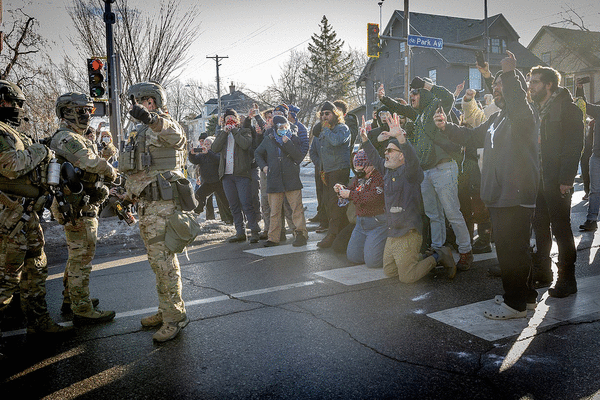
MINNEAPOLIS — Reported ICE activity sent concerned citizens racing to Knollwood Mall last week, determined to track a convoy of unmarked vehicles carrying federal immigration agents.
It took less than half a mile for the agents to spot the tail.
One agent accelerated, then slammed on his brakes — immediately causing a minor collision with a Honda CR-V behind him. Abigail Salm, trailing two cars back, pulled over to film the encounter as men in camouflage pulled two occupants out of the SUV.
“Listen. Have y’all not learned from the last couple of days?” an officer clad in tactical gear said to Salm, 27. The fatal shooting of Renee Good happened 48 hours earlier.
“Learned what?” Salm pressed, according to a video of the interaction. “What’s our lesson here?”
“Following federal agents …” he said with an expletive, snatching the phone from her hand.
A heated verbal exchange resulted in her brief detention at the scene, alongside Blake Road in Hopkins on Jan. 9. Salm said she was restrained, manhandled and threatened to be shot by an armed agent.
“Operation Metro Surge,” touted by President Donald Trump as the largest immigration crackdown in history, deployed a legion of federal agents across the Twin Cities that far surpasses any single Minnesota police force.
A growing number of bystanders and trained observers are mobilizing to lawfully monitor those federal enforcement efforts. They say agents are responding with increasing aggression that includes detainment, overt threats and physical abuse.
Viral video clips of violent arrests and emotional firsthand accounts of alleged mistreatment by masked agents are flooding social media platforms. Complaints to the American Civil Liberties Union about excessive tactics have also surged in recent days.
Numerous individuals recounted being pulled from their vehicles, tackled and sprayed with chemical irritants while attempting to watch or pursue ICE agents as they moved in to arrest or detain individuals. Many agents captured on bystander cellphone cameras do not take kindly to being followed. They regularly accuse civilians of “impeding operations.”
Three local attorneys consulted by the Minnesota Star Tribune said no state law prohibits motorists from trailing law enforcement on public roadways. Surveilling federal actions this way is legal, experts say, as long as those drivers obey local traffic laws, maintain a safe distance and don’t otherwise interfere with their enforcement efforts.
“You have a right to be there. You have a right to record and publish the information,” said Isabella Salomão Nascimento, a First Amendment attorney at Minneapolis-based law firm Ballard Spahr. “What has been very stunning is how easily spooked and how easily triggered these guys are.”
The Department of Homeland Security did not respond to detailed requests for comment. But in prior public statements and recent court filings, federal officials have pointed to a dramatic rise in pursuits involving government vehicles — a phenomenon they said was “virtually nonexistent” before 2025. They also note that assaults on agents are up exponentially.
“Such pursuits have resulted in vehicular crashes, endangerment of officer and public safety, harassment, and even at least one arrest by local authorities,” U.S. Department of Justice attorneys wrote in a December motion, responding to a class action lawsuit alleging maltreatment by ICE.
Hennepin County deputies arrested a 27-year-old man accused of chasing a federal employee in his Mini Cooper at high speeds for nearly 24 miles the day after Christmas, according to search warrant affidavit. The federal official told local authorities that he feared getting in a “shootout” with the driver, who aggressively weaved in and out of traffic and ran another vehicle off the road during the pursuit.
That driver was booked in jail for probable-cause harassment but never charged. The case remains under investigation.
Constitutional law experts examining recent footage and witness statements reject the sweeping characterization that simply monitoring federal agents – either on the street or from your car — is thwarting their ability to make arrests.
“A lot of what I see is not impeding. It’s not obstruction,” said Alicia Granse, a staff attorney with Minnesota’s ACLU chapter, who is currently tasked with triaging a mountain of onlooker and protester complaints. “It’s protected speech. It’s telling the government that they don’t like what they’re doing.”
Since Good’s Jan. 7 killing, Granse estimates she has personally fielded about 75 reports documenting abuses by ICE, including around 10 related to reckless driving.
ACLU lawyers also heard stories about observers trailing ICE vehicles being led to their own homes, presumably as a form of intimidation. Privacy advocates fear agents are misusing personal data obtained through license plate readers and car registrations, according to MPR News.
Since the operation has intensified, videos and witness accounts of the encounters between citizens and federal agents overtook social media. Some paint a full picture, while others don’t show what preceded them.
In the past week alone, ICE boxed in a Woodbury real estate agent recording their movements from his car, slammed him to the ground and detained him at the Whipple Federal Building near Fort Snelling for 10 hours. A 51-year-old teacher patrolling the Nokomis East community told the Star Tribune she was run off the road into a snowbank by ICE for laying on her horn. Officers shattered the car window of a woman attempting to drive past a raid in south Minneapolis to get to a doctor’s appointment nearby, then carried her through the street. Feds pushed an unidentified motorist through a red light into a busy intersection, reportedly fired projectiles at a pedestrian walking “too slowly” in a crosswalk and shoved Minneapolis City Council President Elliott Payne while he was observing their actions from a public sidewalk.
The real estate agent, Ryan Ecklund, appeared in an Instagram video with bruises on his face, alleging that he was forcibly removed from his vehicle “for exercising my legal rights” and later confined to a cell with several other U.S. citizens.
“I wasn’t impeding an investigation. I wasn’t flashing my lights or driving erratically or honking my horn at anyone,” he said after his release. “I was simply recording them as they moved around the city.”
Patty O’Keefe and Brandon Sigüenza told reporters they were similarly following agents seen pepper-spraying observers on Jan. 11 when officers surrounded their car and blasted chemical irritants inside the vents.
After smashing their windows and handcuffing the duo, O’Keefe said agents proceeded to taunt her appearance and make derogatory comments about Renee Good.
Salm, who witnessed the collision in Hopkins, noted that no one ever bothered to check her ID or inquire about her citizenship status while in custody.
“They’re bullies,” she told the Star Tribune. “I was just videotaping.”
Local law enforcement leaders have repeatedly expressed concerns about what they view as escalating and “unnecessarily dangerous” behavior by federal authorities. Minneapolis Police Chief Brian O’Hara lamented to the New York Times that ICE has left cars abandoned on roadways during arrests, blocking traffic — sometimes with dogs still inside. In one case, agents pulled the driver out of a vehicle before placing it in park, allowing it to roll down a south Minneapolis street into oncoming traffic.
Hennepin County Sheriff Dawanna Witt also called out a lack of professionalism during some arrests, telling WCCO Radio last month that “doing this job doesn’t mean you have to be an asshole.”
The ACLU has filed a lawsuit on behalf of six Twin Cities residents who are now asking a U.S. District Court judge to issue a preliminary injunction that would temporarily rein in the conduct of federal agents in Minnesota, limiting when they can deploy chemical irritants or prevent a lawful pursuit. A ruling has not yet been issued.
In court Jan. 13, attorneys for the DOJ appeared to struggle while responding to Judge Katherine Menendez’s questions about whether protesters are acting within their First Amendment rights when following immigration agents in their cars.
Jeremy Newman, from the Justice Department’s Civil Rights Division, repeatedly emphasized that drivers are “chasing” ICE vehicles across the state for the sole purpose of drawing large crowds to scenes of their operations. Menendez pressed him, saying she hasn’t seen any evidence the drivers were breaking traffic laws.
In Los Angeles, journalists won a similar restraining order meant to curb the indiscriminate use of force from both local police and DHS agents flooding their city last summer amid mass anti-ICE demonstrations.
But violations still occurred. Less than a month later, three journalists were beaten with batons while covering a protest.
“They just do what they want,” said Mickey Osterreicher, general counsel for National Press Photographers Association, who filed an amicus brief in the case.
Osterreicher spent 40 years as a photojournalist and nearly as many as a reserve deputy for the Erie County Sheriff’s Office in New York, giving him unique insight into the challenges of both professions. In the years following George Floyd’s murder, he led a series of media trainings for Minnesota State Patrol troopers, hoping to improve those relationships.
But, given recent events, he still fears for the press and all those documenting law enforcement behavior.
“What we’re sadly seeing around the country is that there are people who are meant to uphold the law, who think that they are above the law,” he said. “That’s a real problem – not just for journalists, not just for observers, but for democracy."
_____
Sarah Nelson, Casey Darnell, Zoe Jackson, Paul Walsh and Elliot Hughes of the Minnesota Star Tribune contributed to this story.
_____
©2026 The Minnesota Star Tribune. Visit startribune.com. Distributed by Tribune Content Agency, LLC




Comments