'One of our priorities': 'Superbug' still dangerous for Nevada
Published in News & Features
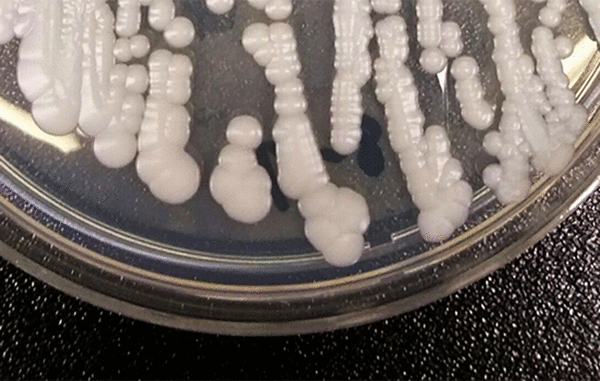
LAS VEGAS — Cases of a potentially lethal fungus have stabilized in Nevada, according to public health officials, who urge continued vigilance against the drug-resistant “superbug.”
Nevada’s first case of Candida auris was detected in Las Vegas in August 2021. By 2022, Southern Nevada was experiencing the largest outbreaks in the country. Case numbers peaked in 2024, then dipped slightly last year, preliminary state data shows.
“Why I strike a more optimistic tone is we have the actual proof that our health care interventions work,” said David Hess, a genomic scientist at the Nevada State Public Health Laboratory at University of Nevada, Reno’s School of Medicine. He noted that he was expressing his own views and not speaking on behalf of the lab, which tracks drug-resistant strains.
Candida auris, a strain of yeast, was first identified in Japan in 2009 and in the U.S. in 2016. In spring of 2023, the Centers for Disease Control and Prevention issued a warning stating that cases were spreading in the U.S. at an “alarming rate.”
“We’re still concerned about it here at the CDC, and I think it’s definitely still one of our priorities,” Dr. Meghan Lyman said last week.
Lyman is the acting deputy chief in the mycotic disease branch of the national public health organization. Mycotic disease is illness caused by fungi.
The fungus continues to spread to new communities, with case numbers climbing across the country. However, the rate of increase has slowed, “suggesting that some of what we’re doing is really helping,” Lyman said in an interview with the Las Vegas Review-Journal.
She cautioned that Candida auris is something that “health care facilities still need to focus on and be diligent about.”
C. auris, as it is often called, is considered a health-care-associated infection — that is, one most likely to be acquired in a medical setting such as a hospital or long-term care facility. It can spread person-to-person by people who don’t know they have it. It also can spread from contaminated surfaces or equipment, where it can survive for long periods.
The fungus can colonize on the skin, typically in the armpit or groin, invisible to the eye and without making its human host sick. These are referred to as colonized cases and are detected through screening. If C. auris enters the body, it can cause a severe infection, a so-called clinical case that 30 percent of the time or more results in death. Symptoms of an invasive infection include fever and chills that don’t respond to treatment with antibiotics.
Most people who become ill from the fungus have a weakened immune system from an underlining health condition. Having a line into the body like a catheter or feeding tube also heightens the risk by providing a way for the organism to enter the body.
Public health officials in Nevada, and across the U.S. in places experiencing outbreaks, have ramped up procedures to prevent infection and transmission of disease.
“I think overall, from a management standpoint, we’re far better off today certainly than we were a few years ago,” said David Perlin, chief scientific officer at Hackensack Meridian Health Center for Discovery and Innovation in New Jersey.
Yet C. auris continues to be a major challenge. Fungal pathogens are highly adaptive, pre-wired to survive in the environment and in the host, he said.
“But this one is sort of adaptive on steroids,” Perlin told the Review-Journal. “It’s really an extraordinary bug.”
This adaptability has allowed it to develop resistance to the drugs used to treat it. In a small percentage of cases, echinocandins — the preferred treatment with fewer side effects — do not work.
Perlin and other authorities said the percentage of cases resisting treatment is not increasing, which is good news.
“That’s not to say that after prolonged exposure that you could not develop resistance to all known antifungal agents, and we’ve seen those, quote, ‘superbugs,’” Perlin said. However, highly drug-resistant Candida auris is “not running rampant across the country.”
Lyman said that while resistance to echinocandins remains low, the number of drug-resistant cases is increasing along with overall cases.
“These are even more difficult to treat and have fewer options, so that just raises the stakes a little more and has us more concerned,” she said. “So I’d say that’s our biggest concern.”
She said there are promising drugs under study for the treatment of C. auris. However, because they are not yet approved, they are available only through expanded access programs or emergency exemptions.
In 2023, Nevada had among the highest number of cases in the U.S., according to CDC data, with Nevada, California and Florida each reporting approximately 600 clinical cases. Lyman said her branch of the CDC is finalizing its data for 2024.
In 2024, the Nevada Division of Behavioral and Public Health reported 692 clinical cases and 1,772 colonization cases — 2,464 total cases — according to data obtained from the division.
In 2025, it reported 628 clinical cases and 1,639 colonization cases — 2,267 total cases, including a preliminary count for December. Cases remain almost exclusively in the southern part of the state.
In late December, the CDC’s Center for Surveillance, Epidemiology and Laboratory Services posted data showing Nevada with the highest number of clinical cases for the U.S. in both 2024 and 2025, citing reporting by states. However, the surveillance center’s figures for Nevada are three times higher for 2024, and 2½ times higher for 2025, than the state’s own data.
The Nevada Division of Public and Behavioral Health, which said its lower figures are accurate, is “working with the CDC on correcting the discrepancy between the reported figures and what is reported on their website,” wrote public information officer Daniel Vezmar in an email.
In Nevada, the number of cases peaked in spring 2024, after the state first mandated case reporting, according to data obtained from the Nevada division. That March, the state reported 59 clinical cases and 233 colonization cases.
According to Vezmar, the division considers March and April 2024 to be anomaly months when more cases were first identified, “likely due to increased screening, testing and awareness.”
“After that time, identified cases have remained consistent,” he wrote. “While case counts have remained relatively stable, the Division continues to work closely with healthcare facilities to monitor the ongoing presence of this pathogen in Nevada and maintain vigilance in implementing measures to protect patient safety.”
Hess said Nevada has done more C. auris testing per capita than any other jurisdiction, which he described as a testament to Nevada’s public health system.
“The more you test, the more cases you’ll see,” he said.
The state has worked to identify drug-resistant cases quickly so that facilities can focus on stopping their spread.
Nevada no longer discloses the number of deaths of people with C. auris, previously saying the cause of death in these cases is difficult to determine and there is no national definition for a death from C. auris.
Critics have noted that in contrast, deaths of patients with COVID-19 who had underlying health conditions were counted as COVID-19 fatalities by the federal government.
This month, the Southern Nevada Health District assumed primary responsibility from the state health division for investigating health-care-associated infections in its jurisdiction.
Like other authorities, the health district’s Anil Mangla stated that C. auris, once it is firmly established in a location, won’t be eradicated but can be controlled.
“We want to prevent and detect and control through robust epidemiologic surveillance, which is key,” said Mangla, the district’s director of disease surveillance and control.
The district has launched a health-care-associated infections program directing resources to prevention of these diseases.
“We want to make sure we are providing adequate training, adequate subject matter expertise, to all these facilities,” with the goal of decreasing C. auris infections, he said.
Hess and other authorities said there is no room for complacency when it comes to C. auris.
“It’s still dangerous,” he said. “We just understand it better.”
___
©2026 Las Vegas Review-Journal. Visit reviewjournal.com.. Distributed by Tribune Content Agency, LLC.






Comments