St. Kitts and Nevis agrees to take US migrants, but says no Haitians allowed
Published in News & Features
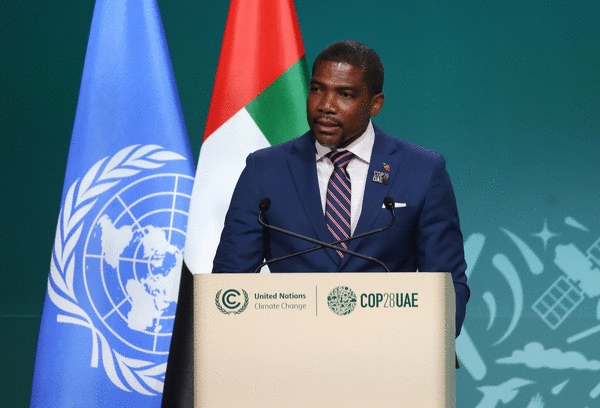
Two more Caribbean countries have entered into agreements with the Trump administration to accept asylum seekers deported from the United States, with one leader explicitly saying Haitians are not welcome.
St. Kitts and Nevis Prime Minister Terrance Drew said that his government has agreed to accept a very small number of third-country nationals from the U.S. as long as they are citizens of the 15-member Caribbean Community known as CARICOM, and are not sexual predators, have no violent backgrounds and are not Haitians
“This does not involve anybody outside of CARICOM,” Drew said at a news conference late last week. “This is in keeping with our character. And I will further say that because of security matters, it does not include Haiti at this time.” He reiterated Haiti’s exclusion at three separate points during the briefing.
The exclusion of Haitian nationals marks the first public acknowledgment by a CARICOM member state that it has placed explicit limits on accepting nationals from Haiti, which is a member of the bloc of mostly former British colonies, in their negotiations with Washington. Though Caribbean governments are known for their exclusions of Haitians and even rejections once they arrive on their shores, what makes the latest development surprising is that Drew is currently the chairman of the regional bloc.
On Monday, seemingly addressing the firestorm over the agreement with the U.S. and Haiti’s exclusion, he said “in approaching diplomacy, one has to evaluate very carefully what are the risks and benefits.
“My first objective always, is to protect St. Kitts and Nevis, and our people” he added. “Any decision that is made is made with that in mind.”
Drew has acknowledged that Caribbean countries are agreeing to accept their own nationals. This raises questions about the scope and substance of the island-nation’s third-party arrangement, which the United States has been aggressively pursuing across the region to expand destinations for asylum seekers and refugees kicked out of the U.S. who cannot return to their countries of origin.
Third-party agreements
So far, six CARICOM countries — Antigua and Barbuda, Belize, Dominica, Guyana, St. Kitts and Nevis and St. Lucia — have announced that they have entered into an arrangement with Washington to accept migrants.
On Sunday, St Lucia’s recently re-elected prime minister, Philip J. Pierre, confirmed that his government had signed “a non-binding Memorandum of Understanding” with the U.S. to potentially accept certain “third country nationals” deported by the Trump Administration.
“We believe that stability is best secured through dialogue, diplomacy and respect for established international norms,” Pierre said during a national address announcing the decision. “We’ll continue to work with our regional partners to safeguard the Caribbean as a zone of peace. St. Lucia’s foreign policy remains rooted in diplomacy, cooperation and mutually beneficial shared interests.”
St. Lucia, Antigua, Dominica and St. Kitts, in addition to being in the eastern Caribbean, all have Citizenship by Investment programs, which allow foreigners to acquire citizenship with investments ranging from $100,000 to $250,000. The program has come under fire from the Trump administration, which has used its concerns over a lack of vetting and transparency as leverage with Caribbean governments.
In December, both Antigua and Dominica were added to a list of countries under a partial U.S. travel ban after Trump issued an executive order, citing their CBI programs.
All the Caribbean countries have negotiated their own conditions for accepting refugees deported from the U.S. who cannot return to their countries of origin., but only Antigua has publicly detailed the parameters governing its agreement with the U.S.
According to a letter Antigua’s government wrote to senior State Department official Michael Kozak, the Caribbean country says it will only consider taking in designated refugees under U.S. law or registered asylum seekers with pending, non-frivolous applications recognized by U.S. authorities who have no criminal convictions other than immigration-status offenses; have no pending criminal charges; are not subject to sex-offender registration; are not on terrorism, organized-crime, or sanctions lists; and are not otherwise excludable on security grounds. Individuals also must possess a certified skill or professional license recognized by the relevant regulatory authorities of Antigua and Barbuda; and have at least basic working proficiency in English.
There is no mention of nationality in the lette. Status will be granted for no more than 24 months unless mutual consent is given for an extension. “If the transferee and immediate family have not achieved self-sufficiency by the end of twenty-four months, Antigua and Barbuda may request their return. The United States shall accept such return and arrange transport within thirty days, securing all travel documents and covering all costs,” the letter said.
Questions about Haiti’s place
Other countries have yet to provide details of their agreement. But so far, only St. Kitts and Nevis, a country with a population of about 46,000 people, has publicly confirmed the exclusion of Haitians, reviving longstanding questions about Haiti’s place within CARICOM.
Neither Haiti’s foreign minister nor the prime minister’s office responded to Miami Herald requests for comment. The decision has prompted debate online over what critics describe as moral contradictions in a region that often positions itself as Haiti’s advocate — the bloc is currently leading discussions about the country’s political transition after Feb. 7 — while excluding the French-speaking country from the practical implementation of regional policies. CARICOM’s Single Market and Economy, which allows for the free movement of goods and services, excludes Haiti, while member states continue to deny Haitian nationals visa-free travel to their countries.
Peterson Benjamin Noel, a former Haitian ambassador to CARICOM, said many member states, including St. Kitts and Nevis, remain reluctant to accept Haitian nationals, viewing them as a form of “silent invasion.” That apprehension, he said, is particularly evident in The Bahamas, the CARICOM country with the largest population of people of Haitian descent, which has declined to join the Single Market and Economy largely because of concerns over the free movement of people.
As a result, Noel said, Haiti is often treated less as an equal partner in regional integration than as a vehicle through which CARICOM can project influence internationally.
“Haiti’s integration is framed more as a symbolic or strategic necessity than as a genuinely inclusive process,” he said.
He added that there exists “an implicit and often unspoken regional consensus regarding Haiti—one that shapes policy positions while remaining largely absent from formal discourse.”
©2026 Miami Herald. Visit at miamiherald.com. Distributed by Tribune Content Agency, LLC.




Comments