'I'm a physician,' he said. 'Don't care' was the reply
Published in News & Features
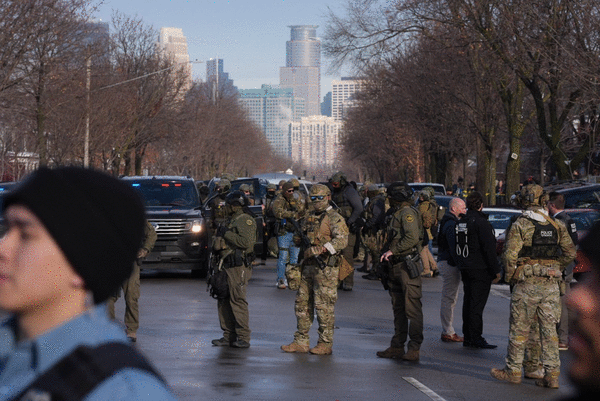
MINNEAPOLIS — A terse exchange between a bystander claiming to be a doctor and federal immigration agents at the scene of the Renee Good shooting on Wednesday raises fresh questions about when and if bystanders with medical training should be able to render aid at crime scenes.
“Can I check a pulse?” yelled the bystander, standing across Portland Avenue from Good’s lifeless body inside her crashed SUV, video footage of the exchange shows.
“No,” an agent replies. “Back up.”
“I’m a physician!”
“I don’t care.”
Neither the purported doctor nor the agent in the exchange has been identified. But experts in emergency response said both were likely acting within their training, and they couldn’t determine whether bystander aid might have changed the outcome. Good was taken to Hennepin County Medical Center in Minneapolis after she was shot in the head while trying to flee the federal agents and pronounced dead at the hospital, according to Minneapolis police accounts and video of the scene.
Doctors and other licensed medical professionals and first responders in Minnesota are obliged to help injured people at emergency scenes under the state’s Good Samaritan law. However, when law enforcement agents are in control, they have authority to accept or refuse that help as they assess the safety and security of emergency scenes, medical and EMS officials told the Minnesota Star Tribune.
Police officers have been “more than willing to take my help” to treat victims of vehicle crashes while waiting for ambulance crews, said Dr. Steven Miles, a retired University of Minnesota physician and bioethics professor who has studied the ethics and roles of physicians in crisis situations.
But that can change “in nonsecure situations like mass shootings or fire,” he said. “A bystander can be told to stand down as part of the scene management.”
One reason for hesitation is that law enforcement officials don’t always know if bystanders are actually doctors, despite what they say. EMS officials said there have been incidents when bystanders, especially at protest scenes, misrepresented themselves or overstated their medical capabilities.
The question of whether officers accept emergency medical treatment from trained bystanders in public has surfaced before. Off-duty Minneapolis firefighter Genevieve Hansen witnessed police officers restraining George Floyd in Minneapolis in 2020. Officers refused her urgent pleas to check on Floyd before he died, she testified in court.
The man identifying himself as a doctor at the scene of Good’s shooting backed off after a second federal agent stepped in, video shows.
“Listen, I understand,” the agent told him. “We’ve got EMS coming in. I get it. Just give us a second. We have medics on scene.”
An HCMC spokesperson declined to address questions about the emergency response and whether bystander aid would have made a difference, because it’s “an active investigation handled by other agencies.”
Miles said the entire EMS response demands a review, starting with whether the federal Department of Homeland Security and the Immigration and Customs Enforcement division have policies governing bystander medical assistance and whether federal agents followed those policies.
If medics were among the agents, as claimed, then the speed with which they responded to Good’s injuries must be evaluated, he said. Witness reports also suggest federal vehicles and other obstructions weren’t cleared to help a Hennepin EMS ambulance crew reach the scene.
If those claims prove true, Miles said, “these failures constitute a life-endangering failure of policy, training, rehearsal, competence and command by ICE in this event.“
Hennepin EMS has a clear policy on bystander involvement by doctors when ambulance crews are already at the scene. Paramedics can relinquish decision-making authority over medical care to doctors who show appropriate credentials and agree to accompany the patients to hospitals. Paramedics also can ask for assistance from bystander doctors who are not willing to take on that level of responsibility.
What to do before paramedics arrive isn’t as clear.
A spokesman said the Minneapolis Police Department does not have a written policy governing when officers should accept or refuse bystander medical help.
The press office for Homeland Security didn’t reply to a request for any guidance offered to federal agents in this situation. A policy memo obliges agents in use-of-force incidents to seek or provide medical attention after safety threats have been resolved but doesn’t address the use of bystanders.
_____
©2026 The Minnesota Star Tribune. Visit startribune.com. Distributed by Tribune Content Agency, LLC



Comments