Migrants deported from US could soon land in 3 Caribbean countries
Published in News & Features
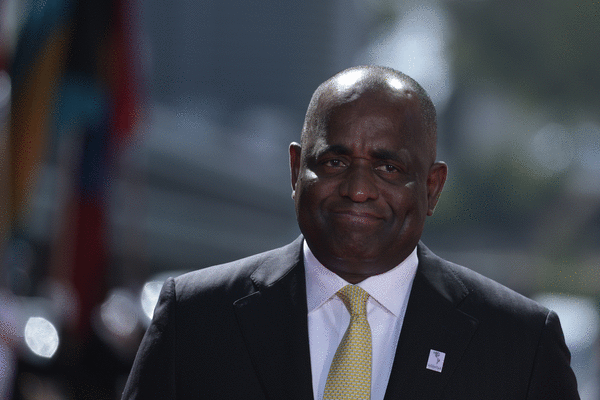
Two Caribbean countries whose nationals have been targeted under a recent U.S. travel ban have agreed to accept asylum-seekers rejected from the United States who cannot return to their countries of origin.
Meanwhile, a third country, Guyana, confirmed to the Miami Herald that it is also close to finalizing “a framework to lead to an agreement,” where the country would accept skilled migrants who don’t have legal status in the United States and do not want to return to their home country.
Earlier this week, the governments of Antigua and Barbuda and Dominica confirmed the development earlier this week, issuing separate statements defending a decision that’s likely to fuel debate in a region already grappling with a host of socio-economic challenges, including rising gun violence, fragile tourism and migration.
Dominica Prime Minister Roosevelt Skerrit, speaking to the media on Monday, said his eastern Caribbean country “has entered into an agreement to facilitate third-country refugees to be sent to Dominica to mitigate scenarios where the United States cannot return these individuals to a state of birth or origin.”
Skerrit tied the decision to the Trump administration’s Dec. 16 executive order that placed Dominica and Antigua and Barbuda under an expanded partial travel ban — a ban the State Department late Tuesday confirmed to the Miami Herald remains in effect for the two Caribbean nations despite reports over the Christmas holidays that implementation had been placed on hold amid ongoing discussions with Washington. Persons who had valid visas prior to the effective date of the restriction are not affected, the State Department said.
The administration cited concerns about Antigua and Dominica’s Citizenship by Investment, or CBI, program, which allows a foreign national to obtain a passport in exchange for financial investments. Known as “golden passports,” the programs are a significant revenue earner for the two island-nations, building everything from hospitals to roads. But the programs have become leverage for the Trump administration in carrying out its immigration agenda amid concerns about the transparency and proper vetting of wealthy individuals who can acquire citizenship with minimum investments ranging from $100,000 to $250,000.
Though five Caribbean countries have CBI protocols, only Antigua and Dominica were included in the partial travel ban, which includes 13 other countries, mainly in Africa.
Sale of citizenships
Crispin Gregoire, a former ambassador who served as Dominica’s permanent representative at the United Nations, said while he doesn’t know whether the other countries will fall into the crosshairs of the Trump administration, he believes the U.S.’s long-standing concerns of “deficiencies” in CBI programs made Dominica and Antigua make them especially vulnerable.
A 2023 investigation involving the Miami Herald, the Organized Crime and Corruption Reporting Project, more than a dozen other media partners and the Government Accountability Project, showed that individuals from Russia, China and Iran were among the newest citizens of Dominica, courtesy of golden passports that provided visa-free travel to more than 100 countries around the world including the European Union at the time.
“CBI is putting (Caribbean Community) passports, more so than the national passports, right in the hands of people that are risky, people who are dangerous.,” Gregoire said. And as a result, “a transactional Trump administration is saying, ‘OK, you want visas for your people to come to the U.S., then you take some deportees, and they have no option but to do that.”
Gregoire also believes both nations’ close ties to China, which is currently building Dominica’s airport, and to Venezuela have also made them more of a focus than other members of the 15-member Caribbean Community known as CARICOM. Secretary of State Marco Rubio, he added “is very concerned about these two islands, and the Chinese presence right in the middle of the Caribbean, and then Dominica.”
Justifying his decision to take migrants from the U.S., Skerrit said given the importance of bilateral relations between his country of 66,000 people and the U.S., he, as prime minister and head of government, believes, ”it is important to find key points of agreement and compromise” with the United States.
“This engagement is based on our responsibility to safeguard the well-being of our people, particularly the access to lawful travel, education, employment and family connections, while strengthening cooperation between our two governments,” he said. “I believe this will further deepen our long-standing relationship and signal clearly that Dominica remains a willing and reliable partner of the United States in our region.”
Opposition criticizes the deal
Skerrit provided few details on how Dominica, still facing a housing shortage after Category 5 Hurricane Maria devastated the island in September 2017, plans to accommodate the refugees.
Dominica opposition leader Joshua Francis of the United Progressive Party criticized Skerrit’s lack of transparency on the decision. In a statement, he raised a number of concerns, including how Dominica could agree to accept responsibility for deportees “when we have yet to fully address the housing needs of our own people.”
“The UPP believes this agreement has the potential to further destabilize our nation economically, socially, and from a security standpoint,” Francis said. “We are not opposed to humanitarian assistance in principle, but such decisions must be made transparently, with full consultation, and with careful consideration of our national capacity, security, and the welfare of Dominican citizens.”
Skerrit said he has insisted in his conversations with the State Department on the need to avoid receiving violent individuals who will compromise the security of the country. “These have been — they have been careful deliberations,” he said.
The Herald has previously reported, however, that such guarantees do not always hold. In October, the Herald reported that hundreds of Cubans and other immigrants with significant criminal records were sent in buses across the border to Mexico by the Trump administration in an expansion of third-country deportations.
In the case of the Cuban nationals, the refugees had been in limbo after being rejected by Cuba. Though Mexico accepts deportation flights from the U.S., it has a longtime practice of rejecting deportees who have been convicted of certain crimes.
‘Possible acceptance’
While Skerrit presented his discussions with the Trump administration as “a done deal,” the government of Antigua and Barbuda presented its engagement with the U.S. “as a possible acceptance of a very limited number of third-country nationals, including refugees.”
In a statement, the government said there is “a non-binding Memorandum of Understanding proposed by the United States, as part of its global efforts to share responsibility for refugees already present in its territory.”
The twin-island nation of nearly 94,000 residents said it was approached, “along with more than one hundred governments worldwide, including several within the Caribbean Community, to consider” the arrangement.
Antigua said the non-binding understanding, which creates no legal obligation on the island nation, doesn’t commit the government to quotas or automatic acceptance of any persons, and may be terminated at any time.
Antigua and Barbuda retains “the absolute right to reject any individual proposed by the United States; all cases would be considered strictly on a case-by-case basis,” the statement said, insisting that “no person with a criminal record would be accepted.”
Antigua Prime Minster Gaston Browne said his country would only accept 10 asylum seekers per year. He added discussions were under way with the United States to about “the restoration of normal visa issuance,” including introducing a biometric system for holders of their passport. The statement said the “authorized consideration” of the third-party migrants is “an act of good faith, reflecting Antigua and Barbuda’s willingness to cooperate with international partners where it is safe, lawful, and consistent with national interests.... This was not a concession, nor an attempt to trade people or curry favor. It was a measured diplomatic gesture, taken alongside many other responsible states, while preserving Antigua and Barbuda’s full discretion and control.”
The decisions come at a moment when there are great divisions and tensions in the region over U.S. boat strikes in the southern Caribbean and the targeting of Venezuelan leader Nicolás Maduro, who was captured by U.S. forces in an overnight raid Saturday. It also comes as Trump seeks to ramp up deportations by pressuring foreign nations in Africa and Latin American to accept U.S. deportees.
In October, Belize, also a member of CARICOM and located in Central America, signed a “safe third country” agreement with the U.S.
Asked about the statements issued by Antigua and Dominica, the State Department spokesperson said, “We have no comment on the details of our diplomatic communications” with other governments.
“Several countries have expressed their commitment to ending the crisis of illegal immigration, including through acceptance of third-country nationals, in addition to facilitating the repatriation of their own nationals,” the spokesperson said. “Our partners in the region are working closely with us to end the crisis of illegal immigration.”
Guyana in discussions
In a Herald interview, Guyana Foreign Secretary Robert Persaud said the country’s agreement with the U.S. would be “very unique” and based on requests from the nation’s private sector, which is seeking skilled individuals.
“This is not a case where the U.S. would be dumping people in Guyana,” he said. “We have the right to refuse anyone.”
In the midst of an oil boom, Guyana has a skills gap of between 70,000 and 80,000 people to meet its changing economy, Persaud said, underscoring the emphasis they’ve placed on receiving skilled individuals with no criminal records.
The U.S. has agreed to bear the cost of “integrating” the individuals in the English-speaking country of just over 800,000 residents. Located at the tip of South America, Guyana is part of the Caribbean Community and shares a contentious land border with Venezuela.
On Tuesday, Rubio and Guyanese President Mohamed Irfaan Ali spoke, but the State Department did not mention any ongoing discussions about transferring migrants.
_____
©2026 Miami Herald. Visit miamiherald.com. Distributed by Tribune Content Agency, LLC.





Comments