Gov. JB Pritzker signs sweeping Illinois energy law boosting batteries and renewables that GOP opposed
Published in News & Features
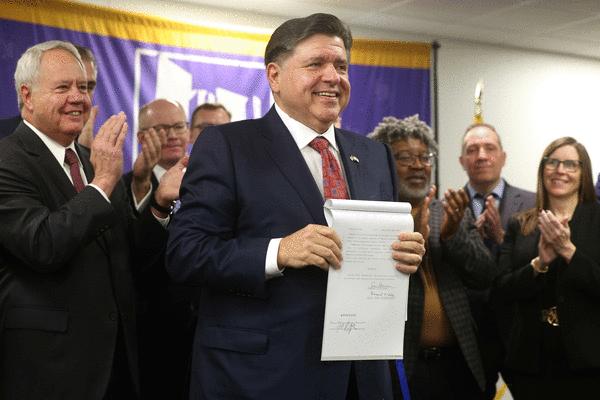
Gov. JB Pritzker on Thursday signed into law sweeping energy-related legislation that promotes battery storage and makes wind and solar power more effective, among other initiatives, with the goal of reducing electricity prices amid rising utility bills for consumers.
“This was one of the most comprehensive responses to the energy crisis that we’re in in the entire nation because it was important to us,” the governor said during a ceremony at Joliet Junior College, flanked by a group of Illinois lawmakers and the law’s advocates. “There’s no time to waste in the race to make electric bills more affordable.”
Dubbed the Clean and Reliable Grid Affordability Act, the new measure comes as state officials have warned that Illinois may face energy shortages and higher bills as data centers and artificial intelligence needs drive a surge in demand.
But whether the new law will meaningfully reduce electric bills remains uncertain. When the law was passed in the fall, it pitted Democrats against Republicans, who noted the massive battery installations would be partly backed by a surcharge on consumers’ monthly bills.
GOP lawmakers on Thursday criticized the measure, which received no Republican votes in the legislature.
“The Governor has signed a bill that weakens consumer protections, expands regulatory authority, and locks Illinois into costly policies,” state Sen. Sue Rezin, a Republican from Morris, said in a statement. “This law will fundamentally reshape how energy decisions are made in Illinois, and the consequences will be felt for years.”
GOP state Sen. Terri Bryant of Murphysboro said Republicans have warned that previously approved green-energy mandates in Illinois have driven up costs and weakened energy reliability, and that the 1,000-plus-page legislation Pritzker signed Thursday didn’t address either issue.
“When those warnings became reality, the Governor and his party did not course correct,” Bryant said in a statement.
Pritzker, who is running for a third term and is considered a potential 2028 presidential contender, blamed President Donald Trump and Republicans in Congress for higher electricity prices across the nation, accusing them of taking action that “abruptly and arbitrarily canceled major clean energy projects that expand the supply of energy.”
State Sen. Bill Cunningham, a Chicago Democrat and a co-sponsor of the new law, said it will allow Illinois to increase the supply of energy to the power grid and reduce its price by making it easier to develop renewable energy. The law will also lift an existing moratorium on new large-scale nuclear construction and add battery storage.
“That’s what we’re doing with this bill,” he said. “That’s all going to bring more supply onto the grid and that will help hold the line on our electrical bills.”
The law was a result of negotiations between lawmakers, organized labor, environmental interests and other groups in response to an especially high demand for electricity in the last couple of years.
That high demand is partly due to the 2021 Climate and Equitable Jobs Act, which aims to promote greater use of renewable energy by 2030 and eventually phase out fossil fuels, as well as the prevalence of data centers that have taken up a significant share of the electrical supply due to the emergence of AI technology. The policy shift also stems from the state’s plan to retire 28 gigawatts of coal- and natural-gas generating capacity by 2045 to improve air quality.
The new law authorizes the Illinois Commerce Commission to sign long-term contracts and allows for funding of pilot programs for geothermal energy networks. It also increases subsidies to retrofit homes to use less energy.
The batteries that comply with the law would work with wind and solar to make the electricity they supply more consistent. They require billions of dollars in upfront investment to be financed by battery developers and secured through the utility bill surcharges.
But according to an estimate released in the fall by the Illinois Power Agency, the batteries would reduce average residential electricity bills by a few dollars per month by 2031 by lowering anticipated rate increases for future capacity on regional electricity grids.
The cost of deploying 3 gigawatts of batteries on the grid by 2031 would add 58 to 68 cents per month to the average residential bill for Ameren customers in mostly downstate Illinois and 40 to 48 cents for Commonwealth Edison customers in the Chicago region, according to the IPA analysis.
But the batteries would pay for themselves by reducing the anticipated rate increases for future space on regional transmission grids, the agency said. In total, by 2031, the batteries would reduce average Ameren residential bills by $3.90 to $8.28 per month and average ComEd residential bills by $1.46 to $1.85 per month, according to the agency.
Including all its other provisions, the IPA has said, the energy law would reduce average Ameren residential bills by $4.49 to $10.59 per month and average ComEd residential bills by $1.46 to $2.03 per month by 2031.
_____
©2026 Chicago Tribune. Visit chicagotribune.com. Distributed by Tribune Content Agency, LLC.






Comments