Once a slowpoke, Toyota growing EV portfolio amid industry pullback
Published in Business News


GEORGETOWN, Ky. — The second-best-selling automaker in the United States is finally making its move on electric vehicles.
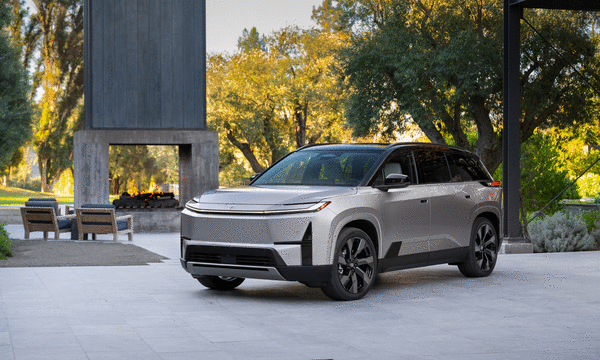
Toyota Motor Corp., at a moment when its Detroit competitors are bringing back Hemi engines and taking massive write-downs on EV efforts, showed off its first-ever American-made battery-electric vehicle Monday during an investment announcement at its Georgetown Assembly Plant.
That model, the three-row Highlander EV, will go on sale later this year and bring the Japanese auto behemoth's total BEV offerings to six — up from just two in 2025. The new $800 million retooling effort will also help bring a second Kentucky-built EV to the lineup in the not-too-distant future, the company said Monday.
"Toyota is not often the first with a new technology," said auto analyst Sam Abuelsamid, Telemetry vice president of market research and insights. "But they take their time. They try to do it right."
The company is known for its steady business philosophy and has purposefully been a tortoise on EV adoption, sticking with its tried-and-true hybrid lineup and correctly predicting a rocky U.S. powertrain transition. And while Toyota has not yet passed the hares — Ford Motor Co. and General Motors Co. both still clobber their rival in EV sales, not to mention the likes of Tesla Inc. and Rivian Automotive — analysts said the slower approach is paying off.
"If you compare Toyota to GM, Ford and Stellantis, I think they've done a better job at product planning," Abuelsamid said, adding that Toyota has maintained supremacy as a gas-electric hybrid leader at a hot time for that market segment without "overinvesting" in EVs as its Detroit competitors have.
"Toyota invested in a way that they could utilize the same resources, whether they were going to sell BEVs, or hybrids, or (hydrogen) fuel cell vehicles," he explained.
The analyst called out the Detroit Three in particular for frequently revised EV goals, product cancellations and battery plant sell-offs while praising Toyota's $13.9 billion North Carolina battery factory as a hallmark of the company's flexible and resilient planning. That plant houses battery production lines supporting gas-powered hybrid, full battery-electric and plug-in hybrid models across Toyota's lineup.
He also praised the brand's approach of deploying, improving and developing multipurpose components in one electric vehicle first — the bZ4x in 2022 — before rolling out other products.
"It was, to say the least, underwhelming. It was not great. The range was mediocre. The charging was slow. There were some other challenges with it," Abuelsamid said of the original model, now called the bZ. "But with Toyota, continuous improvement has always been their thing. They listened to the complaints, and they made the bZ dramatically better in the span of a mid-cycle update."
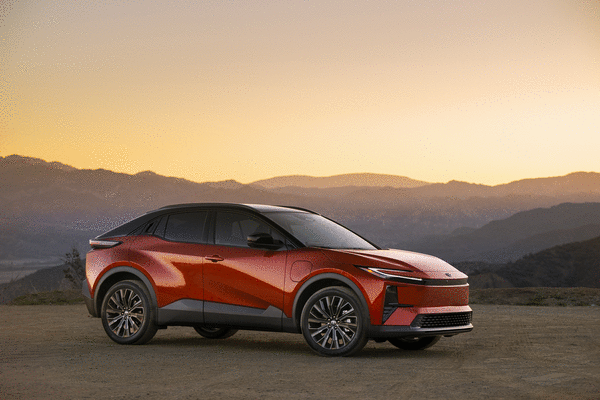
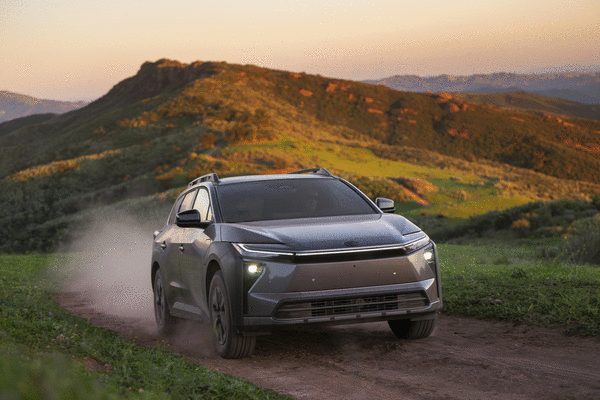
The six all-electric products Toyota plans to sell by year's end include the bZ compact crossover, the more spacious bZ Woodland, the C-HR subcompact crossover, the Lexus RZ luxury crossover, the Lexus ES electric sedan and the three-row Highlander SUV.
Once-unpopular EV approach now looks prudent
For several years, Toyota's posture on EVs has been less about specific targets and more about a general philosophy. The company did not set U.S.-specific goals for battery-electric vehicle sales under the Biden administration, even as regulators rolled out stringent emissions-reduction and EV targets.
Instead, Toyota maintained targets on "electrification" more broadly — including gas-powered hybrids.
"Our mission, our goal, is to reduce as much carbon as we can, as quickly as possible," Julia Rege, Toyota's general manager of environmental regulation, told reporters in Washington, D.C., last week.
"Toyota is very well known for having a multipath strategy that is a portfolio approach, where we are making improvements on our gasoline engines, providing hybrid electric vehicles, plug-in hybrid electric vehicles, battery-electric vehicles, as well as fuel-cell electric vehicles," she added.
Rege's description of Toyota's powertrain outlook uses similar language to what other automakers, industry lobbyists and politicians of all stripes have deployed since President Donald Trump returned to office last year: "The best strategy is to make sure that you're selling what your customers want and being prepared for the future of what customers want as well."
She and other company officials, however, said that a key difference between Toyota and its competitors has been the steadiness of that approach even in a back-and-forth regulatory environment between Republican and Democratic majorities in Washington.
"Some of our competitors are chasing that pendulum as it's swinging back and forth," said Rick Gezelle, Toyota's director of environmental regulation. "You look at our plans, they're pretty stable. We are not pivoting on our plans that we had in place, which were not very popular just a few years ago. But, you know, it's a different story now."
That story has included Ford, GM and Stellantis NV halting or delaying products and taking multibillion-dollar accounting hits on EV investments totaling more than $50 billion across the three companies. Those special charges and write-downs have severely hampered profits.
Other foreign automakers, like Honda Motor Co., have had similar EV headaches after the Trump administration canceled generous federal incentives last year. Honda, and its luxury brand Acura, just announced $15.7 billion in EV charges in conjunction with the cancellation of three models.
Dan Ives, an analyst at investment firm Wedbush Securities Inc., applauded Toyota's "great management team" for avoiding such hits.
"The Street views Toyota is a steady ship in rough waters," Ives said in a phone interview, referencing the slang nickname for Wall Street. He gave them significant credit for their approach, but suggested some of their successful positioning was a lucky byproduct of Republicans' wins in 2024.
"Their steady approach has been smart. I'd call that 75% strategic, and 25% of that is really the backdrop that's shifted. That was out of their control, and now it's really going to be a fork-in-the-road time for a lot of these automakers. Everyone's watching Toyota carefully to see the moves they make."
GM, Ford grabbed market share but have less balance
Though Toyota has avoided large EV losses, its deliberate lag in offering fully electric models has left it far behind competitors — for now. The Japanese automaker captured less than 2% of the U.S. EV market last year, according to a February analysis by CleanTechnica. That was good for ninth place nationally.
Tesla, as it long has, led the way with about 46% market share. GM and Hyundai Motor Group rounded out the top three at 13.2% and 8.1%, respectively.
Paul Waatti, director of industry analysis for AutoPacific, a marketing research and consulting firm, commended GM for having the best approach to electrification of the Detroit Three.
"GM had the strongest strategy, except they wouldn't go into hybrids, which I think they're kicking themselves for not doing that earlier," he said in a phone interview. "It leaves them vulnerable in the market, but to their benefit that they have a very strong (internal combustion engine) portfolio that is still very fresh."
Waatti also cheered the Detroit-based automaker for having a "a slew of EVs that nobody else can really touch, though that makes it difficult, too, because as EV demand is lowering they need to figure out what to do with all this manufacturing space." The company has about a dozen current or soon-to-be available all-electric offerings.
Ford, which had 6.6% of the U.S. market share for EV sales last year, "just went back and forth too much" on its electrification plans over the past several years, Waatti said.
"They were at the finish line with their Next-Gen EV platform, which was supposed to, come out of Oakville, (Ontario). And then it was supposed to come out of Mexico. And then they scrapped that whole thing. And they said they were going to start over. And then halfway through that process, they said, 'OK, nope. We're not going to do that either," the analyst said.
The company's current EV plan, it announced last year, is a $2 billion effort to "radically" overhaul the way it makes electric vehicles at its Louisville Assembly Plant. For now, it makes only one consumer BEV: the Mustang Mach-E SUV.
Stellantis, which sells a trio of consumer BEVs in the United States and sat at 1.5% market last year, has had the weakest strategy of the Detroit Three, according to Waatti.
"Even though they talked about (EVs) a lot, they were still behind. If they would have had a couple of EVs already in play that were doing well, their electrification strategy would have looked much stronger," he said. "Now they're going to be behind the eight ball. They're going back. They're like, 'Hey, now it's V-8 (engines) for everybody."
Toyota's 1.7% is only marginally better than Stellantis, but Waatti said he is far more optimistic about the Japanese automaker's EV plans. "A fair criticism used to be that Toyota talked about electrification broadly, but offered very little substance in the EV space. That's definitely harder to say now," the analyst said.
"Everybody else is scaling back," Waatti said. "Toyota is like, 'Hey, we've really, really lined our pockets with hybrids. And now we can start to offer some EVs vehicles at similar prices to gas-powered options.'"
"With their production volume and lineup, if you look just in the U.S., Toyota might be in the best position as far as powertrain availability across the industry."
©2026 www.detroitnews.com. Visit at detroitnews.com. Distributed by Tribune Content Agency, LLC.








Comments