Javier Blas: Trump is winning the oil-price jawboning battle
Published in Business News
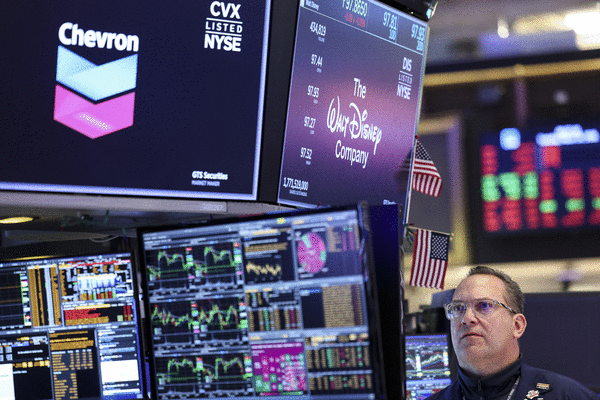
Give credit where it’s due. Despite all the setbacks, Donald Trump is right that the U.S.-Israeli war in Iran war hasn’t triggered the oil price super-spike many feared — at least not yet. “I thought it would be worse, much worse,” the American president said last week, and it’s hard to disagree. Trump, wearing his social media poster-in-chief hat, is a key reason why crude isn’t much higher. Call it the art of oil-market jawboning.
The White House is, so far, winning the fight over the oil market’s narrative — periodically raising the prospect of an end to the conflict even as the bombing carries on unabated. Three and a half weeks into the war, prices remain well within historical ranges, and far away from the thresholds associated with a full-blown “energy crisis.” But verbal volleys don’t keep refineries running, no matter how well timed. Jawboning will soon lose its potency in a longer war.
Since the U.S. attacked Iran on Feb. 28, Tehran has tried to impose an intolerable economic cost on Trump by shutting the Strait of Hormuz, a critical transit point for crude oil, and attacking energy infrastructure across the Persian Gulf. The U.S. has responded by tapping its own Strategic Petroleum Reserve and easing oil sanctions on Russia and Iran. But the most successful tool has been Trump’s interventions via his own Truth Social website.
It helps, of course, that the president has a history of flip-flopping. If markets believe that “Trump always chickens out,” it’s because he has done so many times before. TACO is a lesson Wall Street learned the hard way in 2025 when he regularly announced punitive trade tariffs, only to backtrack later.
And this time the president doesn’t need to actually U-turn to get energy prices to drop and equity prices to jump; he only needs to convince traders that he may do so. Rather than being a sign of weakness, TACO is working in Trump’s favor. No one knows for certain when or if he’ll try to end the war, which has been enough to stop traders from pushing up the oil price.
The biggest nod to his accomplishment is Tehran’s launching of a social media counteroffensive, with senior officials denouncing Trump’s interventions as “jawboning.” The Islamic Republic isn’t wrong, but it’s happy to imitate.
“Fakenews is used to manipulate the financial and oil markets and escape the quagmire in which the U.S. and Israel are trapped,” Mohammad-Bagher Ghalibaf, a prominent Iranian leader, wrote on social media. Tehran knows lower oil prices lessen the incentive for Washington to end the bombing. “We’re aware of what is happening in the paper oil market,” Ghalibaf added.
This internet jawboning is part of a new development in modern conflict: warring nations trying to manipulate the oil market in their favor; one side increasing the economic cost of the conflict and the other one seeking to lower it to keep fighting. Both the U.S. and Japan went as far as considering intervening in the oil-futures market, to keep prices low. Those discussions leaked into the market, becoming another form of useful signaling.
Mike Wirth, chief executive officer of Chevron Corp., earlier this week told attendees at the CERAWeek energy conference in Houston that the level of physical disruption isn’t “fully priced in the oil futures curve.” It’s a view many others share.
Trump has been particularly effective at swaying the financial markets. Barring a couple of dicey days this month, the White House has managed to forestall energy-price panic by either promising action to keep the barrels flowing via Hormuz, or by suggesting the conflict would end soon. At best this is premature optimism, at worst it is Trump selling a lie. Either way it worked.
On March 3, with oil prices soaring, the president said that “if necessary, the United States Navy will begin escorting tankers.” Three weeks later, the convoys are nowhere to be seen. Yet the pronouncement did its job, sending crude prices lower and buying the U.S. time in the conflict’s first days.
When everyone realized Hormuz wouldn’t reopen until the war ended, Trump shifted. He stopped talking about the strait and started saying the combat was nearly over. On March 9, the war was “very complete, pretty much.” On March 20, with the conflict still raging, he had a new message: “We are getting very close to meeting our objectives as we consider winding down our great Military efforts in the Middle East.”
Last weekend we had his 48-hour deadline for Tehran to reopen the Strait of Hormuz or have its domestic power infrastructure bombed. Early on Monday, before most financial markets opened, we had his ultimate jawboning message: Peace may be coming in talks with the Iranians. “They’re talking to us, and they are talking sense,” the president said later. Iran has not confirmed the talks, although it acknowledged messages had been exchanged. Several countries are trying to mediate.
Trump is almost certainly using Truth Social to secure time to finish a job that looks ever harder as the Iranian regime hunkers down. But back in the real world we are losing at least 10 million barrels a day of crude and refined products from global supplies because of the conflict. Sooner or later, the president’s posts will stop working.
When the war started, the White House suggested it was planning for a four- or five-week conflict. If there is no deal, the fighting will enter its fifth week on Saturday. Go beyond that, and markets will be much less persuadable.
Physical oil shortages, already evident in Asia, will spread to Europe and America’s west coast without a ceasefire. Based on my conversations with industry executives and government officials, the U.S. understands that the next two weeks will make or break the physical crude market. If the White House knows, it means the Iranians know too. Jawboning might move markets. It won’t do much when the actual black stuff starts to run dry.
____
This column reflects the personal views of the author and does not necessarily reflect the opinion of the editorial board or Bloomberg LP and its owners.
Javier Blas is a Bloomberg Opinion columnist covering energy and commodities. He is coauthor of “The World for Sale: Money, Power and the Traders Who Barter the Earth’s Resources.”
©2026 Bloomberg L.P. Visit bloomberg.com/opinion. Distributed by Tribune Content Agency, LLC.








Comments