CT dairy farmers say the once-thriving industry is now unsustainable. Here's their plan to save it
Published in Business News
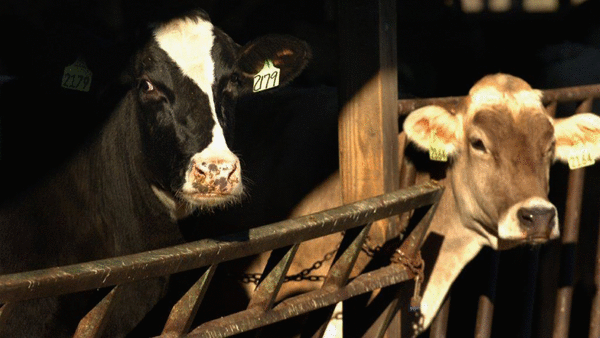
Brandon Smith, a fourth-generation Connecticut dairy farmer, said that he doesn’t want to see the state’s dairy industry disappear, but that without the state’s intervention, the industry is no longer sustainable.
Smith, who works beside his family members at Cushman Farms in Franklin, said that dairy farming is in his DNA. His great-grandfather started the dairy farm back in 1938. In the heyday of the state’s dairy farming industry — the 1950s and ’60s — Connecticut had nearly 1,000 dairy farms. By 1975, Connecticut had 817 dairy farms, but by 2018, the number had fallen to just 100, according to data.
Now, there are just 80 dairy farms left in Connecticut, down from just a few years prior, according to U.S. Department of Agriculture data.
“When I was a kid, I would tell my mom that I didn’t need to go to school because I wanted to work on the farm,” Smith said. “I knew from a very young age I wanted to be a dairy farmer, just like my dad and my grandpa. It runs in our blood.”
But, he said, over the last few years, the industry has become unsustainable in Connecticut as dairy farms continue to close.
“It’s basically a break even industry now, you’re not making any money,” he said. “It’s never been a get-rich industry, but you could make it work to turn a profit. Now it’s nearly impossible to have a good year. Right now, we’re getting the same milk price we were getting in 1995. Obviously with inflation, the prices aren’t the same going out. Our farm this year right now is looking at a $1 million loss.”
Dairy farmers face several challenges, including low milk prices set by the federal government coupled with high operating costs. Farmers struggle to cover production costs, and dwindling state subsidies haven’t been sufficient to keep many businesses afloat, according to officials. Extreme weather events such as flooding are also a continuous threat to farmers
Global milk prices have crashed, driven by a massive oversupply, causing prices to plummet below production costs and threatening many small-to-mid-sized dairy farms. The average price of a gallon of milk in the U.S. is now around $3.43, according to the U.S. Bureau of Labor Statistics.
Smith is now part of a dairy coalition called “Very Alive” along with dairy farmers across the state, advocating for the preservation of the state’s dairy farm industry. He said that for the industry to survive the next few years, the state needs to step up and get involved. He said if nothing happens, Connecticut dairy farmers are anticipated to lose $20 million this year.
The dairy coalition is calling for both short-term relief and long-term tax structure changes to help save the industry. Dairy farmers say they want the state to increase dairy funding with an agriculture sustainability line item of $20 million. That money would immediately be injected into the industry to help farmers in the short term.
Dairy farmers are paid based on the hundredweight, or cwt, which represents 100 pounds of milk — roughly 11.6 gallons. As of early 2026, U.S. all-milk prices are averaging around $18.74 per cwt, though production costs can exceed $23 per cwt for smaller farms. In many states, including Massachusetts, farmers earn a tax credit to ensure that they are not bleeding costs because of low milk prices, essentially keeping cost of production and profits relatively even.
“Massachusetts has had a tax credit in place since the early 2000s and they have thrived on that,” Smith said. “So their tax credit is about $8 million and that brings their payment up another $4 in change per hundredweight. That allows the farmers to not have to bleed profits because of the low value of milk.”
Despite the industry’s decline over the last five decades, dairy producers still have a significant impact on Connecticut’s economy. Dairy farms contribute over $2 billion annually in revenue for the state, according to data. The state has 18,500 milking cows producing the equivalent of two million glasses of milk every day, according to the Connecticut Department of Agriculture. Dairy farms can be found throughout the entire state, with several located in the more rural northwest and northeast corners. The largest dairy farm in the state is Oakridge Dairy in Ellington, which has 2,600 milking cows, officials said.
Seth Balher, CEO at Oakridge Dairy, said that while an initial $20 million would bring short-term relief to farmers, he said a tax credit would be the long-term fix. He hopes that the state legislature passes a refundable long-term dairy tax credit that would activate when milk prices fall below a trigger price. He said that would ensure the industry remains buoyant for years to come despite uncertain price fluctuations.
“The milk price from January 2025 to January 2026 has decreased significantly. We are down $6.24 per hundredweight of milk, that’s $499,000 less than we were making a year ago, but our costs haven’t gone down,” Balher said. “It’s a world market with prices set federally because milk is considered a commodity, but we’re trying to survive locally. If communities still want dairy, which we believe they do, then we need a stimulus for the industry.”
Balher said that many states including Maine and Massachusetts have programs in place to help dairy farmers including tax credits. He said other states like New York have more infrastructure in place to support dairy farmers. Land and resources are cheaper in New York and even feed like hay is far more abundant there. He said on average, New York dairy farmers pay $6 less per hundredweight than Connecticut dairy farmers.
“The reality is that Connecticut presents some real challenges for dairy farmers, yet we know there is great demand for dairy here,” Balher said. “The money we’re asking for is not going directly in our pockets. It’s a stimulus for the entire agricultural economy. Dairy farms generates $126 million in economic impact, create 816 jobs and pay roughly $17.4 million in taxes yearly. The industry contributes greatly to the state’s economy. A stimulus would ensure that those jobs remain here. But if we don’t get help, you will see many farmers begin to leave the state.”
The bill in the general assembly called “An Act Establishing A Tax Credit For Dairy Farmers,” proposes a $20 million aggregate tax credit to support local dairy farmers against cyclical milk price downturns. The bill was introduced by state Sen. Stephen Harding, R-Brookfield, earlier in February and has been referred to the finance committee, according to the Connecticut General Assembly bill tracker.
Separately, a new 20% refundable investment tax credit for qualifying farm equipment and machinery was signed into law last year.
“So far, we have gotten a good amount of support in the legislature,” Balher said. “We’ve heard from many legislators that they will support the bill, so we are optimistic that the state will take action this session. Our dairy farms depend on it.”
©2026 Hartford Courant. Visit at courant.com. Distributed by Tribune Content Agency, LLC.








Comments