Detroit automakers face these potential problems if Iran war drags on
Published in Business News
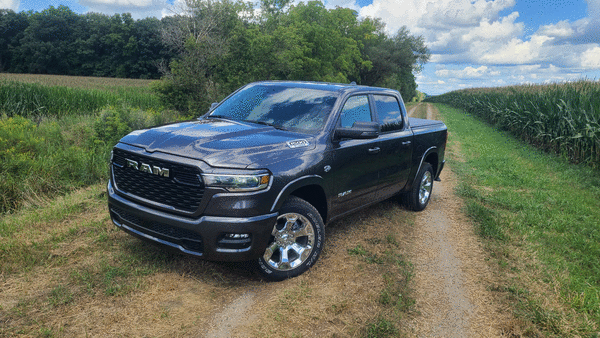
A drawn-out war with Iran that pushes oil prices higher for longer could dampen U.S. car sales and especially ding the Detroit Three automakers because of their heavy reliance on gas-guzzling trucks and SUVs, experts said.
“There’s a potential for a very large impact,” said Michael Greiner, associate professor of management at Oakland University. “If people are spending more money on gas, that’s less money to spend on other things. As a result of that, that would mean people would be less likely to buy a new vehicle, potentially affecting demand for vehicles from the Big Three.”
The U.S.-Israeli attacks on Iran have limited the amount of oil exported from the Persian Gulf region in recent days — about 20% of the world’s oil supply runs through the Strait of Hormuz — and that's already affecting crude prices worldwide and gas prices in the United States.
More: Oil prices steady after report of possible U.S.-Iran talks
The average price for a gallon of regular stood at about $3.10 on Tuesday, up 10 cents from Monday and more than 20 cents higher than a month ago, according to AAA - The Auto Club Group.
Yet the war in Iran would probably need to push past the three or four-month mark for automakers including Ford Motor Co., General Motors Co. and Stellantis NV to feel a significant impact, said Dan Ives, an analyst at investment firm Wedbush Securities Inc.
"The biggest risk is oil prices go much higher, it puts a dent in (vehicle) demand, the supply chain shock continues, and if it continues for months and months, that that is an overhang for the Detroit automakers, as well as consumer confidence," Ives said.
More: Oil prices keep climbing amid Iran conflict; Brent hits 19-month high
Still, he views that scenario as somewhat of a stretch barring a "very prolonged conflict" that translates into much higher oil prices — and therefore gas prices — for an extended period.
"There's consumer confidence and jitters," Ives said. "But I think overall, ironically, this should impact Detroit less than tariffs."
Facing possible exposure
If the conflict does drag on, Detroit's automakers would be especially exposed to higher gas prices and may lose sales to more-efficient models from competitors like Honda Motor Co., Hyundai Motor Co. and Toyota Motor Corp., said Sam Abuelsamid, vice president of market research at Telemetry.
A newly released U.S. Environmental Protection Agency report on average real-world fuel economy shows Ford, GM and Stellantis consistently ranked at the bottom in recent years. And all three companies are focused on churning out even more of their profitable big gas-powered trucks and SUVs, and fewer electric vehicles, amid loosening fuel economy and emissions regulations under the Trump administration.
How past oil shocks changed automakers, consumers
The Detroit Three have found themselves flat-footed before when oil prices shot up.
When gas prices surged above $4 a gallon in 2008, Americans drove less and shunned big new trucks and SUVs, with Asian manufacturers with smaller and more fuel-efficient offerings helping to pick up the slack. A similar shift toward more fuel-efficient foreign offerings from newcomers Toyota, Honda and Nissan came decades earlier, in the wake of oil shocks in the 1970s that had sent U.S. gas prices skyrocketing.
Abuelsamid said Michigan's manufacturers will already be thinking through production changes they may need to make in the coming months in order to respond — including possibly ramping back up EV or hybrid production. Asian competitors with broad fuel-efficient offerings wouldn't need to make major shifts. Toyota's full U.S. lineup is either electric or has hybrid options except for a single model, for example.
GM may be best positioned of the three, Abuelsamid said, given it has the widest range of electric offerings, including some affordable ones. Stellantis, on the other hand, would struggle if gas prices shot up for months on end.
"Stellantis is kind of in the worst place, because in the last 12 months they made the strategic decision that with Trump in power, we're going to just put Hemis and Hellcats in everything we can," Abuelsamid said, referring to the company's beefy V-8 engines. "But with gas prices, that puts them in a bad position."
Middle East impacts
GM spokesperson Kevin Kelly said employee safety in the region around Iran is the top priority, but didn't have anything further to add about the conflict. Regarding the impact of higher oil prices, he said it's too early to speculate on a response, though the company noted it has about a dozen EVs in the market.
Ford spokesperson Dave Tovar said the company was watching the situation but had no additional details.
Stellantis also emphasized the safety of its employees and their families in the Middle East. Company spokesperson Jodi Tinson said it hasn't been possible yet "to fully assess the potential impact on local operations," adding that it had not felt any "significant impact to Stellantis’ operations outside the Middle East."
Industry forecasters were already predicting lower U.S. vehicle sales in 2026 because of the end of the federal plug-in vehicle tax credit and widespread affordability challenges. Additional disruption from the Iranian conflict could cause an oversupply of inventory, declining prices and cost cuts — even layoffs, said Greiner, the Oakland professor.
“It doesn’t take that much of a shift in demand to find themselves in a tough spot,” Greiner said. “Automotive can’t pivot as quickly the way some other industries can.”
Experts said Detroit Three executives won't be overly worried about their Middle Eastern sales taking a hit amid the intensifying conflict that has also drawn in surrounding countries, including the United Arab Emirates, Qatar, Kuwait, Bahrain, Oman, Saudi Arabia, Lebanon and others.
All three automakers had a fairly small slice of the 1.8 million total regional auto sales in 2024, with GM selling about 62,000, Stellantis 50,000 and Ford 70,000 that year.
And in Iran, Ford and GM haven't sold cars for years due to sanctions, Abuelsamid said. Stellantis sold about 14,000 Peugeots there last year. Most of the country's new car market is made up of a handful of Iranian companies and several Chinese brands, including Chery Automobile and Great Wall Motor.
©2026 www.detroitnews.com. Visit at detroitnews.com. Distributed by Tribune Content Agency, LLC.








Comments