Musk's xAI reports wider quarterly loss, plans to power Optimus
Published in Business News
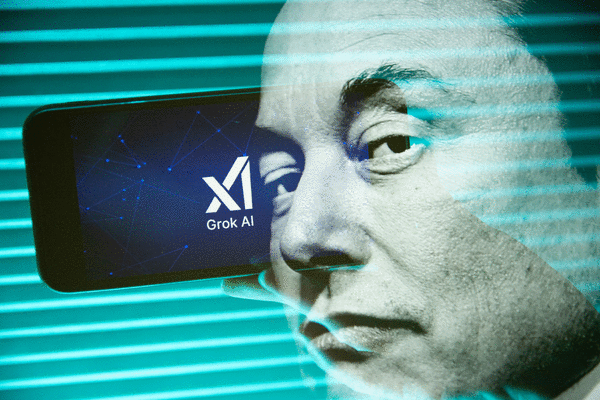
Elon Musk’s artificial intelligence startup xAI is burning cash quickly, with losses mounting as it spends to build data centers, recruit talent and develop software that will eventually power humanoid robots, according to internal documents.
XAI reported a net loss of $1.46 billion for the September quarter, up from $1 billion in the first quarter, the documents reviewed by Bloomberg show. In the first nine months of the year, it spent $7.8 billion in cash.
Like other fast-growing AI startups, xAI is quickly using what it raised in recent funding rounds, it said in its most recent earnings report and a call that xAI executives held with investors, according to people familiar with the matter. The company told investors that its goal is to build AI that is self-sufficient and that will eventually power humanoid robots like Optimus — Tesla Inc.’s robot that was created to replace human labor.
On the investor call, xAI leadership, including Chief Revenue Officer Jon Shulkin, told investors that now xAI’s core focus is building out AI agents and other software at speed, said the people, who asked not to be identified discussing private conversations. Those products will feed into what’s called “Macrohard” — a term Musk has said refers to an AI-only software company, the name a play on “Microsoft” — until it eventually can power Optimus.
The firm’s executives signaled to investors that xAI had the necessary resources to continue spending aggressively. Documents referred to the rapid growth of AI as “escape velocity” — a term borrowed from astrodynamics and often used by Musk to talk about how quickly his companies, including Space Exploration Technologies, can grow.
XAI revenue nearly doubled quarter-over-quarter to $107 million for the three month period ended Sept. 30, 2025, according to financial documents shared with investors and reviewed by Bloomberg.
A representative for xAI declined to comment.
While Musk runs several separate businesses and projects, he frequently intertwines their purposes and resources. Grok, xAI’s chat bot, has been fully integrated into X, the social network formerly known as Twitter, and is also available in Tesla vehicles. SpaceX, Musk’s rocket company, has already invested in xAI, which in turn has spent hundreds of millions on Tesla Megapack batteries.
While Musk has talked about the potential benefits of formally linking xAI and Tesla, the automaker is not currently an xAI investor. Tesla shareholders voted in November on whether the company should invest in xAI — an idea Musk has supported — but the non-binding proposal did not receive enough votes to pass. Tesla’s board is considering next steps, General Counsel Brandon Ehrhart said at the time.
For now, xAI Holdings, the parent company of both xAI and X, is focused on raising money to keep up with its large expenses. It recently closed a $20 billion equity round from investors, including Nvidia Corp., Valor Equity Partners and the Qatar Investment Authority, which valued the company at $230 billion. That cash will presumably power the company for the next year or more, as it is still spending under $1 billion per month on investments, according to people familiar with the firm’s finances. XAI used almost $8 billion in cash on investments through the first nine months of 2025, financial documents show.
XAI has been raising both equity and debt. The firm has worked with Valor and Apollo Global Management on a special purpose vehicle to buy Nvidia Corp. chips, and it expects to do more deals soon to keep building out its Colossus data center site in Memphis, Tennessee. The firm is already planning an expansion of the Memphis complex, and recently purchased a third building in the area that will bring the company’s computing capacity to almost 2 gigawatts, Musk said late last year.
The xAI call with investors offered a chance to hear from newly-appointed leadership at the company. Anthony Armstrong, a former Morgan Stanley banker, joined xAI and X as chief financial officer in the fall, while Shulkin, a partner at Valor Equity, also took a new role at xAI late last year, people familiar with the company said. Armstrong and Shulkin did not immediately respond to requests for comment. Mike Liberatore, xAI’s prior CFO, resigned from the firm last fall after just three months.
On the investor call, xAI executives were optimistic about the firm’s results, highlighting the revenue growth. Still, it may not meet its annual goal. In June, the firm told investors it hoped for $500 million in revenue for the year. Through September, xAI reported over $200 million in sales. The company’s gross profit has increased, though, and xAI reported $63 million in gross profit during the third quarter, up from just $14 million in the prior quarter, the documents show.
Despite this, xAI’s losses continue to grow. Ebitda — earnings before interest, taxes, depreciation and amortization — were negative. The company reported an ebitda loss of $2.4 billion through September, indicating its earnings have yet to make up for its expenses. That’s not uncommon for startups, which often require a lot of cash to grow and take time to turn a profit. Still, xAI’s losses were more than initially expected; the firm previously projected an ebitda loss of $2.2 billion for the full year, Bloomberg previously reported.
XAI has not yet disclosed to investors the end-of-year results, which executives said had been positive.
XAI has raised at least $40 billion in equity to date, including the latest $20 billion round that the firm announced earlier this month. The company paid almost $160 million in stock-based compensation through September, a reflection of the AI talent wars heating up.
(With assistance from Ed Ludlow and Denise Wee.)
©2026 Bloomberg L.P. Visit bloomberg.com. Distributed by Tribune Content Agency, LLC.









Comments