Trump lawyer urges appeals court to toss hush-money case
Published in Political News
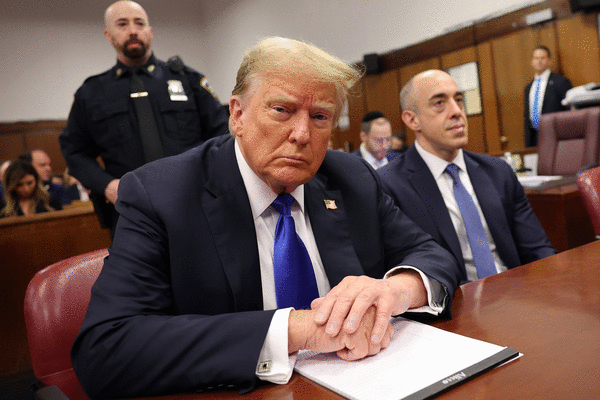
NEW YORK — Judges hearing an appeal of Donald Trump’s criminal conviction for concealing a hush-money payment to a porn star focused on whether prosecutors properly applied campaign-finance law to his conduct.
Trump attorney Robert Giuffra Jr. argued to a five-judge panel Thursday that prosecutors improperly elevated a false-business records case from a misdemeanor to a felony by applying federal campaign-finance law at his trial in New York state court.
The president is appealing a May 2024 verdict that found him guilty of concealing a hush-money payment to an adult film star ahead of the 2016 election. Fresh off an election Tuesday that dealt Republicans widespread losses as a rebuke of Trump’s policies, the president is on the offensive again.
The case centered on a $130,000 payment that Trump ordered to be paid to Stormy Daniels, which prosecutors said was an effort to boost his chances in the 2016 election. A Manhattan jury found Trump guilty of 34 felony counts to hide the payments to Daniels, who claimed to have had a sexual encounter with Trump.
Giuffra argued that no state prosecutor had ever brought a Federal Elections Campaign Act case against a presidential candidate.
“There are certain things that relate to presidential elections that are squarely within the authority of the district attorney, but a FECA violation clearly is not,” Giuffra said. That is “the ultimate problem with this case and why it never should have been brought.”
Judges also quizzed prosecutors about whether they should have used evidence that Trump argues was covered by presidential immunity. The legal doctrine, that a president can’t be prosecuted for official actions while in office, was established by the U.S. Supreme Court in a July 2024 ruling that came out weeks after the verdict in the hush-money trial.
Judge Bahaati Pitt-Burke asked Giuffra if the panel should consider the Supreme Court’s decision on presidential immunity “a new constitutional rule.”
Giuffra said it was now the law of the land that must be followed.
“It’s clearly constitutional law now of the United States,” Giuffra said. “It needs to be followed. And this again, this is a state criminal prosecution of the president and the Supreme Court has made quite clear that we think it’s absolute in that context because of the difference between the separation of powers.”
Giuffra emphasized that the immunity issue transcends politics.
“This is President Trump,” he said. “It could be some other president down the road where you have a state using the statements to obtain a conviction.”
But prosecutor Steven Wu countered that the handful of tweets by Trump and testimony from presidential adviser Hope Hicks that were potentially covered by presidential immunity were “a drop in the bucket” compared to the other evidence presented to the jury.
“There was a mountain of evidence to support the defendant’s guilt,” Wu told the court. “This was a 5,000-page transcript trial. They object to four tweets.”
Pitt-Burke challenged Wu on whether the evidentiary problems raised by Trump’s team were actually minor.
“At what point does it stop being harmless error and become something else?” she asked.
Trump has also challenged whether the case should be heard in state or federal court. A federal judge ruled against the president three times — most recently in August — for trying to move the case to federal court, and there’s an appellate hearing set for later this month. That venue would put the case on a faster track to the U.S. Supreme Court, which would be Trump’s best chance to upend the convictions.
Giuffra is representing Trump in that appellate cases after Trump appointed his two trial attorneys to top posts at the Justice Department and on the federal bench.
©2026 Bloomberg L.P. Visit bloomberg.com. Distributed by Tribune Content Agency, LLC.


























Comments