Israel edges toward coalition talks even as Netanyahu cries foul
Published in Political News
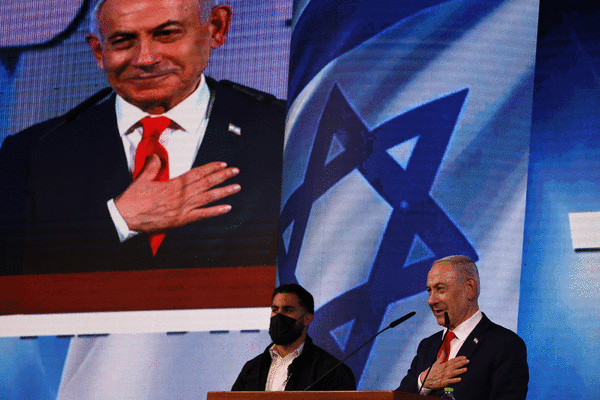
Israel paved the way for talks on a new government, certifying last week’s election results despite Prime Minister Benjamin Netanyahu’s continued claims about voting irregularities.
The results of the Oct. 27 ballot were presented by The Central Elections Committee to President Isaac Herzog on Wednesday. They put Netanyahu’s bloc ahead of that of his main challenger, Gadi Eisenkot, while leaving both short of a parliamentary majority needed to claim victory.
Herzog will within days give one of them a first crack at forming a ruling coalition. Neither has a clear path to power, and days or weeks of negotiations are expected to take place before an outcome is known. Netanyahu remains leader in a caretaker capacity.
Herzog said in a speech that in order to prevent another round of elections, political parties must understand that not every commitment and promise they made to voters can be fulfilled.
“I am not asking anyone to give up their core values,” said the president, who holds a more ceremonial position. “But in the current reality, in which there is no clear winner after the elections, I ask for originality and creativity, courage and goodwill.”
The lack of an outright winner puts Israel’s global standing in limbo. U.S. President Donald Trump, who went to war with Iran in partnership with Netanyahu, had urged Israelis to reelect the veteran incumbent, though his Republican party’s landslide defeat in Tuesday’s midterm elections may further isolate the Israeli leader. Other Western powers view the outgoing Netanyahu government’s hardline policies against Palestinians as deserving of sanctions.
Eisenkot, a centrist ex-general whose camp commands 48 of the 120 seats in Israel’s parliament, known as the Knesset, could bridge the gap by allying with two Arab parties that got a combined 19 seats. Netanyahu’s conservative Likud party has cast that prospect as a treacherous pact with pro-Palestinian politicians that amounts to a security threat — and has played up an investigation into allegations that foreign funds were behind the unusually high turnout of Arab voters.
The Central Elections Committee on Wednesday said that after a review of all complaints it found “no evidence of irregularities” affecting the ballot.
Likud accused Attorney-General Gali Baharav-Miara of hindering a probe by the Shin Bet security service into the alleged voter fraud. She has long been a thorn in Netanyahu’s side due to her public opposition to some of his governance moves.
Baharav-Miara said the Shin Bet had failed to provide a joint investigative team with its recent findings. “In a country with the rule of law, citizens or elected officials cannot be investigated without evidence to warrant it,” she said in a statement.
The Shin Bet declined to comment. The Arab parties deny wrongdoing and accuse Netanyahu of trying to discredit them. Arabs, many of whom identify as Palestinian, make up 21% of Israel’s population.
Israel’s patchwork of parties and alliances of various strengths makes for a complex path to power for either candidate. Eisenkot appears to have more support among those who stood for election than Netanyahu, with parties explicitly opposed to Israel’s longest serving leader representing 67 of the Knesset’s 120 seats.
However, Likud emerged as the biggest individual party with 27 seats. Netanyahu’s total bloc is 53 seats — just eight short of a majority — based on his ruling coalition during the four-year term that started in 2022.
But it’s not clear whether that endures: It includes one ultra-Orthodox Jewish party, a holder of seven seats, which is angered by Netanyahu’s failure to secure an ironclad guarantee of its constituents’ exemption from army conscription and hasn’t said it will back him.
Israeli Arabs are also exempt from the draft, which could pose an obstacle to Eisenkot entering a coalition with their politicians. The ex-general has been strident in his belief that all Israelis should see some sort of national service, even if not necessarily military.
The Arab parties have demurred on recognizing Israel as a Jewish state or describing Hamas as a terrorist organization, making it harder for Eisenkot’s bloc to agree to work with them. Eisenkot lost a son and two nephews fighting Hamas in the war in Gaza, triggered by the Iran-backed group’s attack on Israel in October 2023.
Should Trump opt to resume strikes against Iran, Eisenkot may be persuaded to form an emergency coalition with Netanyahu, according to Avigdor Liberman, whose rightist opposition party won seven seats in the election.
“In such a situation, there would be a great deal of pressure to form a unity government,” he told reporters on Monday. “It could be from Trump, it could be from President Herzog, it could be from the grassroots.”
Liberman confirmed his pre-election position that his party would not join a Netanyahu-led coalition in any eventuality.
If the candidate chosen by Herzog fails to form a government within the allotted six-week period, the task will likely fall to his rival along a similar timeline. If he also fails, Israel will be forced to hold another election within months.
—With assistance from Alisa Odenheimer.
©2026 Bloomberg L.P. Visit bloomberg.com. Distributed by Tribune Content Agency, LLC.































Comments