Rep. David Valadao talks Trump, immigration -- and challenger Randy Villegas
Published in Political News
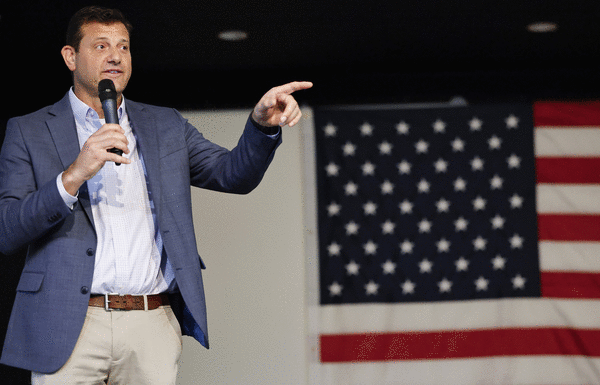
SACRAMENTO, Calif. — U.S. Rep. David Valadao, R-Hanford, is once again facing a competitive reelection campaign for his seat in Congress.
Valadao, 49, has won six of the past seven elections in California’s 22nd Congressional District, overcoming a Democratic registration advantage in the Central Valley. The district, which spans the southern San Joaquin Valley, is home to the state’s most competitive congressional race.
This year, Valadao faces progressive challenger Randy Villegas, a Democratic populist endorsed by U.S. Sen. Bernie Sanders, I-Vt., and Rep. Alexandria Ocasio-Cortez, D-N.Y. Villegas has focused his campaign on working-class voters while criticizing Valadao for accepting corporate donations and casting a pivotal vote for H.R. 1, a federal bill that is projected to leave millions of Americans without healthcare.
Valadao has fired back by labeling Villegas a socialist whose policies and values are out of step with the district. The congressman has also emphasized his moderate streak and background as a local dairy farmer.
“I’m the candidate that will reach across the aisle, and they’ve got a candidate on their side that only goes to one side and is very focused on burying deep into very partisan politics and not reaching across, and I don’t think that’s going to be a winning topic for this cycle,” Valadao told The Sacramento Bee.
In an interview with The Bee last month, Valadao defended his vote on H.R. 1 and discussed his November election against Villegas. The interview, which also covered immigration enforcement, the Iran war and President Donald Trump, has been edited for length and clarity.
Question: A lot of the criticism you’ve gotten over the last year stems from your vote on H.R. 1 (One Big Beautiful Bill Act), specifically the cuts it will have on healthcare. At 64%, your district has the highest Medicaid enrollment rate of any Republican in the country. Some estimates say that up to 57,000 people in your district could lose healthcare coverage when the requirements go into effect. Given all this, can you explain your reasoning for your vote on H.R. 1?
Answer: So H.R. 1 was a tax bill. As far as the healthcare component of it, no one is actually being kicked off and there aren’t actual cuts. Everyone tries to refer to that and I get that. That’s the talking point from the other side. But the reality is, it is community engagement requirements. So people, who have the ability to work and have no dependents, no disabilities and are not senior citizens, they have the ability to either try to work, volunteer in their community, or go to school. And they will have the ability to keep their benefits. But the real reason behind all of this is the program was created to help people who needed it — obviously people with disabilities, people who aren’t able to go to work, people that are senior citizens and are minors. … The idea that someone who is physically able, physically healthy, with no dependents at home to care for, not making an effort that puts the program at risk for everyone. … You have to try to make your situation better. If you want to just sit on the couch and not make an effort for yourself — they’re going to make their own choices for themselves — but they have the ability to do so.
Q: One of your reasonings after you supported the bill was the Rural Health Transformation Project. California was supposed to receive about $230 million from that this year. Do you know how much money your district has gotten?
A: That did play a role in the decision. So that was $50 billion that will go out to the states and California. … I’m not sure off top my head how much the state has gotten or the district. … So there’s a lot of money that plays a role in this that doesn’t get brought up enough.
Q: There’s been a nationwide surge when it comes to arrest, detentions, deportations, including against people that don’t have criminal records and people following the legal pathway. Do you support the current administration’s approach to immigration?
A: When they campaigned, they talked about going after the folks that are here to do us harm — the criminal aliens. Obviously, under the Biden administration, you had a lot of folks that came across this border that we have no idea who they are. Some of them, we know for a fact that there were people with terrorist ties who were trying to come across the border and got across our border. Focusing on that is what I’ve always pushed the administration to do, and I continue to push the administration to do.
Q: Do you think they’ve gone too far with immigration enforcement?
A: In some cases, yes.
Q: Which cases in particular?
A: I’m not going to name cases because we have cases that we work with that we have to sign confidentiality agreements with them, and we work with them, and we work with the administration to try to resolve them in the way we’re supposed to. But you can’t talk about them publicly.
Q: Generally speaking, though, is it with people following the legal pathway, people without criminal records? Is that what you’re referring to?
A: The problem with this situation is that a lot of times the news reports information based off of what they’re hearing. We have access to information that the public does not, and a lot of times there are folks who are being touted in the public domain as if they have no criminal records, and you find later that they are wanted. I had one that murdered someone. I had cases where there was battery. I’ve had cases where people were overstaying visas. I mean, we’ve run across lots of different issues, and that’s the issue that we run into is what’s being publicly reported and what’s publicly available is different than what we’re seeing privately. And then once we find out this, talking to the family, figure out that there was more information out there that’s not out there.
Q: On Feb. 28, the U.S. launched Operation Epic Fury against Iran. The conflict is now in its seventh month, and both countries seem a bit far apart on how to end hostilities. Do you support President Trump’s decision to keep this war going on?
A: This war was going to happen regardless at some point. For over 50 years, they’ve been spending money. They’ve been sending resources to support terrorism around the world. This was going to happen at some point. Am I frustrated with this administration with the way they’ve gone about it? Yes. Was it going to happen at some point? Yes. They were actively trying to acquire a nuclear weapon. They’ve been sponsoring terrorists in many parts of the country and continue to do so in different parts of the region and even into our own country. It was going to happen, and so we need to get this over as quickly as possible and make sure that the Iranians never have access to a nuclear weapon.
Q: So you feel like it’s gone on too long?
A: It has gone on too long.
Q: Support of Israel in the U.S. among just the public has been decreasing in recent years. What forms of financial support to Israel do you consider appropriate going forward?
A: When we have the ability to work with them on technology that helps both countries, that’s something we’ve done and continue to do. When it comes to the specifics on the support we’ve been providing, that is usually for weapons systems that we help develop. We learn from that technology. We learn from that use, and it pretty much is always American-made or somehow spent in the U.S. Every one of those dollars is spent with U.S. manufacturers, so that it actually helps us here on that front as well.
Q: You’ve won six out of the last seven elections, despite the higher Democratic registration advantage. This year, a lot of the political experts seem to think the political winds are blowing more to Democrats, just given American frustration with the president and the party in power. There’s also the fact that Proposition 50 made your district a little more blue, and then the fact that some voters have cited frustration with your vote on H.R. 1. Given all these factors, how concerned are you about this November?
A: This district is not tougher than any I’ve ever run before. I’ve run in districts this tough in the past. This isn’t new. As far as what’s going on with political winds, the issue that we’re dealing with now is Republicans and Democrats are both disliked. So to act like one side is like more than the other is inaccurate. … I focus on a lot of different issues that help the Central Valley, and I think that’s what’s going to come to the forefront.
Q: Do you feel like (Randy Villegas) was a weaker candidate between him and Jasmeet Bains?
A: I think the Democrat Party, the fact that they spent as much money as they did beating him up to make sure he didn’t make it through the primary, is the exact reason why I think everyone saw that he was the weaker candidate.
Q: Do you have any concerns that, given your association with the Republican Party and President Trump, that voters might, in frustration, vote against you?
A: I’ve done a pretty good job over the years differentiating myself from the president and the party where I needed to, and taken on my own party. I mean, I’ve taken a lot of positions that have made people mad on both sides of the aisle. It’s who I am. I’m an independent person who thinks for myself and does what I need to do.
Q: Would you support President Trump coming out here to campaign for you?
A: I’ve never asked for anyone to come out to the district and campaign for me.
Q: Would you be OK if he did?
A: I never asked for anyone to come out to the district and campaign for me.
Q: Why do you think you’re the best choice for this district in comparison to (challenger Randy Villegas)?
A: Because I understand the issues across the board that affect this district, having someone who has no background on any of the issues that affect the majority of folks is bad politics for the district. You want someone that understands the economics of bringing businesses in, someone with a business background. You want to have someone that comes in, especially an agriculture district, someone that has an ag background that understands the importance of getting agriculture to work and function well. But also having someone who also knows how to reach across the aisle, someone that knows how to reach and talk to members on the Republican and Democrat side of the aisle. I’ve had some of my best legislation signed into law under Democrat presidents, and I also have some with Republican presidents. So it’s not uncommon, but it’s important to have someone that knows how to work on both sides of the aisle, not someone who’s a very partisan person. And this is what we’re seeing on the other side.
Q: Some of your critics have brought up your lack of in-person town halls over the last few years. I know you do hold virtual ones. Why haven’t you held an in-person town hall?
A: It’s more convenient. And when we polled the district, 90% of the people that responded said we like the tele-town halls because we have the opportunity to listen. We have the opportunity to ask questions. We don’t have to deal with the protesters. We don’t have to deal with the activists who get bussed in, and we actually get to have a conversation. … So, just by simply asking our constituents what they prefer, they support the way we’re doing it.
____
©2026 The Sacramento Bee. Visit at sacbee.com. Distributed by Tribune Content Agency, LLC.



















Comments