'Suspicious substances' target senators on anniversary of attack
Published in Political News
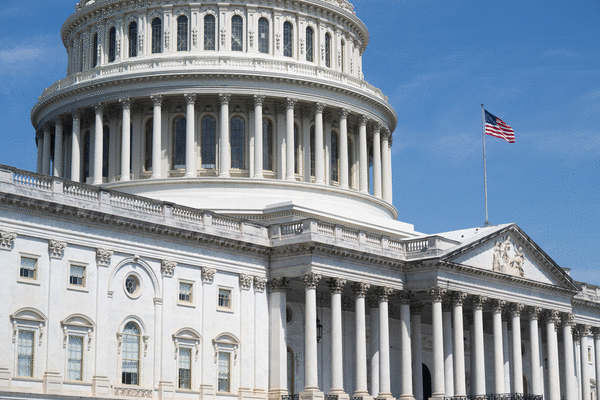
WASHINGTON — On the 25th anniversary of anthrax attacks that shook Capitol Hill in 2001, authorities are investigating “multiple letters containing suspicious substances that were mailed to various addresses nationwide, including multiple Congressional offices,” according to a notice from the Senate sergeant-at-arms.
“Law enforcement are working to intercept any additional letters before they are delivered, however, it is possible that some letters may reach their destinations,” says the notice sent to some Hill staff and obtained by CQ Roll Call.
A state office of Sen. Christopher Murphy, D-Conn., was the target of one of the letters, according to a statement from spokesman Josh Sorbe. Sorbe said the office was informed of the letter by federal law enforcement and is working with investigators.
“Due to those efforts and various safety protocols, the Senator and staff were not in immediate danger. Our office is grateful for the investigators involved in this incident, and we intend to continue close coordination as the investigation continues,” he said.
An office of Sen. Alex Padilla, D-Calif., was another target, according to a spokesperson, who said in an email, “We received the notification from the FBI that one of our offices was mailed a letter containing a suspicious substance, but it was intercepted by USPS.”
In a separate notice Thursday, the House sergeant-at-arms told staff on that side of the Capitol that “no House Members have been identified as intended recipients at this time” but “the SAA continues to monitor the situation and coordinate with law enforcement partners.”
Capitol Police directed requests for comments to the FBI.
“The FBI and U.S. Postal Inspection Service are investigating a series of suspicious mailings sent to various addresses nationwide, including Secretary of State offices and their related election offices,” an FBI spokesperson said in an emailed statement Thursday. “Some of the letters contained an unknown substance and we are working closely with our law enforcement partners to respond to each incident.”
“We are also working with our partners to identify the individual or individuals responsible for the letters,” the statement continued.
Representatives for the U.S. Attorney’s Office for D.C. and the Justice Department could not be immediately reached for comment Thursday.
Suspicious packages have targeted offices outside of Congress this week. On Tuesday, Louisiana Secretary of State Nancy Landry said her office had received a suspicious package with a white powder and evacuated a facility in Baton Rouge. The office was reopened Wednesday, Landry’s office said on X, after officials found there were no harmful substances in the package.
On Wednesday, Ohio Secretary of State Frank LaRose issued a statement saying his office had been targeted with a letter with a suspicious substance inside, but its delivery was intercepted by federal law enforcement.
“Election officials should never have to fear for their personal safety while performing their duties, and there is no place in a peaceful democracy for violence, threats or acts of intimidation,” LaRose’s statement said.
Details in one of the notices circulated on Capitol Hill warn that suspicious letters may have indicators like “discoloration; oily stains; unusual odor; powder emanating from envelope; excessive weight; postmarks that do not match the return address; excessive tape, string or other packaging materials; restrictive markings e.g. ‘confidential’ or ‘personal’; poor handwriting; incorrect titles or typos; titles with no names.”
Thursday marks the 25th anniversary of when letters containing anthrax were opened in the Hart Senate Office Building. An intern in then-Senate Majority Leader Tom Daschle’s office in 2001 opened a letter purportedly from a fourth-grade class, and white powder came spilling out.
That incident changed how mail is handled at the Capitol, where mail is now processed and screened offsite. In its notice to House staffers, the SAA said mail at district offices should be “received utilizing established safe mail handling procedures, including the use of SAA provided mail hoods.” House and Senate district and state offices can also arrange to have mail forwarded to D.C., where it is screened with “established Capitol complex mail screening procedures,” the notice states.
©2026 CQ-Roll Call, Inc., All Rights Reserved. Visit cqrollcall.com. Distributed by Tribune Content Agency, LLC.
















































Comments