Editorial: Voting by US mail will remain free and fair
Published in Political News
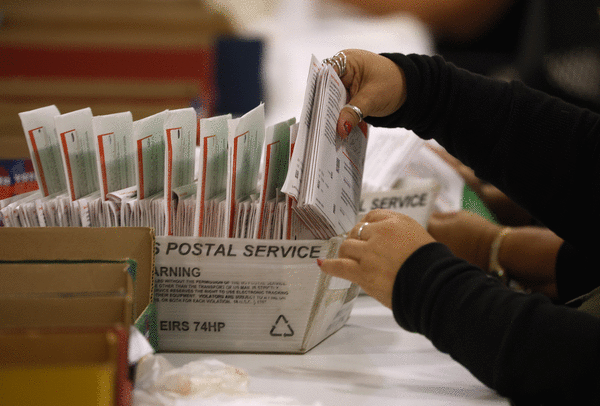
It took them a few tries, but a majority on the U.S. Supreme Court has now correctly ended President Donald Trump’s cynical and partisan effort to muck around with mail ballots during the fast coming midterm elections. The justices behind the ruling were anonymous except for Brett Kavanaugh, the only one brave enough to publicly oppose Trump.
Now Americans in every state and of every political persuasion this fall will be able to vote by mail, a secure, convenient and growing method that millions chose to exercise the franchise. And, no, despite Trump’s cries, postal voting is not subject to fraud and having non-citizens casting ballots illegally.
As for the defeated Trump, he lashed out, as is his wont, berating Kavanaugh and the two other justices he appointed, Neil Gorsuch and Amy Coney Barrett, posting: “These are not the people I interviewed to serve on the United States Supreme Court, they are merely a shell of their original selves,” adding in his earlier complaints about high court opinions on his illegal tariffs and his unconstitutional attempt to undermine birthright citizenship.
Then, recognizing the wrongness of his untoward broadside (but still feeling compelled to spout) he included: “It is not easy for me to write this criticism of the United States Supreme Court – it will likely cost me dearly for years to come – but I feel it my obligation and duty, as President, to do so for the America we love!”
Only the anything-for-Trump duo of Clarence Thomas and Sam Alito dissented by name, so the assumption is that Chief Justice John Roberts and the three liberals — Elena Kagan, Sonia Sotomayor and Ketanji Brown Jackson — were joined by Trump’s three appointees.
The fight was over new Postal Service rules directed by Trump for the handling of mail ballots. As promulgated last month, ballots must use envelopes with an election-mail logo that can to be scanned using high-speed processing equipment and contain a barcode unique to each voter. And each state must get their envelopes approved in advance by the Postal Service.
But, as Kavanaugh pointed out, there isn’t enough time, as some ballots have already been mailed to voters for this November’s contests.
Perhaps throwing Trump a bone (and maybe looking for some political cover) Kavanaugh wrote that “In my view, based on the briefing the Court has received at this interim stage, there is at least a fair prospect that the final rule falls within the Postal Service’s statutory authority.”
But the unnamed majority would have none of that and settled the matter, writing that “The Government is unlikely to succeed on the merits of its challenge to the District Court’s preliminary injunction. And the equitable factors applicable for obtaining emergency relief from this Court do not favor a stay.”
The happy outcome for citizens is that postal voting will continue as the states have set it up, without any interference from the White House, the Department for Homeland Security or the Post Office. That’s good for America and for democracy, even if Trump is disappointed that he can’t meddle in the process.
The court got this one right, allowing the people’s choices to be respected, even if the president doesn’t respect it.
_____
©2026 New York Daily News. Visit at nydailynews.com. Distributed by Tribune Content Agency, LLC.












































Comments