Editorial: After President Trump's prime-time speech, America has no better understanding of how we'll truly succeed in Iran
Published in Political News
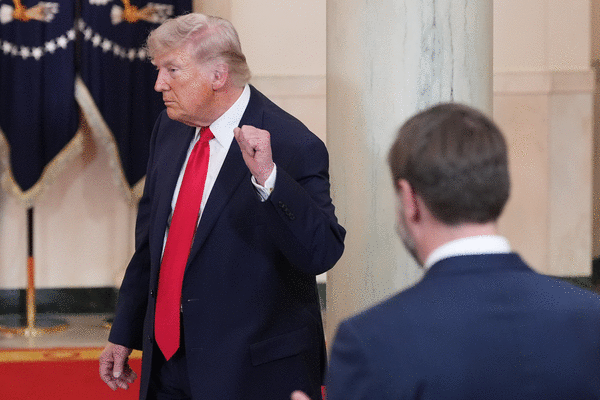
President Donald Trump gave his first prime-time address to the nation laying out his goals in the war on Iran more than a month into the conflict. Better late then never, we suppose.
Alas, we don’t have any clearer idea of how the president intends to achieve those goals than we did before the speech.
Will we allow Iran to keep its weapons-grade uranium once the fighting is over? Not clear. If that’s the result, he said, the U.S. will essentially stand on high alert for the foreseeable future, ready to attack if Iran is detected attempting to weaponize that uranium stash.
Are ground troops still an option? The president didn’t say one way or the other, although troops are now positioned in the region. Trump’s assertion, however, that the war would wrap up within two to three weeks would appear to count that option out. Then again, the president is capricious and that could change.
Will Trump adopt Putin-style tactics by destroying power plants or even desalination plants in what could amount to an attack on the beleaguered Iranian people themselves? Trump wasn’t clear there, either, even if he warned cartoonishly of bombing the nation of 90 million-plus “back to Stone Ages” if its leaders don’t agree to U.S. demands.
And will we continue to allow Iran to control access to the Strait of Hormuz, through which about 1 in 5 gallons of the world’s oil used to flow before Iran took control of the channel?
There, Trump was a bit more clear but hardly in a satisfactory way. That’s not our problem, he said. The U.S. produces more than enough oil to meet its own needs. Other countries — he didn’t name European members of NATO, but he didn’t have to — that rely more heavily on Mideast oil should just do the job themselves. No wonder these countries are exasperated.
We have no doubt that the U.S. military, along with its Israeli partners, has inflicted immense destruction on Iran’s formidable war infrastructure.
The world is a safer place when Iran is no longer able to threaten the Middle East, and beyond, with missiles nor imperil the world with its nascent nuclear bombs. Under the tyrannical ayatollahs, Iran has been a destabilizing force for decades, and a nuclear-armed Iran truly is an unacceptable outcome, as Trump said and presidents before him also have iterated. The president spent much of his confounding talk, little more than a collection of soundbites, really, on the glories of his limited accomplishments these past few weeks.
But the salient question of where do we go from here, the question most observant Americans are asking, went unanswered. What will be the state of affairs in the Middle East once Trump ends our campaign? What will have changed over the long haul? Can Trump articulate that? If so, we did not hear him do so on Wednesday night.
If this is too much to hope for from the president, then one of his inner circle had better step up, although we suspect that they are not sure from moment to moment where this improvisational president will go next, any more than are the rest of us.
In the short run, leaving the issue of access to the Strait of Hormuz to others, as Trump has at least articulated, should be a nonstarter. The understandings with Iran upon the cessation of hostilities, assuming there are some, must include safe and predictable transport through the strait for the world’s commerce.
As of now, more than 40 countries brought together by the United Kingdom are discussing how to reopen the strait through diplomatic means after the war is over. The U.S. notably isn’t part of that group. That’s ridiculous.
That disquieting development comes as Trump openly is musing about withdrawing the U.S. from NATO, the alliance that was key to one of this country’s greatest post-World War II foreign-policy achievements — the winning of the Cold War over the former Soviet Union. Trump is angry that NATO countries have refused to get involved in the Iran war, and indeed some of those reactions have been to say the least unhelpful (Spain’s refusal, for example, to allow the U.S. to use its air space).
But it’s unreasonable to expect other countries to participate in a war when they haven’t been meaningfully consulted. NATO is vital to the future security of Europe, and history has taught us that Europe’s battles inevitably draw in the U.S. Alienating our historic allies could well harm our future strategic and security interests.
Geopolitically, the world seems to be getting more unstable. The circumstances may be hard to predict, but this much is certain: At some point, we’re going to need more friends, not fewer. NATO must be preserved and, in the future, the trust between the allies must be strengthened.
We worried at the outset of this war that Trump didn’t really have a plan beyond the bombs in Iran. After Wednesday night’s speech, our concern only is amplified. Iran’s potential weaponizing of the Strait of Hormuz was only in the abstract then. Now we see it in practice, and feel it at the gas station.
The Iranian people, meantime, to all outward appearances are in no better a situation than they were before the bombs and missiles started flying. That’s unacceptable too, given the sacrifice of human life.
When next we hear a prime-time address from the president, we hope he has something more hopeful for the Middle East in general, and the suffering Iranian people in particular, to say.
___
©2026 Chicago Tribune. Visit at chicagotribune.com. Distributed by Tribune Content Agency, LLC.
















































Comments