Alaska Legislature on track to pass election reform bill after years of failed attempts
Published in Political News
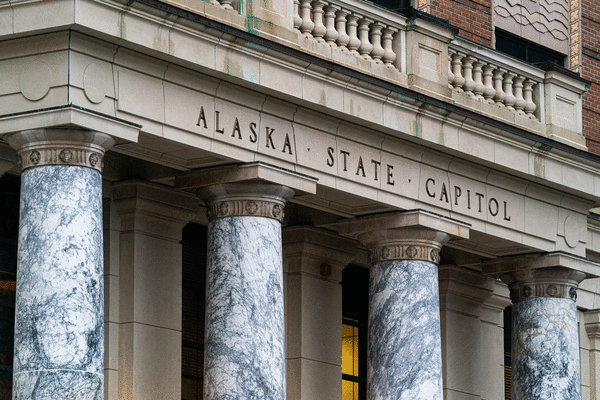
After a bipartisan vote in the House on Monday, the Alaska Legislature is poised to pass an omnibus election reform bill, a goal that has eluded lawmakers since 2022.
Alaska legislators have repeatedly sought to make substantial changes to the state's voting laws. Republicans have wanted to more easily remove inactive voters from the state's rolls. Democrats and independents want to make absentee voting easier and ensure that the state's rural, predominantly Alaska Native voters have equitable access to the polls.
Efforts to marry both parties' priorities failed in the final hours of the 2022 and 2024 legislative sessions.
An omnibus election reform bill crafted by Sen. Bill Wielechowski, an Anchorage Democrat, passed the Senate last year, but stalled in the House. Lawmakers promised to return to the effort this year.
The bill underwent several changes in House committees before it was brought to a floor vote on Monday. A marathon floor session on Monday concluded with a 23-16 vote, with three Republican minority members joining all present members of the bipartisan House majority to support the legislation.
"There is a lot that I fought for to get put in this bill, time and time again," said Rep. Sarah Vance, a Homer Republican who voted for the bill and called on other members of her caucus to join her. Rep. Kevin McCabe of Big Lake and Rep. Jeremy Bynum of Ketchikan were the only other minority members to vote for the bill.
Because it was changed in the House, the bill must still return to the Senate, where lawmakers will be asked whether they agree with the changes made, before it can be sent to the desk of Gov. Mike Dunleavy.
But Wielechowski already began celebrating the long-sought achievement of passing a bipartisan elections bill on Monday, before the Senate vote had been scheduled.
"We are raising the standard for elections in Alaska," Wielechowski said in a statement. "SB 64 makes it easier for eligible voters to participate and harder for errors or misconduct to undermine the process. This protects both access and the integrity of every vote."
The bill establishes a ballot curing process that allows voters to correct minor errors that might otherwise result in their ballots being rejected. It creates a ballot tracking system so voters can receive updates on their absentee ballots by phone or email, much as Anchorage voters are already able to do in municipal elections. It adds tribal IDs to the list of acceptable voter identification. It creates a rural community liaison within the Division of Elections to improve outreach and access in rural Alaska.
Those changes have been long called for by Alaska Native advocates, predominantly in rural communities, where the Division of Elections has repeatedly failed to provide equitable access to the polls.
In both the 2022 and the 2024 elections, polling places failed to open for the primary and general elections in several Western Alaska communities due to staffing and other issues. In the 2024 election, the Division of Elections sent the incorrect ballots to several communities in Southwest Alaska. In a special 2022 election conducted mostly by mail, thousands of ballots were rejected due to minor errors such as a missing signature. The rejected ballots were cast disproportionately in rural Western Alaska communities and in urban districts with a high share of voters for whom English is a second language.
The bipartisan elections bill also makes it easier to remove Alaska voters from the rolls. Alaska election officials had long said that existing laws don't allow them to easily remove voters who have moved from the state, leading to ever-growing voter rolls after the establishment of automatic voter registration through the Permanent Fund dividend application.
As part of negotiations to ensure bipartisan support for the bill, majority lawmakers agreed to remove a provision that would have entirely eliminated the witness signature requirement on absentee ballots. Witness signatures are meant to prevent voting misconduct, but the Alaska Division of Elections currently has no method of verifying the signatures, according to elections officials.
Former House Speaker Cathy Tilton, a Wasilla Republican who now serves in the Senate, said in 2024 that House Republicans were opposed to eliminating the witness signature requirement because they thought doing so would tilt election results in favor of Mary Peltola, a Democrat who ran unsuccessfully that year for U.S. House.
The 16 Republicans who voted against the bill in the House raised a series of concerns about it, as they proposed 10 amendments on the floor. None were adopted.
The bill is intended to take full effect ahead of this year's general election, posing challenges for the Alaska Division of Elections to implement it ahead of this year's primary and general election. Republican minority members also said that creating a rural voting liaison in the Division of Elections, meant to help address well-established disparities in voting access between voters on and off the road system, was unfair toward voters in urban parts of the state.
Dunleavy has yet to comment publicly on whether he would allow the bill to become law if it reaches his desk. Asked Tuesday, his spokesperson Jeff Turner declined to say whether the governor would allow the bill to become law as currently written.
The measure does not resolve several conflicts between Alaska's existing law and changes sought by Republicans at the federal level.
President Donald Trump has been calling for Congress to pass a law requiring voters to present proof of citizenship in order to vote, and requiring stricter forms of identification to be shown at the ballot box. Alaska's existing laws ban noncitizens from voting, but allow voters to register to vote without showing proof of citizenship.
The U.S. Supreme Court is currently considering a case challenging states' ability to receive and count absentee ballots after the day of the election, if they were postmarked by Election Day. The bill adopted by the Alaska House affirms the state's ability to count ballots received within 10 days of the election, as long as they were postmarked on or before the day of the election.
_____
© 2026 Anchorage Daily News. Visit www.adn.com. Distributed by Tribune Content Agency, LLC.




















































Comments