Commentary: Governing by breakdown -- The cost of congressional paralysis
Published in Political News
Picture a bridge with a clearly posted warning: without a routine maintenance fix, it will close. Engineers agree on the repair, but the construction crew in charge refuses to act. The problem is not that the fix is controversial or complex, but that making the repair might be seen as endorsing the bridge itself.
So, traffic keeps moving, the deadline approaches, and those responsible promise to revisit the issue “next year,” even as the risk of failure grows. The danger is that the bridge fails anyway, leaving everyone who depends on it to bear the cost of inaction.
This is precisely how Congress handled the impending expiration of the Affordable Care Act’s enhanced subsidies for millions of Americans in late 2025. The danger was clear, the consequences well understood, and yet GOP leadership allowed the policy cliff to approach simply because they could not—or would not—move their own caucus to act.
Paralysis as a governing condition
This paralysis reflects something deeper than ordinary partisan division. It points to a more troubling reality: one of America’s two major parties now struggles to govern at the most basic level.
House Republicans are not engaged in a substantive debate over health-care reform itself. Instead, they allowed a clear deadline to pass that will drive up premiums for millions because party leaders cannot control their caucus or accept even short-term responsibility for an existing law.
A leadership failure in plain sight
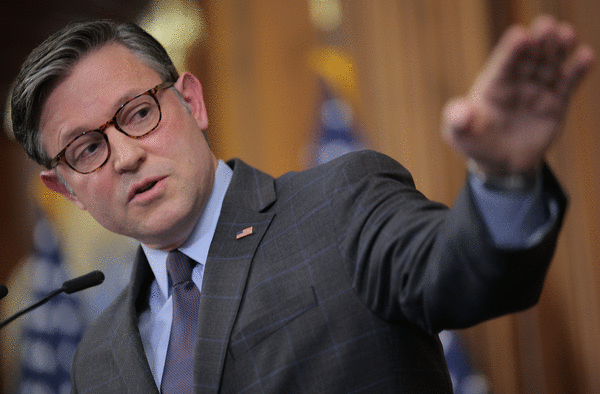
That failure marks a clear breakdown of leadership, where inaction flows directly from decisions made at the top. Speaker Mike Johnson refused to bring a clean extension of the ACA subsidies to the floor, despite a looming expiration date and consequences that were widely understood inside and outside Congress.
Instead of governing through regular order, Johnson attempted to block a vote entirely. The result was a procedural embarrassment: four moderate Republicans joined Democrats to force action through a discharge petition. It was an extraordinary step that signaled not bipartisan cooperation, but the collapse of party leadership and legislative control.
This was not a minor misstep or a tactical gamble. Leadership is the Speaker’s primary responsibility, and Johnson was elected by his party to exercise it. That role requires deciding when a vote must happen, managing internal dissent, and assembling a working majority even when the outcome is uncomfortable.
On the ACA subsidies, Johnson failed each of these tasks. With a clear deadline and well-documented consequences, he could neither marshal enough Republican votes to govern nor contain defections within his caucus. The result was not negotiation or strategy-driven delay, but a leadership vacuum at a moment when governing mattered most.
Power without responsibility
None of this should come as a surprise. Johnson emerged as Speaker only after weeks of chaos, when loyalty became more important than demonstrated governing skill. His elevation came only after President Donald Trump publicly signaled his approval.
In today’s Republican Party, real power does not flow from the Speaker’s gavel so much as from Trump’s favor. Johnson was chosen not because he could manage a fractured conference, but because he proved himself reliably compliant with Trump’s priorities and instincts. That compliance carries a cost.
A Speaker selected for loyalty rather than leverage is ill-equipped to confront his own caucus, especially when governing requires choices that cut against the party’s dominant political narrative. The ACA subsidy fight exposes the predictable result: a House leader constrained by deference to Trump, unable to lead independently, and presiding over a party that can obstruct almost anything but struggles to govern when the stakes are clear.
What this means for democracy
This episode illustrates a broader democratic risk. When Congress cannot pass even time-sensitive, widely understood legislation, it teaches voters a corrosive lesson: representation does not guarantee results.
Over time, this failure pushes power away from the legislature and toward executive action, judicial intervention, and procedural brinkmanship. Policy increasingly happens through emergencies and workarounds rather than deliberation and lawmaking. The ACA subsidies are not an isolated case; they are a warning sign of what governance looks like when paralysis becomes routine.
What comes next
What would it take to change this trajectory? Without corrective action, Congress risks locking in a model of non-governance in which foreseeable harm is accepted as routine and legislative authority steadily erodes.
The solutions are straightforward, even if the politics are not. House leadership must reassert the basic norms of governing, beginning with allowing votes on must-pass, time-sensitive legislation even when outcomes are politically inconvenient. Members of Congress, especially those in the majority, must treat preventing predictable harm as a governing obligation, not a concession. Lawmakers in both parties should resist the steady drift toward procedural shortcuts that mask leadership failure rather than resolve it.
More fundamentally, the Republican Party faces a choice it has deferred since the rise of Trump a decade ago: whether it intends to function as a governing party or merely as an oppositional movement organized around one dominant figure. As long as loyalty to Trump outweighs responsibility to the institution, paralysis will remain the norm.
The bridge will keep deteriorating, and Americans will keep paying the price for a Congress that sees the danger coming but cannot bring itself to act.
_____
Robert Cropf is a Professor of Political Science at Saint Louis University.
_____
©2026 The Fulcrum. Visit at thefulcrum.us. Distributed by Tribune Content Agency, LLC.













































Comments