Cracks emerge as members of Congress try to curb their own stock trading
Published in Political News
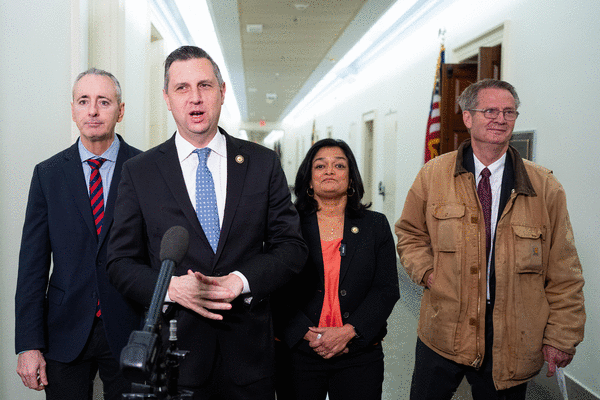
WASHINGTON — Lawmakers hoping to ban congressional stock trading are seeing fractures in their alliance as they try to bring the issue to the House floor next year before attention turns to the midterm elections.
Rep. Anna Paulina Luna, R-Fla., accused Democratic leaders of trying to derail consensus legislation hammered out by a bipartisan group earlier this year and teased a new plan from the Republican side.
“Hakeem Jeffries actively worked against the consensus bill … which is so crazy,” she said as she emerged from a Thursday afternoon meeting in the speaker’s office. “So we’re gonna get this done and get this through anyways, without his help.”
Majority Leader Steve Scalise, R-La., said the House Administration Committee would now work to advance legislation on the stock-trading issue in the new year, without providing details.
The meeting in the speaker’s office appeared to satisfy Luna, who has been a thorn in her own party leaders’ side as she wielded a tool known as a discharge petition, which allows members to force a floor vote on legislation, provided they can reach 218 signatures.
Her petition on the consensus bill has been slow to pick up steam, with just 74 signatures so far as of Thursday morning. But even as she touted commitments from Republican leadership to bring some kind of legislation to the floor, she stressed she would keep the pressure on.
“I’m not pulling my discharge,” she said.
Led by Reps. Chip Roy, R-Texas, and Seth Magaziner, D-R.I., the consensus bill unveiled this September would bar members of Congress and their families from owning stocks and impose penalties for violations. It was the product of weeks of discussions among a group of rank-and-file members and sought to find common ground that has proved elusive.
Supporters of a ban say it would restore trust in Congress by eliminating the appearance of insider trading, while opponents point out that insider trading is already illegal and argue that smaller revisions to a 2012 disclosure law, known as the STOCK Act, could be enough.
After emerging from the meeting in the speaker’s office Thursday, Roy said he was feeling good about pivoting to the new plan described by Republican leaders.
“I think we’ve got ourselves to a place where we’ve got general agreement that we’re moving in the right direction. They’re drafting language, and I feel like we’ll be able to move on it early next year,” he said.
“It’ll be good,” Luna said. “There’s gonna be some pieces of what we put together on the discharge, some pieces from the STOCK Act.”
Things were already looking rocky for the consensus legislation earlier this week, after Democratic leaders threw their weight not behind that bill, but behind a different one introduced Tuesday by Magaziner.
Minority Leader Hakeem Jeffries and other top-ranking Democrats have signed on to that new proposal, which would extend a stock-trading ban to the president and vice president as well. That would be a nonstarter for most Republicans, given President Donald Trump criticized a similar proposal in the Senate earlier this year.
Democrats plan to file a discharge petition on their new bill next year, Magaziner said. That would set up dueling discharge petitions, though Magaziner urged members to sign both.
“My position is that I support both bills,” he said Wednesday of the consensus bill and his latest offering. “I encourage all members to sign both petitions, and hopefully one of them gets over the finish line.”
After his Republican colleagues emerged from their meeting in the speaker’s office and teased their own new plan, Magaziner said, “It sounds like we’re going to find out more in January, and so we’ll see.”
“The issue of including the vice president and president is something that many Democratic members feel strongly about, and I don’t have an indication yet on how whatever bill Speaker Johnson is envisioning would handle that issue,” he added.
Whatever happens, he said, “anything that falls short of a ban on members owning and trading stocks will not be enough.”
“Now does that mean that I would vote against something that was a half measure or a half step in that direction? No, not necessarily,” Magaziner said. “I mean progress is progress, and so I’d consider voting for something that fell short of the goal, if it was still forward progress.”
_____
Valerie Yurk contributed to this report.
______
©2025 CQ-Roll Call, Inc., All Rights Reserved. Visit cqrollcall.com. Distributed by Tribune Content Agency, LLC.


















































Comments