SC agency chose not to protect rivers because of industry pressure, ex-official says
Published in Science & Technology News
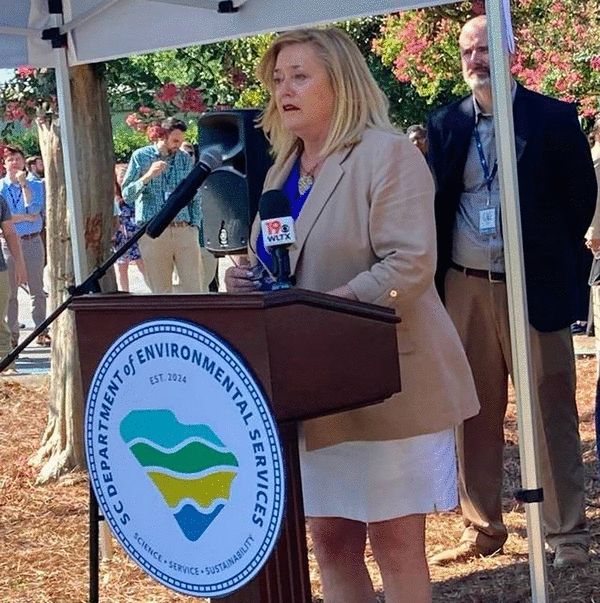
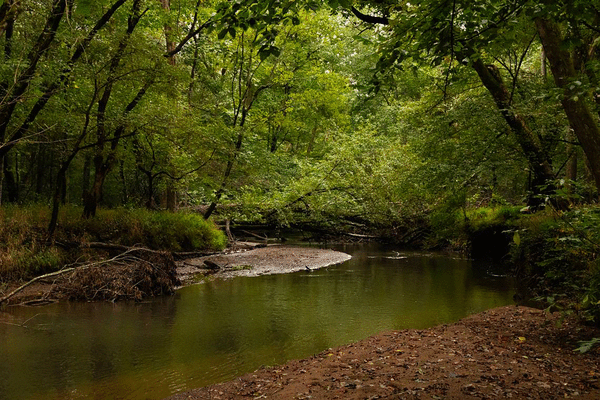


South Carolina’s environmental agency has known for years state that oversight of rivers is so weak that industrial-scale farms can suck rivers dry, but the department has done little to protect waterways from overuse because of political pressure, the department’s former water division chief says.
Mike Marcus, who retired as director of the Department of Health and Environmental Control’s water bureau in 2021, has written a report outlining flaws he says exist in the rules and how that allows big farms to siphon away water others may need.
His report is being used as evidence in a lawsuit by environmentalists against the agency that replaced DHEC, the S.C. Department of Environmental Services.
Documents filed as part of the lawsuit also include sworn testimony by an environmental services staffer supporting the Marcus report. The state rules allow rivers to be depleted of water for months, according to a deposition from DES staff member Leigh Anne Monroe.
No river in South Carolina is known to have been completely dried up because of a lack of oversight, but environmentalists say some waterways have been lowered in areas with large withdrawals — and the threat of losing all water in a river at some point is nothing to dismiss.
Both the Marcus report and Monroe’s testimony are the latest in a long-running effort by environmental groups to tighten rules that were approved years ago to protect rivers, but in fact, are riddled with loopholes that favor industrial scale-farming. Environmentalists say the state’s 2010 water withdrawal law isn’t strong enough, and the regulations that accompany it are even weaker.
Having an adequate amount of water in rivers helps protect fish and wildlife, provides recreational opportunities for boaters and allows others who need water to get their share.
In his report, dated Oct, 16, 2025, Marcus said DHEC/DES staff told upper level management about flaws in the water regulations, but high-level officials didn’t do anything about it.
“Internally, staff explained to management that the regulation, as written, would yield unintended outcomes’’ and would not protect rivers, Marcus wrote. “I was informed that such staff concerns were not considered to be important by management and that changes ... likely would not be supported by the various user groups who had authored much of the text.’’
Marcus, water bureau director from 2018 to 2021, went on to say in the report that “there were industry and political obstacles to approving a regulation’’ that better protected rivers.
The Marcus report did not name which members of upper-level management failed to act to improve the river protection rules. DHEC/DES has had six full-time directors, and several interim directors, since the Legislature passed South Carolina’s first surface water withdrawal law 16 years ago. The current director is Myra Reece, a longtime agency staff member. The agency also had one previous high-level water bureau employee with ties to industry.
Laura Renwick, a spokeswoman for the environmental department, did not directly address the criticism in the Marcus report, but said in an email that changing the regulations would “not result in significant improvement in the evaluation and decision-making process.’’
Renwick’s email also said the state is planning a comprehensive review of policy, rules and regulations affecting rivers, groundwater and drought.
An attempt to gain comment from the S.C. Farm Bureau, a powerful lobbying force for agriculture, was unsuccessful. The Farm Bureau supports a variety of agricultural interests, including mega farms that withdraw large amounts of water for irrigation. Tommy Lavender, a lawyer who often represents industry and was involved in talks about changing the regulations, had no immediate comment.
But others said the Marcus report is accurate. Lowcountry resident J.J. Jowers, who was involved in 2020 discussions on whether to improve the regulations, said it never seemed to him that DHEC wanted to tighten the rules.
“They look at you straight in your face and won’t talk to you — It’s obvious political pressure,’’ Jowers said. “I can’t blame them because, if they spoke out too much, they’d be gone.’’
Carl Brzorad, a lawyer with the Southern Environmental Law Center, said Dnvironmental Services should have done more because it’s obvious the state rules are inadequate and favor big agricultural interests over the general public's. He said it is significant that a former top level water official and a current staffer say the rules are inadequate.
The lawsuit says industry drafted the regulations and DHEC accepted that. The department ‘’took the industry’s version and just put it in the code of regulations,’’ Brzorad said. “It is a total blank check for industrial agriculture to take all the water out of rivers.’’
Brzorad said the department’s failure to consider changes to the regulations aren’t surprising. The department has failed in other cases to seek improvements in laws or regulations to protect the environment, including with the discharge of forever chemicals in rivers, limits on those chemicals in sludge, and the discharge of other pollutants into waterways, he said.
“We certainly see the agency bending over backwards to protect industrial polluters in other areas,’’ he said. “I don’t know if it’s an inability or an unwillingness to do what needs to be done to protect public health and the environment.’’
Because of concerns about the water regulations, the law center asked a court Monday to declare part of the rules in violation of the law and to prohibit Environmental Services from using the rules in examining large water withdrawals.
At issue are regulations that were supposed to provide detail on how to administer the 2010 water law.
The lawsuit Brzorad’s organization filed two years ago said the regulations do not follow the water withdrawal law. Regulations often accompany state laws to provide guidance on how the law should be administered.
The suit followed criticism in 2022 by the U.S. Environmental Protection Agency that South Carolina’s water law and regulations are not scientifically sound, do not protect fish and wildlife and could allow rivers to be dried up by excessive use during certain times of the year. The EPA said at the time that South Carolina’s rules are inconsistent with the federal Clean Water Act.
Questions about both the 2010 law and the regulations have come up regularly since the law passed. A major concern is over provisions that allow huge farms to take all the water they want without public notice or permits, both of which are required of industries that seek to withdraw water.
All the large farms need to do is to register the amount they want to take. State regulators must approve that as long as the withdrawals are within what’s known as “safe yield,’’ or the amount of water that can be withdrawn without hurting the environment.
The problem is that the safe yield formula is a mathematical calculation that doesn’t take into account seasonal differences in river levels, critics say. As a result, rivers could be dried up for as much as half a year by withdrawals, critics say. That would occur during the times of year when they are naturally the lowest, often in the summer and fall, critics say.
Monroe, the DES program manager of water quantity permitting, said in a deposition that the regulations do not mirror the law and do not protect rivers from being depleted.
Asked if the agency has failed to use a safe yield formula that adequately protects rivers, she said: “Yeah. I mean, that’s what it seems like to me at this point.’’
Already, the capacity of some rivers has been completely allocated to some entities or people, meaning others could not withdraw water — and the rivers could be dried up at certain times of the year if all the water were withdrawn, court records show.
Among them are streams in the Edisto River basin, a farming rich area about an hour’s drive west of Columbia. Monroe answered “yes’’ when asked in her deposition if her agency has authorized interests to “completely dewater” the Edisto River basin for more than half a year.
In addition to those concerns, excessive withdrawals could be a particular problem for streams, such as the Reedy in the Greenville area; the Black and Pee Dee rivers in eastern South Carolina; and the Tyger River near Spartanburg, court records show.
Questions about large farm withdrawals began to arise in 2013, when residents of Aiken and Barnwell counties learned that a massive potato farm was planning to open near the Edisto’s south fork.
The state did not issue a public notice about plans to withdraw billions of gallons of water by the farm and a permit was not required under the law since agricultural withdrawals are exempt. Many people were outraged that the farm was opening with little public input. People questioned whether the withdrawals would dry up the south fork at times during the year.
The State newspaper chronicled the issue in a 2017 series of stories, including an investigative package on the impact megafarms were having on the Edisto River basin.
_____
©2026 The State. Visit thestate.com. Distributed by Tribune Content Agency, LLC.






Comments