California's plastic bag phaseout nears, but leftover bags remain unregulated
Published in Science & Technology News
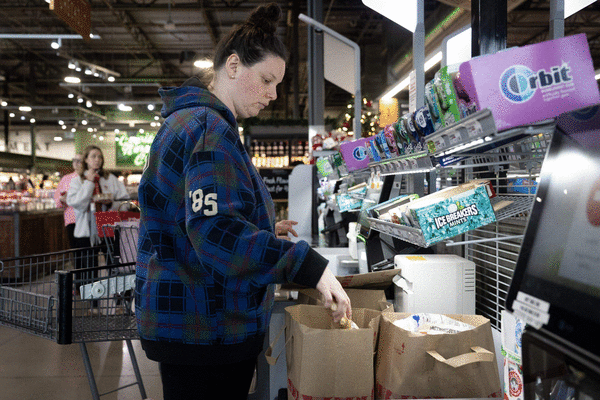
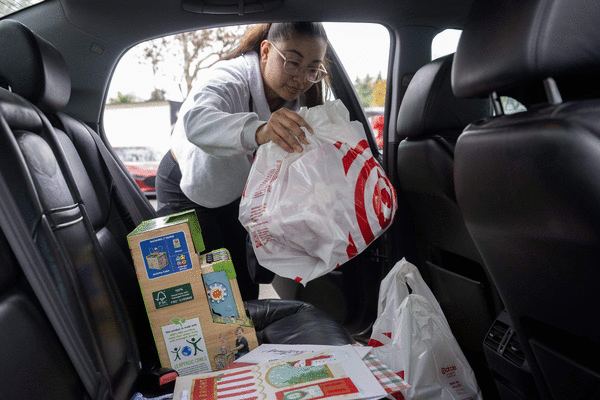

At the Target store on Riverside Boulevard on Friday, stacks of plastic bags sat prominently at checkout counters — the only visible option available for shoppers at both self-checkout kiosks and traditional lanes.
Under Senate Bill 1053 that passed in 2024, those plastic bags are set to disappear from checkout counters by the end of 2025.
However, the fate of plastic bags already in storage will not be regulated under the law, leaving individual stores to decide how to handle their remaining inventory.
“We have been planning for this transition since earlier this year and all of our stores have been working through the existing plastic bags since then, so we are set to be out of them across all stores before the end of the year,” Ashley Carter, a spokesperson for the Raley’s Cos., said in an email to The Sacramento Bee.
“We already have paper bags set to roll out ... as the plastic bags are worked through.”
Carter’s explanation was reflected at Raley’s Freeport Boulevard store, where paper bags were the only option at checkout and customers relied on them or their own reusable bags.
Nina Culliver, a 33-year-old South Land Park resident, was among many shoppers who used paper bags to carry their groceries on Friday. Culliver said that she supports the incoming law.
“Plastic is detrimental to the landfill, and it’s flying around everywhere in the environment,” Culliver said. “Paper bags decompose easier, and it’s just better in general. I don’t think (the change will) make a huge difference for us.”
Chris Swayn, a 40-year-old shopper who visited the store with his daughter, also said he supports SB 1053, and makes a habit of reusing his shopping bags, both paper and plastic.
“The plastic bags I usually use to scoop my dog poop … it’s a good reusable way to use them.
“The paper bags, I use them to store my charcoal for my barbecue,” Swayn said. “Taking care of our planet’s a pretty big responsibility, and even small little changes can make bigger changes down the road.”
A long road to a full plastic bag phaseout
In 2014, legislators approved Senate Bill 270, banning thin plastic checkout bags while permitting thicker plastic bags intended for reuse. After voters upheld the law through Proposition 67 in 2016, the ban took effect statewide later that year.
The effort, however, was widely seen as unsuccessful, as data later showed the law did not reduce plastic waste as hoped, even when excluding the period in 2020, when enforcement temporarily paused during the COVID-19 pandemic.
According to CalRecycle, California landfills received about 157,385 tons of plastic grocery and merchandise bags in 2014. By 2021, the amount of those bags being thrown away had grown to approximately 231,072 tons, a jump of about 47%.
State Sen. Catherine Blakespear, D-Encinitas, said SB 1053 is designed to close a loophole in SB 270, which allowed thicker plastic bags to proliferate, contributing to an increase in plastic waste.
“Shockingly, some 18 billion pounds of plastic waste flows into the oceans every year from coastal regions alone,” Blakespear said after SB 1053 passed last year. “California must do its part to eliminate this scourge that is contaminating our environment.”
Julia Stein, deputy director of the UCLA School of Law’s Emmett Institute on Climate Change and the Environment, agreed that SB 1053 represents a course correction after earlier policies allowed thicker plastic bags that ultimately increased plastic waste.
“It’s pretty challenging for waste management infrastructure to deal with these plastic bags,” Stein said, noting that they slow operations and add costs at waste facilities. “Having these products out of the waste stream just makes it much more economical to run the process, and ultimately, that efficiency will get passed on to repairs.”
Stein also noted that there is currently no federal law that would override California’s plastic bag phaseout, and said she does not expect the federal government to intervene.
“I’ll never say never, because we’re seeing a lot of things out of the federal government that have surprised me in the last year,” she said. “But at this point there’s no preemption authority that would mean that the federal government would intercede and try to stop California from doing this.”
The strategy of using up existing plastic bags before the law takes effect was also employed by the Save Mart Cos.
“We have been educating our associates and customers on the pending change and have been working to exhaust our supply of plastic bags for several months now; we don’t anticipate any excess,” the company said in a statement to The Bee. “If we do have remaining plastic bags in January, we plan to transfer them to our stores in Nevada.”
The fate of plastic bags at stores such as Target on Riverside Boulevard, however, remains unclear, as Target did not respond to The Bee’s request for comment. Sprouts Farmers Market, Foods Co. and Grocery Outlet were among the other retailers that did not respond.
“While the law will no longer permit affected stores from distributing plastic carryout bags to shoppers in the new year, stores can find alternate uses for their existing inventory or sell remaining product for legal use elsewhere,” noted Lance Klug, a spokesperson for CalRecycle, while noting that this guidance is not a mandate and does not include enforcement.
Meaning, as of now, there are no statewide regulations in place to prevent large-scale dumping of plastic bags already in storage once the phaseout begins.
Adjusting, one shopping trip at a time
At Target, customers rushed in and out, carrying plastic bags that the store offered as the only visible option. Devin Valdez, a 32-year-old Midtown resident, was among those shoppers, stopping in to do some holiday shopping.
Bringing her own tote bags is not yet a habit for her, Valdez said, but added, “I don’t mind stepping up and doing that” for the environment.
“Sometimes I think it’s frustrating that a lot of this stuff falls on the everyday consumer,” Valdez said. “However, I do see the value in not utilizing plastic bags as frequently. And if that is where we’re heading, then my partner and I will just adjust.”
Jazmine Valencia, a 29-year-old Midtown resident, carried her items out in plastic bags placed inside her cart. Noting that she typically uses whatever is offered at the counter, Valencia said that more paper bags have been appearing at checkout counters at other stores, and that she does not expect the new law to be inconvenient.
“I use these as my little trash bags in my bathroom,” Valencia said of the plastic bags. When asked what she would use instead, she said she would either buy trash bags or simply not line the bin.
_____
©2025 The Sacramento Bee. Visit sacbee.com. Distributed by Tribune Content Agency, LLC.






Comments