Sex Pistols on 50th anniversary tour: 'I don't really like the word “punk,”' says guitarist Steve Jones
Published in Entertainment News
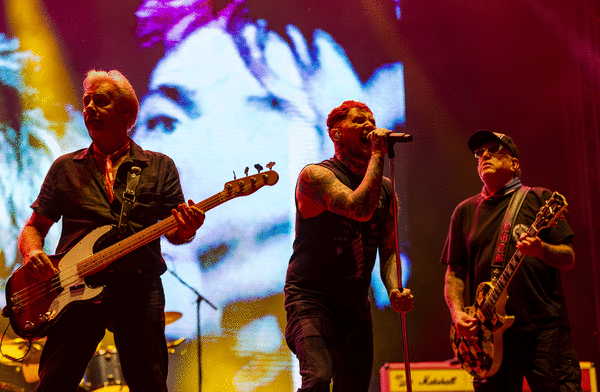
SAN DIEGO — No other punk-rock act made as big or as enduring an impact in such a short time as the Sex Pistols, the combustible English band that was launched in late 1975 and imploded just 26 months later in San Francisco.
But that doesn’t mean the group’s co-founders are eager to embrace the banner of punk — or its ethos — during their revamped band’s ongoing 50th anniversary tour.
“I don’t really like the word ‘punk’,” said guitarist Steve Jones, 71, speaking from London.
“To me, we were just a continuation of rock and roll. But so be it. You have to call everything (by a name). Rap music is called rap, grunge is called grunge. But to me, punk is just another form of rock and roll, and punk is just another word. Punk is a continuation of the rock and roll spirit.”
“I totally agree with that,” said bassist Glen Matlock, 70, in a separate interview from London.
“I don’t think any of us were particularly enamored with the word ‘punk.’ And if you look up what it means, ‘punk’ is not particularly savory. I think rock music is a baton race. You take the baton from those who come before you and people kind of dig you, and then you pass the baton on afterwards.
“I’ve worked with people who came just before us, like Iggy Pop and Mick Ronson, and also with people who came after us, like Primal Scream and Zak Starkey. So, yeah, I agree with Steve. We came to be called ‘punk,’ although we weren’t happy about it. But it was out of our hands by then; the cat was out of the bag. So, there you go.”
Jones and Matlock are now on a fall U.S. concert trek with original Sex Pistols’ drummer Paul Cook, 70, and — in place of long-estranged front man John Lydon (aka Johnny Rotten) — singer Frank Carter, 42. Lydon lost a 2021 lawsuit against his former bandmates when he tried to block the six-part biographical television series, “Pistols.” He has denounced his former band’s tour with Carter as “karaoke” and called Carter “a rented puppet.”
Punk rock turns 50
This year’s Lydon-free Sex Pistols’ tour was originally scheduled for 2025 but was postponed after Jones broke his wrist in what he described as an “old man” accident. The delay means that the tour now coincides with the 50th anniversary of punk rock, as underscored by several landmark events.
It was in 1976 that the New York-bred Ramones released its game-changing debut album. The same year saw the London-based band The Damned become the first English punk group to release a single in the U.K.
Moreover, 1976 saw the Ramones perform their first European concerts — on July 4 and 5 — at two different London venues. The pair of shows were attended by the members of such fledgling English punk bands as the Damned, Sex Pistols and Clash, along with future members of the Pretenders, Buzzcocks, Adam and the Ants, the Slits, and Siouxsie and the Banshees.
The Sex Pistols’ first public performance, as the opening act for the pub-rock band Bazooka Joe, took place four months later at a London art college where Matlock was enrolled at the time. It was followed a few weeks later by the release of “God Save the Queen,” the uproarious song that would soon help transform the Sex Pistols into both national sensations and pariahs.
The song’s take-no-prisoners opening verse was the aural equivalent of tossing hand grenades at the powers-that-be, with Lydon snarling the lyrics with a combination of glee and nihilistic abandon. What resulted perfectly captured the increasing sense of bleakness and despair enveloping England at the time:
“God save the Queen / The fascist regime / It made you a moron / Potential H-bomb / God save the Queen / She ain’t no human being / There is no future / In England’s dreaming.”
That lit a fuse that — just five days later — ignited when the Sex Pistols did a profanity-laced interview on a nationally broadcast live TV show in London. The tabloid press swiftly denounced the band as a menace to society and worse.
The ensuing uproar led to the band being dropped by its record company, EMI, a month later. One month after that, the Sex Pistols signed a new contract with A&M Records, only to be dropped just six days later after the label’s co-founder, Herb Alpert, objected to the band’s “negative energy.”
Matlock left the band in early 1977 after repeated clashes with Lydon. He was replaced by the decidedly unmusical Sid Vicious, who died of an accidental heroin overdose in early 1979. The group’s debut album, “Never Mind the Bollocks, Here’s the Sex Pistols,” was released in late 1977 by Virgin Records in the U.K. and Warner Bros. in the U.S.
An instant classic, it went on to greatly inspire a host of bands on both sides of the Atlantic, including Joy Division, Bad Brains, Social Distortion, Nirvana, Green Day, Blink-182 and many more. The Sex Pistols’ current tour finds them performing almost all of the songs from that album in the same order as on the record.
‘We didn’t know diddly!
Jones chuckled when asked if the Sex Pistols knew just how influential its only studio album would prove to be.
“No, we didn’t know diddly!” replied the guitarist, who at some of the band’s early concerts wore an “I hate Pink Floyd” t-shirt.
“We got a buzz doing the shows. There was something happening, the fashion and the whole thing. There was a movement. You could see it. You couldn’t avoid it. We knew that was happening, but we didn’t know the extent of how far it would go from doing one record. But here we are. We’re still playing the songs, 100 years later! But the whole punk thing, culturally, I didn’t like.”
And how did Matlock, who co-wrote 10 of the 12 songs on the “Never Mind” album, regard the non-musical aspects of punk?
“It was important,” he said. “I wrote the lyrics to ‘Pretty Vacant.’ And that’s the way I was feeling as a sort of dispossessed young man in the mid-1970s in London, where we had IRA bombings, power cuts, and everybody was on strike and rubbish was piled high in the streets.
“There was a real air of despondency. So, to me, ‘Pretty Vacant’ was like a primal scream,” Matlock said. “You (had) all these things going on and you didn’t know how you can cope with it, but you were just going to do something anyway. And John’s lyrics for ‘God Save The Queen’ — which was originally called ‘No Future’ — to me, were not delighting in the fact there was no future. There was no future unless you try and do something about it for yourself. I ascribed to all of that, but I think maybe I might believe in it a bit more than the guy who wrote the lyrics.”
Jones generally agrees with Matlock’s assessment of punk, although he appears to hold Lydon in higher regard.
“When you say the word ‘punk’ you know exactly what it means, so it’s good for that,” Jones said. “But 10 years later, you got your Green Days and all the other bands that were ‘punk rock.’ I don’t know, man. Its just music — isn’t it? — and we were one of the lucky ones that made something out of it. There’s a million people who wanted to form bands, and that was the good thing about so-called punk rock. It did give the message that anyone could do it.
“Like, I couldn’t play guitar, John couldn’t sing. And that gave us a certain sound that I think turned people on when they’d see us early on and saw how great we were, as far as a young band coming up with some pretty killer songs. The lyrics that John came up with for his age, and the power in the music was pretty phenomenal. John was way ahead of his time, lyrically, and he was sharp as a tack. I’ve always got a lot of respect for that. I was lucky enough to be in a band with John and that we got a good guy to be the singer.”
Matlock and Jones did back-to-back Zoom calls with the San Diego Union-Tribune. The interviews have been edited for length and clarity.
Q: You co-wrote nearly every song on “Never Mind the Bullocks.” What was your goal back then?
Matlock: My goal?
Q: You were young and it’s not like you had a big track record. So, it was a completely open slate.
Matlock: It was all about that this was our first proper band. Everybody had a load of influences, but we also had loads of things that we hated. We didn’t want to sound like what we hated … and it just came out as the Sex Pistols. Steve, Paul, and myself, we learned to play together. That counts for a lot more than just: “Oh, he’s a good guitarist”‘ So, the total is more than the sum of the parts.
Q: When the Sex Pistols’ first reunion tour played at the Universal Amphitheater in Los Angeles in 1996, I sat directly behind two 15-year-old girls. Even though they were born several years after the band imploded, they knew the words to every song and sang along to all of them. After the concert I asked them how they liked it, and they said it was the best concert they’d ever been to. I had to smile because it was also the first concert they’d ever been to. But they were clearly thrilled. When you were 15, what was the best concert you had ever been to?
Jones: Oh, man, there were many! You’re so impressionable at that age. My thing when I was, like, 14, 15 and 16 was the Faces with Rod Stewart, Roxy Music and, of course, David Bowie & the Spiders From Mars. That was my big “This is what it’s all about!” moment. I’ve always loved all kinds of music from an early age. Tamla Motown, Jimi Hendrix — “Purple Haze” blew my mind when I was a kid. I’m a music fan, not just someone who likes music. I take it a step further. I couldn’t live without music and I ended up being a musician, in one shape or another. I guess it was meant to be. It’s great when kids love it and know all the words. I liked Led Zeppelin, Deep Purple and Nazareth. There were loads of good rocking bands band then.
Q: Were you a fan of the Sensational Alex Harvey Band?
Jones: I loved Alex Harvey! I loved the theatrics, the whole bit with Zal Cleminson on guitar with his (painted) clown face and Alex coming through the (mock) brick (stage) wall. It was so great. Alex was such an original.
Q: I ask this with my tongue partly in cheek, but did you really hate Pink Floyd?
Jones: Um, well it was John’s T-shirt. I must say, I wasn’t crazy about them. I thought David Gilmour was a tasty guitar player, but it wasn’t my bag. I liked more straight-ahead rock music, like the Faces and Bowie. That was my bag. Pink Floyd was a bit too much stoner music for me.
Matlock: When I was about 14, I actually saw Humble Pie supporting Grand Funk Railroad in Hyde Park in London, and (Humble Pie lead singer) Steve Marriot was fantastic. It was when Peter Frampton was still in the band and he looked like such a rock star. Humble Pie blew Grand Funk off the stage, they really did, and that was great. I was always a big fan of the Faces. I saw them three times … I used to stand in front of the mirror when I was 14, pretending I was in the band.
Q: Your memoir, “I Was a Teenage Sex Pistol,” was published in 1990 — six years before the first Pistols’ reunion tour — and the film documentary of the same name premiered lastyear. In the 36-year period between the book and the film, how have your feelings about the band, its music and its impact evolved or changed?
Matlock: Well, it’s been a bit up and down. And in those 36 years, we’ve reformed several times with John. We did a big tour in 1996. We did some shows in 2003. We played in 2007, and then we did quite a big tour in 2008. So, we’ve never totally gone away. All of us have done loads of different projects in the intervening periods. I do my own stuff and I’ve been playing with Blondie the past few years as well. I was really enjoying that until (Blondie drummer) Clem Burke, who was a very good long-term friend of mine, passed away last year.
But I’ve been doing loads of stuff. Steve’s always doing things and Paul’s had his own band. Everybody’s on top of their chops, as we say, and we all play pretty good. And then it’s been capped off by having Frank Carter. He was suggested to us by my son, Louis, and he’s turned out to be fantastic. He’s a great showman. He reads the band and pitches it justright. He’s not trying to be John. He’s his own man. He sort of pays tribute to us. He’s a real good crowd pleaser, a shaman.
Q: What does Frank Carter bring to the equation for you?
Jones: He brings a lot of energy. He’s a lot younger. He’s a mere 42. I’m 71. But I look after myself. I think you’ve got to. If you want to do this game, you can’t be partying. And we’re having a blast, me, Glen, Paul and Frank, and it’s great. I look forward to the shows. The crowds love it. That makes me happy and we’re just having a great time right now. And I can’t wait to come to the states. I’m curious to see how it gets received with a different singer.
Q: With no offense to the others, is it fair to say you were the most musically accomplished member of the Sex Pistols as a teenager?
Matlock: A little bit. They always said, initially, I was more of the musician then. Perhaps I was ahead of them at first. But — don’t tell them this — only by about three or four weeks! You go out gigging and you work out what works, and what doesn’t work. And Steve got really good. Steve is very good at what he does, and that’s always been my answer: It’s a simple thing done well. So, that’s the musical side. But there’s another side to it: The mythology and the mystique, which was created with all of us, and John as well. You can’t take that out of the equation. Whether John totally believes in that, I’m not quite so sure these days.
Q: I got lost there. Whether he totally believes in what?
Matlock: My problem with John, and why I fell out with him, is I don’t think he was that sincere in his sincerity. And I think I’ve been kind of proved right over the years.
Q: If someone had come up to you in 1976 and told you that in 2026 you would be out touring with the Sex Pistols and playing all the songs from the band’s first and only studio album, would you have thought they were nuts? How would you have reacted?
Jones: I don’t know, because my brain ain’t the same as it was when I was 19, 20, 21 years old. It wouldn’t have made any sense to me then. But looking back now, it makes sense. We’re not the first band who have stayed together for many years. But it wasn’t going to last the way it was going, and it didn’t.
We broke up and then we didn’t do nothing for 20-odd years. I wasn’t surprised, because I didn’t want it to continue. When we got to the states (in early 1978) and we ended the tour in San Francisco, I was the one who said: “I’ve had enough. And me and (Paul) Cook, we just walked away from it. And I’m glad I did. It was miserable, but we were young and stupid. If we were smarter, maybe we should have taken six months off and regrouped. But I just had enough of it. It was horrible.
Q: The only time the Sex Pistols performed in San Diego was at the Street Scene festival here in 2003 when John was still in the band. Do you have any recollection of that?
Jones: Yeah, it was a big outdoor thing and there were a lot of people.
Q: Hindsight is 20/20, and the saying “never say never”…
Jones: It might happen — (a reunion with John Lydon) might happen.
Q: Really?
Jones: You never know, man. Like you say, never say never. But yeah, that could happen. Well see, because next year is the big one, isn’t it (with the 50th anniversary of “Never Mind the Bullocks”)? You know, all these anniversaries, I lose track.
Q: Since you mentioned next year being the big anniversary, and with never say never in mind, have there been any preliminary talks about reuniting with John?
Jones: There ain’t nothing happening.
Q: But you’re hopeful?
Jones: No, I wouldn’t say hopeful, but you never know. I know what you’re looking for, but I can’t give it to you because no one’s spoken about it. But if you got someone coming to the table saying: “Look, this is what you could make,” a lot of people would hang in there — if the price was right — even if you hated each other.
Q: When I talked to Steve, I said: “Hindsight is 20/20. And then I said three words: “Never say never.” And without my asking a question, he knew exactly where I was going and said that next year is the big anniversary (of “Never Mind the Bullocks”) and that something was possible, even though there haven’t been any discussions. How do you feel about next year? And is the door at least partly open for a full band reunion?
Matlock: What, you mean with John?
Q: Yes.
Matlock: Oh, I don’t know. There’s some people in the world you can say you’re not that keen on and that you’re not a big fan of — at all. And I think (John) might come under that. I don’t think John can cut it with the songs. I’d have to think long and hard about that. But who knows?
But you know what? I’m really enjoying performing with Frank. He’s brought a whole new lease of life to the band with youthful energy and a smile on his face. And lots of people don’t have smiles on their face these days. Stuff like that is infectious, it rubs off on the audience and everybody’s been having a fantastic time. What you said earlier about the young girls coming to our (1996 reunion concert), we’re getting that now. It’s like a family affair. People are bringing their kids and they’re all punks — dad punk, nana punk, young kid punk, granddaughter punk.
Q: Did your own kids go through a punk phase?
Matlock: Well, they still are! Our stage manager is my son. And my other son’s in a band called Wargasm, which is doing more of a hardcore kind of punk thing. But to me, punk is not necessarily a look. It’s an attitude. I think it’s become a byword for an alternative music where people sort of read between the lines and don’t take “no” for an answer so much. That’s not such a terrible thing. And I’m very fortunate. I’ve been able to travel all around the world, and punk means the same in nearly every country you go to. So that’s not a bad thing to have as a legacy.
Paul Cook’s wife came last year when we did some shows (with Frank Carter) to run it up the flagpole. And she said to me, as I was walking off stage: “I’ve seen you so many times before with John, and this is the first time I’ve ever seen you come off stage with a smile on your face.”
©2026 The San Diego Union-Tribune. Visit sandiegouniontribune.com. Distributed by Tribune Content Agency, LLC.






Comments