Commentary: Never heard 'Choosin' Texas'? Consider that a wake-up call
Published in Entertainment News
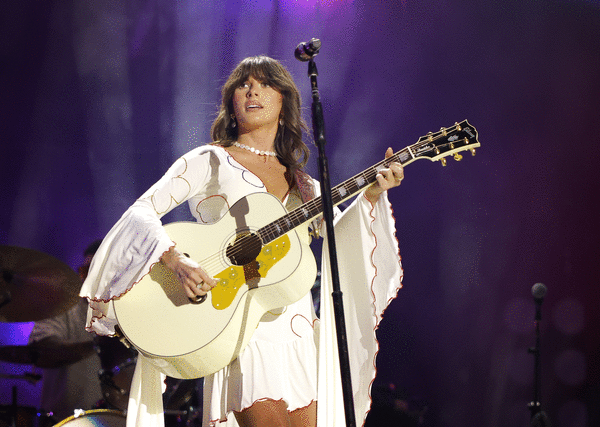
Music fans and journalists who spent the last few months looking for the song of the summer faced a plot twist fit for Hollywood: The winner was a single released last October. Billboard announced last week that Ella Langley’s "Choosin’ Texas" had secured the No. 1 spot on the Hot 100 chart for the 23rd week, breaking the record held by Mariah Carey’s "All I Want for Christmas Is You."
Yet for a song that had achieved such extraordinary chart dominance, "Choosin’ Texas" hardly felt inescapable. For many people, it raised a question: How could a song they’d never heard of become so massive?
The question itself is an indication that many people haven’t realized just how much the norms shaping music charts have changed. And the answer should challenge not only our notion of song of the summer, but the idea that we can still experience one collectively in the first place.
The numbers were clear. From July 4 to the week of Sept. 12, "Choosin’ Texas" remained at No. 1 on the Hot 100. On Billboard’s specialized Songs of Summer chart, it held the No. 1 spot for 14 weeks. While the “song of the summer” has always been as much a cultural distinction as a chart designation, Langley’s single finished ahead of contenders including Taylor Swift’s "I Knew It, I Knew You," Drake’s "Janice STFU" and Ariana Grande’s "Hate That I Made You Love Me" on the seasonal chart.
None of those songs managed to completely dominate the culture either. But if chart performance still means anything in determining the song of the summer, "Choosin’ Texas" was that song — or there wasn’t one. Langley’s dominance is a symptom of both a long-term promotion commitment and a music distribution pattern that’s seismically shifted even since 2019.
When Lil Nas X’s "Old Town Road" held the No. 1 spot for 19 weeks seven years ago, it was buoyed by a couple of factors. There was a visualizer that used footage from the video game "Red Dead Redemption 2." Plus, there was the song’s own novelty, which fused melodic trap — a rap subgenre popularized by rappers like Future and Young Thug — with country music. That led to the viral YeeHaw challenge, which only further propelled the single. Shaboozey’s "A Bar Song (Tipsy)," which tied Lil Nas X’s mark in 2024, benefited from a similar country-trap structure as well as an accompanying line-dance trend that went viral on TikTok.
Those elements extend beyond country music too. For example, the eccentric “ee-er” song portion of rapper Roddy Ricch’s "The Box," which remained atop the Hot 100 for 11 weeks in 2020, turned the song into a meme with limitless applications. Drake’s "God’s Plan," released in 2018, was sticky enough to slide into playlist and radio slots everywhere. But when he donated his $1 million music video budget to the people he featured in the video, he also gave the song a goodwill push that only enhanced its ubiquity.
To varying degrees, these internet elements made songs from Lil Nas X, Shaboozey, Drake and Roddy Ricch self-reinforcing promotion machines that kept them atop the charts. Those intentional and sometimes unintentional marketing mechanisms helped give them an immediate centrality that Langley’s single did not.
While "Choosin’ Texas" benefited from social media presence — it’s been used in over 600,000 TikTok videos and has gotten more than 2.8 billion TikTok views — the videos that center the song are spread across multiple lanes rather than one identifiable trend that reached singular omnipresence.
Some fans joked about misheard lyrics. Others discovered it through a viral dance featuring cows on TikTok. Then there’s the cohort that ran into it the old-fashioned way: on the radio. The song received enormous airplay — securing about 58 million airplay audience impressions (1) on country radio — but the medium no longer provides the kind of shared exposure it once did as listeners scatter across streaming platforms. Two years ago, Edison Research found that radio’s share of the average American’s daily audio time had fallen from just over 50% in 2014 to 36% in 2024.
Collectively, these factors prevented her from penetrating pop culture in a uniform fashion. Rather than a record-breaking 100-meter sprint, fragmented pipelines meant that "Choosin’ Texas" climbed gradually at a well-paced jog.
It debuted at No. 39 on the Billboard Hot 100 in November. By January, it had reached the top 10. The song hit No. 1 for the first time in February. When Langley’s album Dandelion was released in April, it gave "Choosin’ Texas" renewed promotion. Drake dropped his Iceman album a month later, which led to the track "Janice STFU" spending two weeks at No. 1, briefly interrupting Langley’s run. But "Choosin’ Texas" eventually reclaimed the top spot.
In the realm of historically explosive No. 1 singles, Langley’s sheer consistency camouflaged her dominance. If you didn’t notice the country singer’s elevation, Drake definitely did; he previewed a Don Toliver-assisted remix of "Choosin’ Texas" at the end of August before premiering the complete version in his short film, "FOMO," earlier this month.
With so many ways to access music, even the concept of being late might be becoming dated. More than ever, time is relative, and no one thing is everything to everyone.
Langley’s feat speaks to an increasingly fractured media ecosystem where even major accomplishments can be reduced to ambient noise. By the time a broader audience had to reckon with "Choosin’ Texas" being the unofficial song of the summer, the season was already over. When music lovers begin looking for the next one, they should probably start this fall.
____
(1) Audience impressions estimate how many times a song potentially reached listeners on the radio, not how many individual people heard it.
____
This column reflects the personal views of the author and does not necessarily reflect the opinion of the editorial board or Bloomberg LP and its owners.
Peter A. Berry is a culture journalist with bylines in XXL, Variety, COMPLEX, Rolling Stone, Okayplayer and more. He also writes the "Rate It Or Love It" newsletter on Substack.
©2026 Bloomberg L.P. Visit bloomberg.com/opinion. Distributed by Tribune Content Agency, LLC.








Comments