Rick Kogan: A 4-part Rupert Murdoch family saga tells us money can't buy you love
Published in Entertainment News
CHICAGO — Leo Tolstoy, who could write a bit, opened his 1878 novel “Anna Karenina” with this memorable line: “All happy families are all alike; each unhappy family is unhappy in its own way.”
It’s a good thing he never met Rupert Murdoch’s brood, for even as clever as Tolstoy was, he’d have been hard-pressed to detail the unhappiness of this clan.
Here they are, captured in an often overwhelming, frequently perplexing and ultimately depressing four-part Netflix documentary, “Dynasty: The Murdochs.”
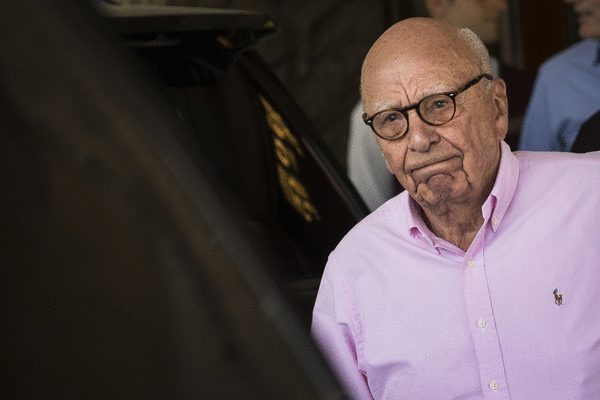
It is directed by Liz Garbus, a New York City-born filmmaker, who tries her best to capture the complexities and ravenous energies of this now 95-year-old Australian-born media mogul, as well as untangle the psychological games and pains he visited upon his children.
It is generally accepted that HBO’s critically acclaimed family saga “Succession” was inspired by the Murdoch family. Indeed, early on in this documentary series, the New York Times writer Jim Rutenberg, one of its most knowledgeable commentators, says, “To explain the Murdochs, you have to understand the television show ‘Succession.’”
If you were a fan of that series, or not, you will find that the real-life counterparts are bland by comparison to the TV actors.
In short, the siblings are Prudence, from a first marriage. From a lengthy second marriage to Anna are sons Lachlan, a conservative-leaning, gregarious sort, and James, the so-called smart brother and liberal-leaning, and daughter Elisabeth, successful on her own but never accorded respect by her misogynist dad. There are two daughters, Grace and Chloe, from Murdoch’s third of five marriages, but they were too young to have gotten into the succession mix. (I had forgotten that wife No. 4 was Jerry Hall, Mick Jagger’s former partner for decades). All of these Murdoch kids wind up being billionaires, but were ever overshadowed and manipulated by their dad.
As you will hear in this documentary and see in its details, “Rupert said his dream was to build a family business. Rupert got everything he wanted and it ripped his family apart.”
It began in earnest when he was 21 and inherited newspapers after his father, Keith Murdoch, died and he began to play exuberantly in media fields.
Since the program races through his early acquisitions, it misses altogether his impact in Chicago. When he arrived in 1984, he was best known (and feared in some journalistic quarters) for his ownership of newspapers in London and the New York Post, a tabloid known for its screaming headlines, suspect credibility and politically conservative editorial views.
He came here with his checkbook and outbid a group of locals to buy the Sun-Times for roughly $90 million, which was put up for sale by its owners Marshall Field V and younger half-brother Ted Field. This led to 60-some staff members resigning from the paper. I was among that crowd, dominated by columnist Mike Royko, who came to the Tribune and famously referred to Murdoch as the “alien” and said on TV that he published newspapers that “no self-respecting fish would want to be wrapped in.”
The chaos Murdoch caused would echo for years after he was forced to sell the paper in 1986. He did so due to Federal Communications Commission cross-ownership rules, which prohibited owning a newspaper and a television station in the same city. His purchase of WFLD-Ch. 32 helped launch the Fox network. (He sold the paper for a nearly 50% profit.)
There are likely dozens, if not hundreds, of similar tales, for Murdoch was voracious in his empire building. And that empire exerted plenty of influence, with Fox making the most noise, even as it encountered troubles.
We get a look at some of those, such as the phone hacking in 2010-11 London, that involved illegal voicemail interception of politicians, the royal family and celebrities by reporters at Murdoch’s News of the World, which resulted in massive financial payouts, staff resignations, and the final print edition of the 168-year-old newspaper.
And soon came, in 2016, the sexual harassment allegations that forced the resignation of Fox boss Roger Ailes and star Bill O’Reilly.
The background comes, understandably, without any input from the Murdoch family and though there are snatches of previous interviews and ample television news segments with them, we make do with some very smart observers and, seen for the first time on television, many emails and text messages that go to the dark heart of Murdoch.
There are observations from people who have worked for Murdoch for decades, such as reporter Paul McMullan. We learn — no surprise here — that Murdoch cheated when playing Monopoly. But there is painfully little about or from Anna, the mother of Elisabeth, Lachlan and James, but for an odd allegation that she once killed a woman in a hit-and-run accident, of which we hear no more.
For a dash of star power, we also get actor Hugh Grant, trotted out to comment on the surely unwanted attention focused on him by Murdoch’s reporters after he had been arrested for being caught with a sex worker in 1995.
There is no question that Murdoch was a towering figure, able to influence politics and the public discourse. And we learn that he thought of Donald Trump as a “(expletive) idiot” before helping boost him to the White House.
The fighting among the “children” came to an end in, of all places, a Reno, Nevada, courtroom, in September 2025. Billions were disbursed, succession was settled and whatever love might have remained was shattered.
There is, for all of its flash and private jets, a sad shadow on this series. F. Scott Fitzgerald, who also could write a bit, had this in his 1926 short story “The Rich Boy, “Let me tell you about the very rich. They are different from you and me.”
No kidding, and good luck to them.
———
(Rick Kogan is a columnist for the Chicago Tribune.)
———
©2026 Chicago Tribune. Visit chicagotribune.com. Distributed by Tribune Content Agency, LLC.


Comments