Commentary: Whitewashing 'Wuthering Heights' now hits differently
Published in Entertainment News
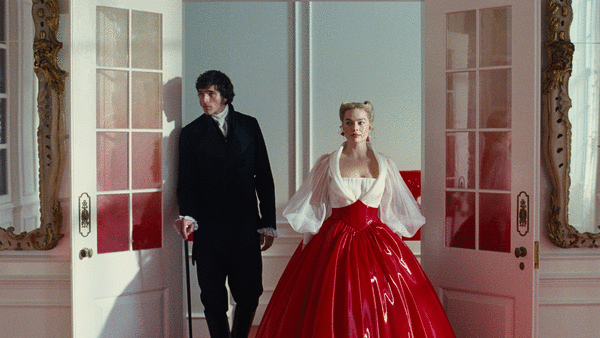
Emily Brontë's "Wuthering Heights" has been adapted to the big screen numerous times and, save for Andrea Arnold’s 2011 version, has largely been consistent in one disappointing way: the whitewashing of Heathcliff.
So when the complaints about the colorblind casting in Emerald Fennell’s “Wuthering Heights” came, they didn’t feel entirely unfamiliar. What’s changed is the terrain. Whether it likes it or not, Hollywood is now one of the country’s most visible political battlegrounds — where casting is treated less like a creative choice than as a statement of values.
Viral videos of violent ICE raids widely criticized as racial profiling, alongside news of visa limits that disproportionately impact nonwhite-majority countries — and a sustained assault on DEI — have heightened how audiences read race on-screen and what it signals in the real world.
Fennell’s “Wuthering Heights,” then, can’t just be another adaptation. It’s the latest proxy fight over race and representation. The original novel was written in 1847 and has lived on for more than a century and a half, firmly embedding itself in pop culture. But the film doesn’t explore the exclusion of Heathcliff, played by Jacob Elordi, because of his ethnicity, or its effects on his social class. The fact that he’s described as “dark-skinned” and a “gypsy” is central to the story because it unsettles the novel’s Victorian characters.
Then there is Fennell’s decision to cast nonwhite actors in supporting roles — Hong Chau as Nelly Dean and Shazad Latif as Edgar Linton. It’s a departure from the book that inverts the story’s racial politics, inadvertently amplifying the victimization of Cathy Earnshaw, played by Margot Robbie, and Heathcliff, while minimizing the effects of their own choices and cruelty.
The film portrays Nelly, Cathy’s paid companion, as a vengeful schemer (unlike her counterpart in the book). Her spiteful machinations — burning Heathcliff’s letters to Cathy and her inaction ultimately leading to Cathy’s death from sepsis — become an obstacle to a white couple’s love story. Meanwhile, Cathy’s callousness toward Nelly, including sidelining her in favor of Heathcliff, is glossed over.
These are racist undertones that sparked online discourse. Jananie K. Velu, a popular YouTuber known for her book content, captured many people’s frustrations in a YouTube short with over 50,000 views. She noted how the casting of Chau and Latif avoids the complexities of Cathy and Heathcliff’s romance and winds up “blam[ing] the Asian servant and the rich brown man” Cathy marries for her own gain. Velu says that the film is a reflection of real life in that it’s “a story rooted in the cycles of violence perpetuated by whiteness that has its genesis in the abuse of people of color.”
In response to the backlash, Fennell has defended Elordi’s casting as Heathcliff, saying she made the movie she “sort of imagined” when she read it and was focused more “on the pseudo-masochistic elements of it.” Even so, it’s hard to ignore how the director’s creative license reinforces the idea that people of color and those from lower economic classes are seen as threats to power and whiteness.
In a tumultuous political landscape, audiences are increasingly primed to notice this kind of racialized and class-based tension in the media they consume. But movies have always been political, even when their messages are subtle or when filmmakers insist they’re simply telling a story.
Paul Thomas Anderson’s "One Battle After Another" exemplifies this point. In the film, Leonardo DiCaprio plays an activist whose group bombs the office of an antiabortion politician and raids detention centers to rescue immigrants. The discourse surrounding the film transposed our political climate onto the story despite it being loosely based on the 1990 novel "Vineland." However, Anderson has stated that "One Battle After Another’s" political violence is “very far from reality.” Speaking with the Brazilian news magazine Veja, Anderson noted that his movie is ultimately the story of “a father who wants to protect his teenage daughter” and that he considered “the political aspect itself of lesser importance to the plot.”
The timing and content of the film made his insistence on downplaying the politics of the movie perplexingly reductive. Not only was "One Battle After Another" released two weeks after Charlie Kirk was assassinated, but it also portrays abuses of power by fictional autocrats that mirror the authoritarian playbook of the Trump administration.
Likewise, Fennell’s adaptation of "Wuthering Heights" may be personal, but her choices don’t exist in a vacuum or land on neutral ground. Her use of colorblind casting is a cautionary tale. However well-intentioned the strategy is nowadays, it can be harmful when deployed without careful consideration. In a story anchored in power, inheritance, exclusion and social consequences, colorblind casting operates as a kind of erasure, flattening the very tensions that give the plot meaning.
Movies don’t always reflect our real world, nor do they have to. But studios, writers and directors have to accept that once art is public, its meaning is no longer solely dictated by the creators’ intentions. Interpretation belongs to the moment the art arrives in — and to audiences shaped by headlines and history.
———
This column reflects the personal views of the author and does not necessarily reflect the opinion of the editorial board or Bloomberg LP and its owners.
Mae Abdulbaki is a critic, entertainment journalist and podcaster. She has been a member of the Gotham Television Awards nominating committee and a juror at film festivals, including SXSW.
©2026 Bloomberg L.P. Visit bloomberg.com/opinion. Distributed by Tribune Content Agency, LLC.








Comments