Court filing lays out alleged messages between North Carolina girl and San Diego mosque shooters
Published in News & Features
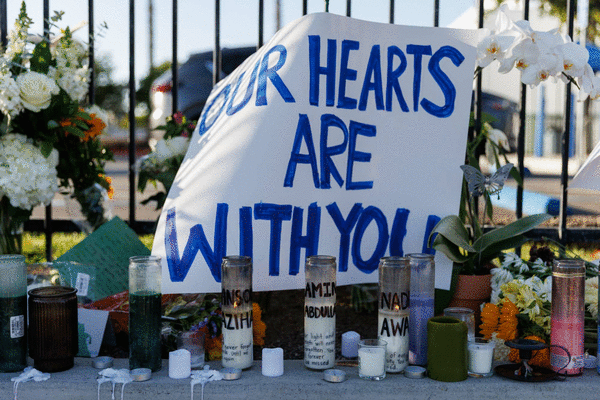
SAN DIEGO — A half hour before two teens ambushed a San Diego mosque and killed three congregants, they were in a parking structure communicating with a North Carolina girl, talking about the planned attack, according to newly filed court documents.
Prosecutors say the girl, Sarah Lindsay Santiago, was recording as one of the teens, Caleb Vazquez, mounted his cellphone on a tactical helmet in order to livestream what they were about to do.
That moment is one of several communications between the youths, as laid out in a Nov. 18 filing from North Carolina prosecutors, who have charged Santiago, 17, with conspiracy and murder for her alleged role in the deadly May 18 attack at the Islamic Center of San Diego.
The girl is accused of disseminating online a livestream of the attack and a hate-filled manifesto penned by the two. Santiago, of Winston-Salem, North Carolina, was arrested in late August and charged as an adult in Forsyth County, North Carolina, where Winston-Salem is located. She has pleaded not guilty.
The new filing, called a “bill of particulars,” discloses to the defense the nature of the evidence gathered in the case. It provides new detail into what the teens were allegedly discussing in electronic communications, including that Vazquez was aware that he was on the radar of federal agents, who’d reached out to his mother regarding his online activities days before the killings. Vazquez, a 19-year-old Chula Vista resident, was at a mental health treatment facility at the time.
Authorities say Vazquez and friend Cain Clark, 17, ambushed the mosque, then planned to attack a nearby Jewish temple, Kehilat Ariel Messianic Synagogue, and a nearby high school, which investigators have determined was Madison High School, according to the filing. Clark, who did online schooling, had a loose association with Madison as his neighborhood school. He lived in Clairemont.
At the Islamic Center, security guard and congregant Amin Abdullah, 51, engaged the two in a gunbattle as he notified fellow congregants, giving them time to hide — it was just after 11:40 a.m. and scores of children were in school on the center’s grounds.
The teens fatally shot Abdullah, then shot and killed Mansour Kaziha, 78, a founder and caretaker at the mosque, and Nadir Awad, 57, husband of a teacher at the mosque’s school. He lived nearby and ran to help after hearing gunshots.
As the teens fled, authorities say, they shot at a landscaper a few blocks over, then drove a little farther, stopped in the middle of a residential street and killed themselves.
The document does not say how the teens found each other online but indicates that the alleged conspiracy dates to January. The filing states that in a Jan. 18 conversation with Santiago over the Discord app, Vazquez “expressed violent animus toward religious and racial minorities.” In the weeks that followed, Vazquez and Santiago allegedly discussed their admiration for mass shooters, and Santiago called for the death of members of some religious or ethnic groups.
In April, Santiago bought, to be shipped to Vazquez, a patch associated with white supremacy, the filing states. He bought and shipped to her a tactical helmet.
The day before the shooting, the two allegedly communicated via the Signal app, and Vazquez said he was going to be investigated by federal law enforcement.
The day of the shooting, Vazquez told Santiago via TikTok that “we have to do it today,” according to the court filing. She asked what they had to do, and also said she would support them if they “came over here,” the document reads. The document states that Vazquez “responded that law enforcement would catch him ‘no matter what,’” and she offered to help with bail.
He said he would go to prison for conspiracy. She responded, according to the document: “if you do this you know the same thing that happened with you is going to happen to me.” The document states that she later added: “plus don’t want to imagine all the fangirls you might have.”
The prosecution filing alleges that Santiago advised Vazquez to cover his digital tracks.
Later that same morning, the filing alleges, Santiago was on Discord with someone identified in the document as Otto, saying that Vazquez and Clark “were ‘gonna do something’ that would result in her being investigated by federal law enforcement.” In a message to a TikTok user with a different handle, Santiago said her “bf,” generally considered shorthand for “boyfriend,” was “gonna do an attack” and that she would be “fedded,” the filing alleges.
During the attack, the document alleges, Santiago “simultaneously transmitted the livestream” to Otto, who is alleged to have uploaded the video online.
After the shooting, she asked Otto if she should call law enforcement and, according to the document, Otto replied “in the affirmative.”
The filing alleges that Santiago twice called the San Diego police non-emergency line about 20 minutes after the shooting. The calls lasted four minutes, but the filing does not say whether she spoke to anyone or was on hold. About 90 minutes after the attack and the deaths of the gunmen, she called 911 in Forsyth County. The document does not indicate what transpired in the call.
The document states that in messages with the TikTok user, who is not identified by name, she was asked if she disclosed information about the video call to law enforcement, and she said she had not.
Santiago is due back in court Jan. 4.
©2026 The San Diego Union-Tribune. Visit sandiegouniontribune.com. Distributed by Tribune Content Agency, LLC.





Comments