Burnham backing for possible new EU referendum surprised Cabinet
Published in News & Features
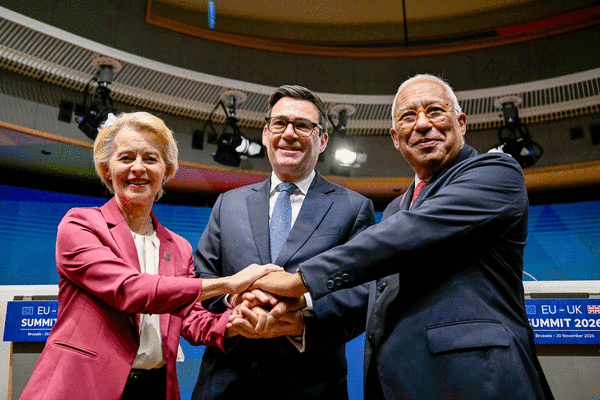
Prime Minister Andy Burnham’s signal that any attempt to take the U.K. back into the European Union would require a referendum blindsided Cabinet ministers and officials who said they weren’t consulted on the policy.
Burnham told the House of Commons on Monday that it would be “unthinkable” for Britain to rejoin the E.U. without a national plebiscite, his clearest indication yet as to how he sees a path opening up to eventual re-entry. Previously, he has been less definitive about whether a referendum or an election would be needed to secure public consent on such a move.
The prime minister’s comment in response to a question from backbench Conservative lawmaker Bernard Jenkin surprised members of his own Labour government, according to people familiar with the matter. They hadn’t been informed that the government position was that a referendum would be required to rejoin the bloc, said the people, who spoke on condition of anonymity discussing internal government deliberations.
The reaction from officials and ministers hints at frustrations within government about Burnham’s tendency to speak off the cuff, announcing measures and strategies that catch his colleagues off guard. As recently as last week, Downing Street officials were saying it was undecided whether any eventual effort to rejoin would need public approval via a general election or referendum.
Burnham was in the Commons to explain his policy in the wake a summit in Brussels on Friday, in which he had European leaders expressed their desire for deeper ties. Burnham has been open about his desire to move closer to the E.U., suggesting rejoining could be on the table in future but stressing any such decision would have to be taken with the approval of the British public.
While opinion polls show support for closer ties with Europe, some in Labour are wary of reopening the Brexit battles. One official said the prime minister should have sought agreement with the Cabinet on such an important statement given there were differing views on the wisdom of holding another referendum that could dominate British politics for years.
The premier told the Commons that he would take a “pragmatic approach,” had “no fixed opinion” and had set “no fixed destination” on his Europe policy. He also signaled any attempt to take Britain back into the bloc it left in 2020 would be for the next Parliament, pointing to his party’s election manifesto from 2024, which included a vow that there would be “no return to the single market, the customs, union, or freedom of movement” during the current term.
Downing Street declined to say whether Burnham consulted his senior-most ministers before making the commitment. The Cabinet was scheduled to meet Tuesday morning in No. 10 Downing St.
One Burnham ally pointed to an interview Burnham gave the Sunday Times newspaper on Oct. 19, which cited the prime minister as saying that a referendum would be needed to rejoin the E.U, but not necessarily for joining the single market or the customs union. He had previously told the BBC that a second referendum was “possible.”
Ministers such as Burnham’s de facto deputy, Louise Haigh, had indicated the premier could gain a mandate to rejoin via the party’s next general election manifesto, although other senior figures privately argue a referendum would be necessary. Burnham’s willingness to confirm such a significant policy without having built a Cabinet consensus has prompted frustration among some Labour MPs who are wary of him appearing inconsistent.
Burnham has often appeared to go off-script while arguing his case in Parliament and in interviews, which supporters say is part of his political appeal. Still, that’s forced his aides to clean up remarks after the fact, such as when he told Parliament in September that national security “can’t come at the expense of social security.”
He has also struggled to articulate a position on referendums on Irish unification and Scottish independence.
While Burnham initially ruled out a vote on either, he later suggested in Parliament that they could be held if there was “majority public support” for one, a condition previously established for Northern Ireland, but not Scotland. There was initial confusion on what that implied for Scotland, but Burnham has settled on the line that a second independence vote is “off limits” for the current Parliament.
There is also some concern over the extent to which the E.U. and Britain’s membership of it has become the dominating issue in British politics because Burnham keeps bringing it up. One Labour official told Bloomberg they were concerned the government would be talking about the E.U. for years at the expense of other policies.
The premier has previously said he wants to see the U.K. re-join the E.U. “in his lifetime,” but that he would not get ahead of public opinion.
For now, Burnham said the U.K. has started an “informal exchange of ideas” with the bloc on options for future ties. Domestically, he’s promised to lay out options to the British public next month.
©2026 Bloomberg L.P. Visit bloomberg.com. Distributed by Tribune Content Agency, LLC.




Comments