How a recent UN vote on Cuba highlighted US diplomatic pressure on the Caribbean
Published in News & Features
Four days before the United Nations General Assembly was scheduled to vote on a resolution calling for the end of Washington’s decades-long embargo against Cuba, eight former Caribbean leaders, including Jamaica’s longest serving prime minister, circulated a call for unity.
In an open letter, the former heads of state and government condemned the embargo as a violation of international law and said recent measures imposed by the Trump administration were worsening the economic hardships facing millions of Cubans.
The signatories included former prime ministers Freundel Stuart of Barbados, Said Musa of Belize, Keith Mitchell and Tillman Thomas of Grenada, Bruce Golding and P.J. Patterson of Jamaica, Ralph Gonsalves of St. Vincent and the Grenadines and former president of Guyana Donald Ramotar.
“We, the undersigned former Heads of State and Government of the Caribbean Community (CARICOM), strongly and unequivocally urge all nations to vote in favor of the Resolution on October 28, 2026,” the letter stated.
In the end, the non-binding resolution passed in the U.N., as it had done in 33 other votes dating back to 1992. But unlike in previous years, the outcome at the U.N. last month underscored the ongoing shift in the Caribbean’s support for Havana amid pressure from the United States.
Weeks later, the prime minister of one of the countries that failed to vote in favor of the resolution against the embargo acknowledged during a weekly radio program that a warning from the Trump administration had prompted his government to reverse its decision to support Havana.
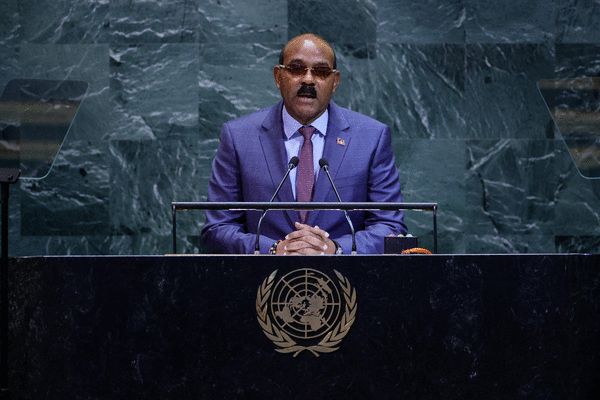
Antigua and Barbuda Prime Minister Gaston Browne admitted that he had instructed his ambassador to the U.N. to abstain from the vote. Antigua and Barbuda is among several Caribbean countries whose nationals have been restricted from entering the United States, and Browne had warned that supporting the resolution in favor of Cuba would jeopardize ongoing negotiations with the U.S.
“We had decided to support Cuba on a resolution recently and changed our position because we had a call from the State Department advising us that they’re making progress in the negotiations and if we supported Cuba, that it would undermine the negotiations, so we changed our position,” Browne told listeners.
“Our instructions to the ambassador in New York was to abstain,” he said. He added the ambassador from Antigua never showed up for the vote. “I don’t know what happened, but we changed our position because of certain things that were said, and we’re still trying, but it’s not something we have any control over,” he added.
Of the Caribbean countries present during the vote, seven voted in favor of the resolution: The Bahamas, Barbados, Belize, Grenada, St. Kitts and Nevis, St. Vincent and the Grenadines and Suriname.
Three countries abstained: Guyana, Haiti and Jamaica, while Antigua and Barbuda, Dominica and St. Lucia were marked as absent.
The only country to oppose the measure was Trinidad and Tobago. Its prime minister, Kamla Persad-Bissessar, has been a vocal supporter of President Trump’s policies in the Caribbean and an outspoken critic of the Cuban regime.
In response to questions from the Miami Herald, the State Department defended the U.S. approach toward Cuba and said the Caribbean governments’ position reflect a decline in international support for the communist island.
“President Trump has done more to promote accountability for the Cuban regime’s bad behavior than any other president in U.S. history. For the first time in over three decades, a third of the world declined to support Havana’s sham anti-embargo resolution at the United Nations,” a senior State Department official said.
Browne’s revelation about Antigua’s reversal came after a caller to the radio program complained about not being able to travel to the U.S. to visit her ailing mother because her U.S. visa had expired.
“I have said time and time again that there is no justification for it because, you know, we have had very good relations with the United States. We have never done anything to offend them, so up to this day, we’re not quite sure,” Browne said.
The prime minister’s disclosure raised questions about Washington’s diplomatic pressure and the lengths it is willing to go to get Caribbean governments to abandon their traditional support of Cuba. But the senior State Department official rejected that interpretation.
“This alleged characterization of Antigua and Barbuda’s decision is not accurate,” the official said. “Caribbean countries are rightly opting to stand with the Cuban people and against the criminal Cuban which needs to implement reforms for the benefit of its citizens.”
_____
©2026 Miami Herald. Visit miamiherald.com. Distributed by Tribune Content Agency, LLC.





Comments