Illinois Federation of Teachers makes plea to lawmakers for more school funding
Published in News & Features
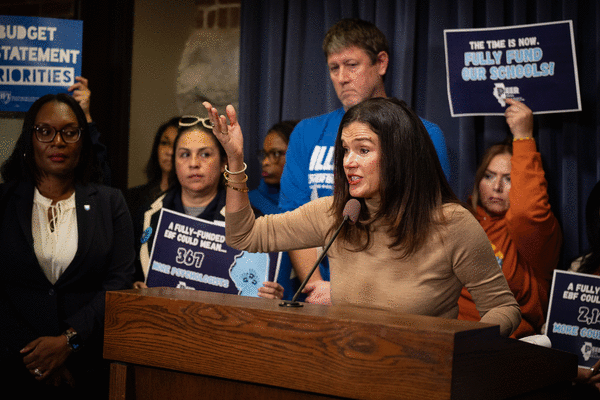
SPRINGFIELD, Ill. — One of Illinois’ largest teachers unions made an impassioned plea for more school funding Wednesday as state lawmakers convene in Springfield for the first stretch of the fall veto session.
Leaders of the Illinois Federation of Teachers, flanked by students and educators, asked lawmakers to funnel an additional $500 million to schools across the state. Proponents have pointed to Illinois’ evidence-based funding formula, which is still billions of dollars short of fully funding every school district.
“At the rate we’re going, it’s gonna take another generation of schoolchildren who are going to be attending schools that don’t have the resources, the staff, the nurses, the counselors, the paraprofessionals and the support that they need,” said Cyndi Oberle-Dahm, the union’s executive vice president. The IFT represents roughly 103,000 teachers across the state, including members of the Chicago Teachers Union.
The union’s demands come as Chicago Public Schools faces looming layoffs and other cuts if more funding doesn’t materialize.
Getting that money will prove to be a tall order. Lawmakers have six days in the fall veto session to work with, including three days this week and three more in December. School funding may be eclipsed by other issues on their priority list, such as the Chicago Bears stadium and data center regulation.
Gov. JB Pritzker’s budget office announced last week that the state was expected to bring in about $1 billion more in tax revenue than projected. Advocates argue the money could be put toward schools, but Pritzker’s office said it wants to set aside the funds as a “one-time surplus” to soften the blow of cuts to federal safety-net programs.
Any changes to the state’s budget will require a three-fifths supermajority in the General Assembly.
The IFT is calling for $100 million to go toward mandated categoricals — state grants for services such as special education, transportation and school lunches. Another $400 million, the union said, should be put into the state’s evidence-based funding formula, which provides general funding to school districts based on enrollment, demographics and student need.
Since 2018, lawmakers have mostly added $350 million to the formula annually, as required by state law. But because that figure isn’t adjusted for inflation, most school districts have slipped further away from their funding targets. CPS is funded at just 70% of what the state deems adequate, down from 73% last year. There are 270 districts in the lowest-funded category with an adequacy ratio below 72%.
Jesus Lechuga, a student at Curie Metropolitan High School on the Southwest Side, said the district’s shaky finances have created instability for students and staff. An after-school leadership program he participated in was cut during this year’s budget crunch.
“Our students cannot keep waiting for the resources they deserve,” Lechuga said.
State Rep. Will Davis, a Democrat from Homewood and a main sponsor of the evidence-based funding law, said Wednesday that EBF needs a “significant increase” in annual state dollars. Davis believes the yearly bump should be around $550 million in order for schools to be funded more adequately under the formula.
Still, he said he doesn’t anticipate that to come up during the veto session.
“I think I’ve seen some agenda items about veto. EBF, or education funding is not one of them,” Davis said in an interview from his Springfield office. “Therefore, it’ll be our usual walk in the spring session regarding trying to advocate for more money to be put in the budget that we hope to pass at the end of May.”
CPS is perennially cash-strapped, but schools were particularly hard hit this year as officials closed a $732 million deficit. To stave off teacher layoffs, CTU-aligned board members passed a budget banking on an extra $150 million in state funding, which they framed as a pressure tactic to force lawmakers to act. CPS leadership warned the move carried serious financial risk.
Relying on the unconfirmed funding, CPS rehired about 280 school staff. They may be laid off again in December without more state money, officials wrote in a recent memo to board members, although the district said this week it’s unclear how many would be impacted. And those layoffs likely still wouldn’t be enough to plug the district’s midyear budget gap.
CPS has not responded to questions about which cuts may be on the table. But this summer, officials had weighed furloughs and a midyear spending freeze.
Other pressures are straining the district’s finances, too. CPS surpassed its special education contingency budget by $17.8 million after more students qualified for services than anticipated. The district also overestimated its general state funding by $19 million, in part because Illinois changed the way it counts low-income students.
A delegation of parent and district officials, led by CPS CEO Macquline King, traveled to Springfield this week to lobby lawmakers. The CTU sent its own delegation of school staff. Against the backdrop of the Capitol, King said in a CPS social media video that limited state funding “creates an opportunity gap for our students.”
“Our students are our future, and they deserve the best education we can provide,” King said. “Not next month or next year, but now.”
_____
(Chicago Tribune’s Jeremy Gorner reported from Springfield.)
_____
©2026 Chicago Tribune. Visit chicagotribune.com. Distributed by Tribune Content Agency, LLC.




Comments