Camp Lejeune saga nears end as government seeks to limit damages
Published in News & Features
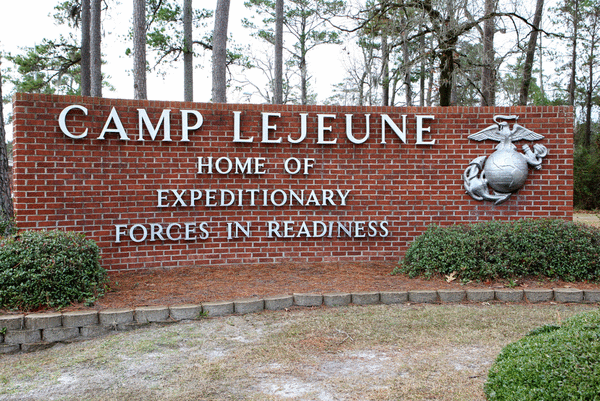
The final stages of a decadeslong battle over contaminated drinking water at Marine Corps Base Camp Lejeune are taking shape this week in a North Carolina federal court, where the first trial has begun and a mass settlement plan is in the works.
It’s been four years since Congress passed and President Joe Biden signed into law legislation ensuring individuals suffering from illnesses tied to their time at or near the base could seek compensation from the government.
The first court proceedings only just began Monday, however, in a lawsuit filed by former Marine Frank Mousser arguing his 2020 kidney cancer diagnosis resulted from exposure to toxic chemicals while stationed at Camp Lejeune in the 1980s.
But attorneys involved in Camp Lejeune litigation say the deck is stacked against Mousser and thousands of other prospective claimants, thanks to years of government bean-counters working to limit their losses. A court-ordered mass settlement is expected by Friday, the deadline set by the U.S. District Court for the Eastern District of North Carolina.
“It’s almost like they had to finally set up a trial, just for purposes of showing that the litigation is moving,” said Marc Bern, an environmental and personal injury lawyer representing Camp Lejeune claimants.
A billion here ...
Bern, who’s been involved in mass tort litigation for over 50 years, said he understands the math problem facing government lawyers given the scale of potential compensation they could be on the hook for.
The Congressional Budget Office at the time of the 2022 law’s passage said the Camp Lejeune claims could total more than $20 billion. Based on Mousser’s lawsuit and thousands of others still pending, the government could be on the hook far more than that amount if there’s no global settlement limiting the claims.
The 2022 law allowed anyone who spent more than 30 days at Camp Lejeune when the water was contaminated, between 1953 and 1987, two years to file damage claims with the Navy. If there was no resolution in six months, victims could file lawsuits at the Eastern District court in North Carolina.
Mousser’s lawsuit says he received his cancer diagnosis in 2020, at age 57, over three decades after his four-year stint at the North Carolina base.
The suit claims he’s suffered “pain, fear, anxiety, depression, and isolation; the loss of his work and of his intimate life with his wife; the loss of much of the enjoyment of life ... and a likely death more than ten years early, all as a result of his exposure to the water at Camp Lejeune.”
In a motion arguing for compensation, Mousser’s attorneys say his economic damages total nearly $1.2 million, including $802,874 for future care and $305,101 for lost earning potential. Plus, he’s seeking non-economic damages for pain and suffering.
Meanwhile, the Justice Department said in a Sept. 14 court filing that 408,500 claims have been filed, and the government has offered 3,637 of those victims settlements of between $100,000 and $550,000, for a total of nearly $1.1 billion.
That’s in line with a 2023 decision by the Biden-era Justice Department and Navy to approve what was called the “elective option,” or settlements based on the amount of time spent at Camp Lejeune and the illnesses they contracted later, if they agreed to drop further claims against the government.
Attorneys for plaintiffs and the government have each said in court that a majority of claims are likely to be thrown out due to lack of documentation. But even if a fraction of the claims are found to be legitimate, settlement payments could significantly exceed the CBO’s expectations.
“I think that I really would be shocked if there’s a trial,” said Bern, who helped win settlements worth billions of dollars for victims of the 9/11 terrorist attacks. “If there’s a trial and there’s a decent verdict ... what if somebody gets a million dollars for a kidney cancer? How do you pay, even if it’s, say, 250,000 legitimate claims?”
‘Elective option’
Bern said a more likely outcome was a global settlement based on the 2023 Justice Department-Navy plan.
Under the “elective option,” those who contracted any of five “Tier 1” diseases — kidney cancer, liver cancer, non-Hodgkins lymphoma, leukemia or bladder cancer — are eligible for $150,000 if they spent less than a year at Camp Lejeune between 1953 and 1987; $300,000 if they were at the base between one and five years; and $450,000 if they were there for more than five years.
Those with “Tier 2” diseases — multiple myeloma, Parkinson’s disease, kidney disease or end-stage renal disease, and systemic sclerosis or scleroderma — would be entitled to $100,000, $250,000 or $450,000, depending on length of time spent at Camp Lejeune.
In addition, the government would pay another $100,000 in cases of premature death from the diseases.
“Clearly, they’ve been working on a global settlement for a long time,” Bern said. “And other cases where there have been types of injuries like kidney cancer have gone for $200,000 or $250,000 a case. Well, now, there’s almost a half a million cases.”
The Justice Department’s motion to dismiss Mousser’s case seeks to offer some justification beyond the government’s simple math problem.
The motion argues that Mousser “spent significant time away from Camp Lejeune” while stationed there between 1982 and 1986, including for “deployments, trainings and medical treatments.” In addition, his current prognosis is “excellent” and he is “most likely cured of his cancer” without any “significant impacts” on his kidney functions.
The motion acknowledges he will “reasonably require additional” medical care, including a potential cancer recurrence, and that Mousser suffers from a “myriad of additional unrelated medical issues,” none of which are related to his time at Camp Lejeune.
But the government argues he cannot establish “general” or “specific” causation between exposure to water at Camp Lejeune and his cancer diagnosis.
The government similarly argues he can’t substantiate the need for the compensation he’s seeking, and that Mousser currently receives healthcare and disability benefits from the Department of Veterans Affairs — which is already straining under soaring costs. The Camp Lejeune litigation law was part of a much broader VA benefits expansion for veterans suffering from toxic exposure.
Bern said the government’s aggressive defense against Lejeune claims is not surprising.
“Look, the shareholders in this case, if you want to equate it to that, are the taxpayers, and the DOJ has an obligation to pay cases that are legitimate, meritorious,” he said. “They also have an obligation not to pay cases that are not meritorious. There’s not a blank check here.”
At the same time, victims of the contamination deserve justice, Bern said.
“You know these are patriots, true patriots, who were treated horribly by the government, by this country, and they’re entitled to just compensation, and hopefully that will happen,” he said.
‘Exposed and shamed’
Former Rep. Matt Cartwright, D-Pa., who oversaw the Justice Department’s budget on the Appropriations Committee, helped push the 2022 Camp Lejeune law to fruition after hearing from victims.
Now a mass tort attorney in Philadelphia, Cartwright said the government has been clearly stonewalling on the issue for years.
“I have felt nothing but frustration with the DOJ and the Department of the Navy,” said Cartwright. “The way they’ve acted, they acted like huge tobacco companies that got sued. That wasn’t the point. The point (of the 2022 law) was to give these people their day in court, and they’ve acted like nasty civil defense lawyers the entire time.”
Cartwright said he hoped a trial proceeds before any settlements are negotiated, to help expose the government’s role in the Camp Lejeune-related illnesses. The story, he said, involves “people in charge, people who knew ... that there was poison in that water, and kept their mouths shut rather than cause trouble.”
“These people need to be exposed and shamed,” Cartwright said. “We need to make an example of the people who keep their mouths shut when they know people are being poisoned.”
Adding to the concerns of plaintiffs in the litigation are comments made by President Donald Trump at a rally in North Carolina last week, saying Camp Lejeune victims will be compensated only if Republicans win the midterm elections.
Some victims took the threat as an indication the government never plans to pay their claims.
“That’s a legitimate concern by the claimants, no question,” Bern said. But he also dismissed the president’s statements as purely political. “Trump, of course, regardless of what you think about him, he just says things that other people would never say.”
©2026 CQ-Roll Call, Inc., All Rights Reserved. Visit cqrollcall.com. Distributed by Tribune Content Agency, LLC.





Comments