Carnegie Mellon students, professors weigh in on Griffin's $3 billion donation, planned Miami campus
Published in News & Features
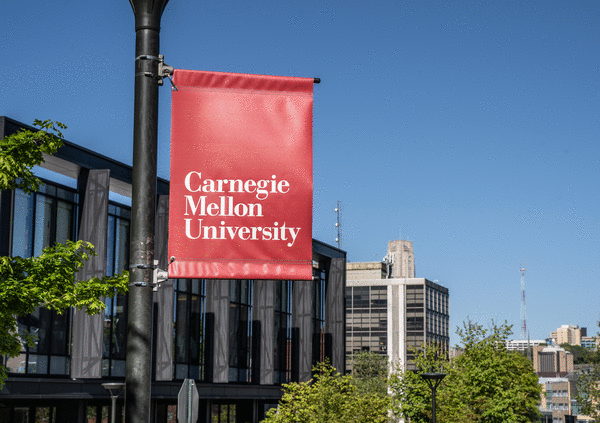
PITTSBURGH — Looking out at the green Tepper Quad on Carnegie Mellon University’s Oakland campus, Benjamin McHale pondered what might be next for the elite institution after the announcement of a $3 billion gift.
It’s a number that broke records nationwide.
Citadel CEO and billionaire Ken Griffin’s gift to the university is the largest individual donation in higher education history. Two-thirds of that gift will be used to establish a CMU campus in Miami, while the remaining $1 billion will go to the flagship Pittsburgh campus.
“I can’t even comprehend what we’re going to use the money for,” said McHale, a sophomore from Squirrel Hill who studies business. He pointed out that the gift dwarfs the impactful $67 million given by alumnus and investor David Tepper in 2013, making it possible for CMU to create the quad and construct a 295,000-square-foot building to house its Tepper School of Business.
“I’m super excited for Pittsburgh.”
School officials announced the donation on Wednesday. The Miami campus, to be located in the coastal city’s Wynwood neighborhood, will begin welcoming students in just two years if all goes as planned.
By its completion in 2041, it will enroll 3,500-4,000 undergraduate, master’s and doctoral students and employ about 300 faculty and 600 staff members, according to school officials.
Meanwhile, $500 million of the gift to Pittsburgh will be invested in CMU’s School of Computer Science, which will now bear Griffin’s name. The rest of the Pittsburgh portion will be used to recruit talent, expand access and affordability for students, and invest in research.
Illah Nourbakhsh, a CMU professor of robotics, sees the gift to the School of Computer Science as a game changer for the world of artificial intelligence.
Much of the current discourse surrounding AI is driven by companies motivated by pleasing shareholders and maximizing value, Nourbakhsh said. This donation will give CMU the resources it needs to steer the direction of AI.
“We finally have the chance to have our people, our students, tame [AI] in the right ways,” Nourbakhsh said. “The university campus is again the center of innovation. People are first.”
Others, though, have questioned why Griffin picked CMU to make this historic donation. Griffin is a Florida native who earned his bachelor’s degree from Harvard University, and he has no immediate connections to Pittsburgh or CMU
Stephen Makin, a creative writing student at CMU, said he found this fact “odd.” He hopes students see a trickle-down benefit from the donation.
Makin also said he hopes the Miami campus doesn’t begin to overshadow the flagship Pittsburgh campus.
“All I hope is that having another campus doesn’t detract from the legitimacy of a school like this one that seems presently on the rise,” said Makin, a senior. “I hope it’s not us shooting ourselves in the foot.”
Griffin told the Post-Gazette it was CMU’s “laser-like focus” on national opportunities that prompted his gift. In a Wednesday interview with CNBC, he didn’t directly address why the money wasn’t going to his alma mater, Harvard.
Students and others have also questioned whether Griffin, who has been appointed to the university’s Board of Trustees, will hold any unfair influence over CMU.
“It’s interesting he basically bought a spot on the board,’ said Clementine Constantino, a junior studying harp performance.
She’d like to see some of the money be used to support student financial aid and CMU’s arts programs.
Constantino’s friend, Tabitha Mo, echoed the hope that this money will increase affordability. She said she appreciates that Griffin is using his money to support education, and thinks the Miami campus sounds “pretty cool.”
“If I had the money and felt passionately about the path a school was going down, I’d give it,” said Mo, a junior studying flute performance.
As Jayden Peterson, a freshman business major, sees it, Griffin is investing in education “instead of buying yachts.”
“It’s going to make CMU’s name a lot bigger,” Peterson said. “This donation validates the students.”
CMU’s recently formed American Association of University Professors chapter called on the university to use the gift to retroactively address the lack of cost-of-living and merit salary adjustments, fund scholarship amid federal funding cuts, and support diversity, equity and inclusion initiatives.
“We look forward to a strong faculty partnership in shaping the priorities and strategies that will realize this gift’s full potential across all disciplines and community needs,” the faculty group said in a statement.
The establishment of the Miami campus is doubling down on Griffin's investment in the Florida city, which he sees as the “nexus of the Western Hemisphere.” He moved Citadel headquarters to Miami in 2022.
“Money usually talks, and the establishment of a Miami campus tells me the CMU board, with Griffin's generosity, is talking with its feet with $2 billion of investment,” Robert Strauss, a CMU professor of economics and public policy, said in a written statement.
The Miami campus’ degrees and curriculum will be structured around “grand challenges areas” rather than traditional academic majors and departments. These areas will include human health and biological discovery; national security and strategic capabilities; energy and climate resilience; and advanced manufacturing and industrial transformation.
Norman Bier, director of CMU’s Open Learning Initiative, sees the expansion into Miami as a way for the university to continue solving the world’s problems.
“For me, this builds on something fundamental to Carnegie Mellon: Understanding technology means understanding the people it affects,” Bier said in a written statement. “By bringing CMU’s expertise to Miami’s dynamic ecosystem, we’ll attract even more of the world’s brightest minds and cultivate partnerships with industry leaders to work on some of the world’s toughest problems.”
Justin Cui, a master’s student in the Griffin School of Computer Science, said he believes Griffin’s gift speaks to the university’s reputation.
“We’re in a very important time in history right now,” Cui said. “We’re defining the future.”
© 2026 the Pittsburgh Post-Gazette. Visit www.post-gazette.com. Distributed by Tribune Content Agency, LLC.






Comments