Bessent says AI industry must own its risks and find solutions
Published in News & Features
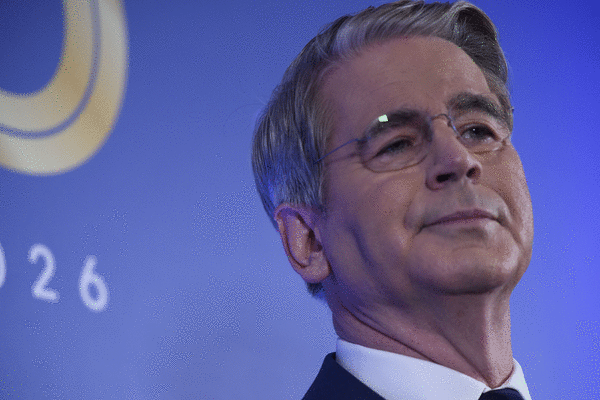
U.S. Treasury Secretary Scott Bessent criticized prominent artificial intelligence figures’ warnings about existential risks posed by the technology as alarmist and unhelpful, calling on the industry to police itself and produce solutions.
“I believe that we have to be prepared for every occasion, but on the other side, this alarmism without solutions by some of the AI community, that’s not leadership,” Bessent told Axios in an interview published Saturday.
Anthropic PBC Chief Executive Officer Dario Amodei, OpenAI chief Sam Altman and xAI Corp.’s Elon Musk in September called for the industry to slow development of its most advanced models, citing growing risks for humanity. Microsoft co-founder Bill Gates also warned the technology is powerful enough to cause “a billion deaths” and called for government regulation.
President Donald Trump almost immediately rejected such calls, labeling the increasingly dire warnings about risk to humanity a “hoax” and insisting the U.S. must push forward to maintain leadership over China — a sentiment that Bessent echoed in his remarks to Axios. “We cannot lose our lead to the Chinese,” he said.
“It is the people at the labs who have to accept responsibility, and I agree with that,” Bessent said. “I think the labs have come around to that way of thinking, too.”
No new regulations
In a meeting with top industry executives including Musk, Microsoft CEO Satya Nadella, Meta Platforms Inc.’s Mark Zuckerberg, Palantir Technologies Inc. CEO Alex Karp and OpenAI President Greg Brockman. this week, the U.S. president shot down the idea of new federal regulation.
“There’s a belief that there should be tremendous self-regulation, and we automatically have regulation with the Department of Justice, the FBI, all of that, but the self-regulation is very important,” Trump told reporters at the time. He instead endorsed using outside auditors to assess AI systems’ safety in a nonbinding accord with Silicon Valley leaders.
Bessent told Axios the U.S. will also seek to mitigate risks with a bilateral notification system with China that aims to reduce uncertainty, share warnings about serious incidents and help both governments respond before an AI problem escalates or spreads globally.
The treasury secretary and Chinese Vice Premier He Lifeng discussed artificial intelligence during talks in New York in September, saying the two countries agreed to create a “U.S.-China AI dialogue” to try to develop a common understanding of the technology’s benefits and threats. The two met shortly before the summit between Presidents Donald Trump and Xi Jinping in Washington, where AI was among the topics.
Xi told Trump during his visit that China and the U.S. can keep discussing AI, exchange views on its risks and benefits and work together to prevent its misuse, China’s Xinhua news agency reported.
Bessent told Axios they discussed risks such as uncontrolled AI agents and non-state actors using AI for cybersecurity or biological threats.
“A lot of these Chinese models are very powerful — not as powerful as the U.S. models — but you get something that’s 80%, 90% as powerful, without guardrails that can be imported anywhere in the world,” Bessent told the outlet.
Asked about AI industry executives’ calls for regulation, however, Bessent replied: “Well, then they should slow down.”
“We want safe acceleration,” he said. “It is the people at the labs who have to accept responsibility, and I agree with that.”
©2026 Bloomberg L.P. Visit bloomberg.com. Distributed by Tribune Content Agency, LLC.





Comments