Chicago-area election officials gear up for potential ICE, FBI presence at the polls after Trump threats
Published in News & Features
CHICAGO — Before federal immigration agents stormed across the Chicago region last year and President Donald Trump threatened to send in the National Guard, Gov. JB Pritzker warned both moves aimed to “normalize” a federal military presence to intimidate voters and depress turnout in the 2026 midterms.
Some at the time viewed Pritzker’s contention as a bit of a stretch, given federal laws prohibit armed civil or military personnel at the polls and state laws bar election interference. But as the immigration surge grew chaotic, combative and deadly in Chicago through Operation Midway Blitz and in other operations throughout the country, the governor’s concerns gained traction.
Now, citing recent comments by Trump and top administration officials, voting rights activists and Democratic officials have filed at least two lawsuits in federal court in Washington that seek to block what they contend is a “polling place policy” that would allow U.S. Immigration and Customs Enforcement and FBI agents to operate in or around polling places.
At the same time, local county clerks and election officials in Illinois have stepped up planning for various scenarios involving federal activity at the polls. Their options include deploying lawyers to federal and state court to seek injunctions and using local law enforcement to make arrests under state law.
“A polling place should be a safe and protected civic space where every eligible voter can walk through the door, cast their ballot and leave without fear or intimidation,” Cook County Clerk Monica Gordon said last week after a roundtable of local officials and voting rights advocates in west suburban Franklin Park. “The polling place belongs to the voters on Election Day. Our job is to make sure they can exercise their right to vote safely, securely and without interference.”
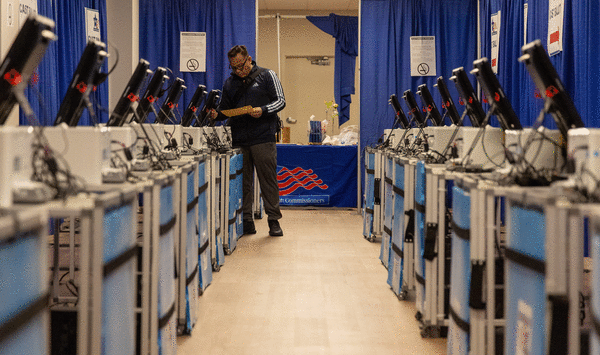
The general election is Nov. 3, less than five weeks away, and early voting in Chicago starts Thursday at the Early Voting Super Site, 137 S. State St., and the Chicago Board of Election Commissioners’ offices at 69 W. Washington St., on the 6th floor.
Over the past three months, staff from Illinois Attorney General Kwame Raoul’s office and the Illinois State Board of Elections staff have held weekly virtual meetings with local election authorities around the state. The meetings initially focused on federal court rulings that rejected Trump-led efforts to restrict mail-in balloting. But they have “fed into other conversations” about the potential for federal intervention in the election, said Lake County Clerk Anthony Vega.
“This is a heightened resource, or at least a mechanism, for having those higher-level conversations and they’re super helpful,” Vega said, because “elections are run at the local level (and) it’s going to be up to the clerks to really be the driver in terms of preparation.”
“Since we run elections at the very local level, sometimes it can be very isolating. Being able to get together is very beneficial,” said Vega, who also has been hosting webinars with Lake County State’s Attorney Eric Rinehart on election interference issues, including one set for Oct. 14.
Voters share election officials’ concerns. A Suffolk University/Chicago Tribune survey of 500 adult Chicago residents conducted in April found 64% said they were concerned immigration agents would reemerge around the general election, while 31% said they don’t share that concern. The poll’s margin of error was 4.4 percentage points.
“We know that a number of constituents continue to make calls, whether it’s directly to their member of Congress, whether it’s the Board of Elections or a state senator or a city council person or (speak) among family members at the dining room table: ‘Will we be able to vote this year?’ ‘Will it be safe to go out and vote?’ ‘Will my vote count … and when I go to vote, will I be threatened? Will I be in any way harassed or in any way feel the fear to go vote because perhaps there is a deployment of ICE agents there?'” U.S. Rep. Delia Ramirez said after the Franklin Park event.
“The president has weaponized fear and division and abused every authority and power to erode social trust and undermine democratic institutions,” the Democratic congresswoman said.
A federal court case filed in September on behalf of Hispanic civil rights groups, voting rights group Common Cause and the city of Denver, Colorado, as well as a lawsuit filed by various campaign entities of the Democratic National Committee and congressional Democratic leaders, cite a number of statements from Trump and the administration that they say warrant judicial action.
In May, when reporters asked Trump about sending the National Guard or ICE agents to polling locations, he said he would “do anything necessary” to hold what he viewed as an “honest election.”
On Sept. 1, Homeland Security Secretary Markwayne Mullin said the administration’s policy could include sending immigration agents to polling places to conduct enforcement operations, including serving warrants and detaining people suspected of being unlawfully present in the country.
Two weeks later, FBI Director Kash Patel was asked during a Senate Judiciary Committee hearing if he planned to send agents to the polls. He replied, “Election integrity is of paramount importance.” Asked whether he would pledge not to interfere with the will of voters going to the polls Nov. 3, Patel responded, “I pledge unequivocally that I will not participate in your charade of lies.”
“Notwithstanding federal law, and the traditional sanctity afforded to polling places, the Trump administration has made clear by word and deed over the past year that it asserts the authority to dispatch armed officers to active polling locations,” the Democrats’ lawsuit contends.
A federal statute enacted by Congress just weeks before President Abraham Lincoln was assassinated in 1865 prohibits “armed men” in the “civil, military or naval service of the United States” from being present “where a general or special election is held, unless such force be necessary to repel armed enemies of the United States.”
Additionally, federal law prohibits any person “whether acting under color of law or otherwise” from intimidating, threatening or coercing any other person “for voting or attempting to vote,” or “urging or aiding” someone else to vote or attempt to vote.
The Illinois Constitution prohibits denying the right to vote “based on race, color, ethnicity, status as a member of a language minority, national origin, religion, sex, sexual orientation or income.” In addition, anyone who “by force, intimidation, threat, deception or forgery knowingly prevents any other person” from lawfully voting “is guilty of a felony.”
It also gives election judges the power to seek the arrest of anyone for the “breach of the peace or for any breach of election laws” or interference with the election and requires law enforcement to follow such an order “as if a warrant had been issued.”
As has traditionally been the case, the Illinois attorney general’s office is sending out teams of assistant attorneys general and investigators to monitor the elections.
But the Chicago Board of Election Commissioners has gone a step further by retaining an outside law firm so it can go to court quickly if necessary.
Marisel Hernandez, who chairs the Chicago election board, said the election authority realized a year ago, with the launch of Operation Midway Blitz, that city polling places could face federal intervention in 2026.
“We started meeting with a number of law enforcement agencies — and that includes the FBI, the Chicago Police Department, the Illinois attorney general’s office, the Cook County state’s attorney’s office, the Illinois Board of Elections and the Cook County sheriff’s office as well — because we wanted to be prepared in case anything occurred and we wanted everybody to be on the same page with regards to a plan of action,” Hernandez said.
“We’re trying to do everything we possibly can to stay ahead of any potential issues and react accordingly,” she said.
At least one field investigator, usually a retired law enforcement officer, will be stationed at each early voting site, Hernandez said. On Election Day, 212 more field investigators and 50 ward supervisors will be on patrol, with 200 auxiliary field investigators on standby, she said.
“We’re determined to reassure the voters that everything proceeds as normal,” she said.
____
©2026 Chicago Tribune. Visit at chicagotribune.com. Distributed by Tribune Content Agency, LLC.





Comments