Miami's plans for Cuba's 'day after' revisit thorny questions about money, reconciliation
Published in News & Features
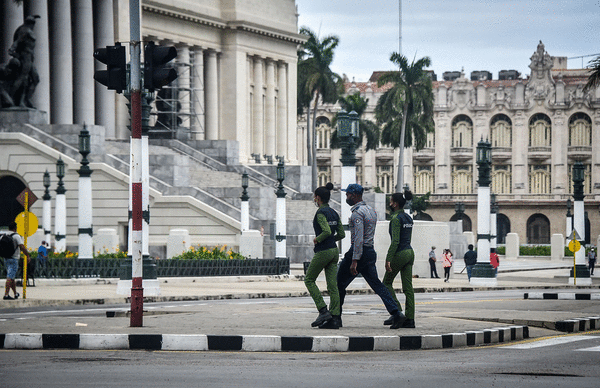
As President Donald Trump mused about “taking Cuba” earlier this year, the question that has hovered over the exile community for decades — what happens the day after Cuba’s communist regime falls — suddenly gained urgency, sparking an intense planning effort in Miami for a future transition whose contours are still unclear.
Prominent Cuban Americans and opposition organizations have rushed to offer their own vision for a post-communist Cuba, producing a “freedom accord,” a “fundamental law,” a playbook for “Day zero,” and an economic stabilization program. Wealthy Cuban American families have gathered in a new chamber of commerce, ready to invest when democracy comes to the island.
As they plot plans for the future, they have stumbled upon challenges similar to those that underpinned post-communist transitions in Eastern Europe near the end of the 20th century, from how to pay to rebuild a country whose power plants, hospitals and roads are in ruins to what to do with the Communist Party.
The planning boom is a product of events in 2026: U.S. special forces captured Venezuelan strongman Nicolás Maduro on Jan. 3. The Trump administration then cut off the oil that kept Cuba’s lights on. It also opened back-channel conversations with Raúl Castro’s grandson. Trump told reporters in March he expected to have the honor of “taking Cuba in some form.”
That talk has faded, but Cuba’s collapsed economy and humanitarian crisis, paired with foreseeable leadership changes in the near future — the country’s ideological leader, Raúl Castro, is 95, after all — demand urgent action, the people involved in the planning have said.
“Nobody knows the how, the manner or the outcome,” Jorge Mas Santos, chairman of the Cuban American National Foundation and an owner of the InterMiami soccer club, told The Miami Herald. The foundation released one of the most ambitious Cuba plans this spring. Like most, it is written for the moment after regime change arrives.
It calls for “a free-market democracy grounded in private initiative,” a constitutional republic with an independent judiciary, and a government that is “limited, transparent, and focused on creating the conditions for growth — not on directing growth.”
Mas said he came out of meetings with Trump and Secretary of State Marco Rubio earlier this year “convinced that we are going to see a change in Cuba,” which is why, he added, “those of us who are abroad need to show Cubans on the island that there is a path for change and they don’t have to fear it.”
Mas put Cuba’s reconstruction capital needs at between $40 billion and $90 billion — and said raising that kind of money is “zero problem.
“This equation is not going to fail for lack of capital,” he said. “What is needed is a legal framework, a framework of protection and investment incentives.”
He said his family’s assets are available to invest in a free Cuba. He predicted rapid results: a first-world electrical grid “in the first year” and full employment within six months to a year. “We cannot be talking here about a transition of four, five, six, seven, eight years,” he said.
Rafael Romeu, CEO of Washington-based DevTech Systems and president of the Association for the Study of the Cuban Economy, estimated a much higher reconstruction cost of $275 billion to $375 billion over 10 to 15 years. The money, he said, would primarily come from the Cubans abroad, which he called “Cuba’s oil” and “the only resource large enough to rebuild” the island.
“This is not aid,” he said at an event organized by the American Museum of the Cuban Diaspora in July, where he presented his “Cuba Day Zero” road map. “It’s a national rebuild of Cuba’s entire economy, funded by private capital, not taxpayers.”
A major roadblock is that Cuba cannot count on the funding that rebuilt Eastern Europe. Post-communist economies received $165 billion in multilateral support between 1990-95. But Cuba does not belong to the institutions that provided it, such as the International Monetary Fund or the World Bank. U.S. law – the 1996 Helms-Burton Act – requires the U.S. government to oppose Cuba’s admission to such financial institutions until the president formally notifies Congress “that a democratically elected government in Cuba is in power” in Havana.
“There is no multilateral safety net on day one,” Romeu said. “And USAID-led nation-building like in Iraq or Afghanistan is no longer U.S. policy,” he said, referring to the foreign aid agency dismantled by the Trump administration.
Still, Helms-Burton authorizes humanitarian aid and assistance to a transition government to meet the population’s “emergency” needs. Romeu estimates Cuba needs $180 million to $270 million in U.S. aid to stabilize the country in the first six months, pay civil servants, police and doctors, and keep “lights on and people fed.”
A newly created Cuban American National Chamber of Commerce said its members want to see full legal guarantees and a democratic government before making any investments.
The chamber’s members say the money is there. Juan Omar Sixto told The Miami Herald that if the group reaches its goal of 100 wealthy Cuban-American families, their combined net worth would be around $200 billion. At the group’s first gathering in March in Miami, he said Cuban Americans in exile are willing to move capital to Cuba, but only when change comes.
At a congressional hearing in June, Miami U.S. Rep. María Elvira Salazar asked Rubio whether Washington could find “another Delcy” in Cuba — a reference to Delcy Rodríguez, the Venezuelan former vice president who now leads the country as interim president. Rubio said the administration has not found “a singular individual right now that we would trust and rely on to lead this transition from start to finish.” He then cited the post-communist transitions in Poland and the Czech Republic.
“One of the things they did is they did preserve certain institutions in their society in order to provide stability and longevity,” he said.
A proposed transition law drafted by the Cuban American Bar Association follows a similar premise. It allows public employees and government officials to keep their jobs if they were not “significantly involved” in human rights violations and swear loyalty to the new order. Military officers could remain in service under similar conditions.
The proposed law creates a 15-member “Pro-Unity National Council” that would appoint an interim president and Cabinet. Its members would be drawn proportionally from “the dissidents, exiles, and Cuban citizens as a whole, including members of the previous regime.”
The question of whether people from the current system should help lead the transition elicits strong emotions among Cuban exiles. News reports that the Trump administration had contacted Raúl Castro’s grandson were met with disbelief and rejection among many exiles in South Florida.
“The incompetents need to get out of the way — the Castro family, the bureaucratic apparatus inside Cuba,” Mas said. “Those have to be eliminated... because they are all an obstacle to progress.”
Human rights activist Rosa María Payá, whose group Pasos de Cambio is one of the signatories of the Freedom Accord, a transition plan that brings together several opposition organizations of Cuban exiles and dissidents on the island, said Havana’s current leadership would have to leave on day one. However, those leading the transition efforts would need to work with the government bureaucracy at the beginning, she concedes.
The accord’s signatories have already established working commissions that Payá said “will be the leadership of the departments or ministries during a provisional period.”
Payá, who also serves on the Inter-American Commission on Human Rights, also opposes the administration’s efforts to work through a figure in the current government, rejecting the widely shared view that no organized opposition movement exists in the country.
“Today the opposition, the Cuban civic organizations, are ready to lead this process,” she said.
A Cuba Working Group at Harvard University, mostly made up of Cuban and Cuban American academics and activists, including two from Miami and three from the island, takes a different approach: Its members want Cuban authorities to “take the initiative in this process and become facilitators,” their report says. It acknowledges that “this is not a premise shared by all political actors in Cuba and the diaspora.”
The report provides a searing assessment of the government led by Cuba’s appointed leader, Miguel Díaz-Canel, and its role in precipitating a humanitarian crisis on the island. It also blames the Trump administration for aggravating it with sanctions. But it argues that the situation is so bad that the Cuban government “must” facilitate a peaceful transition, beginning with a full amnesty for all political prisoners and the elimination of laws and decrees criminalizing dissent.
The report drew quick pushback. An editorial piece in Cuban independent news outlet 14ymedio argued that Harvard’s proposal risks preserving “the power of the leadership responsible for the national tragedy under a new institutional guise.” Right-wing commentator Ninoska Perez-Castellón made a similar point in the Miami-based newspaper Diario las Américas, also questioning the report’s call for Cuban Americans to lobby the administration to end the Helms-Burton law.
Alejandro de la Fuente, a Latin American history professor at Harvard University and founding director of its Afro-Latin American Research Institute, originally convened the Cuba Working Group and said he understands why many Cubans, in the U.S. and on the island, reject the idea that the current leadership should have a role in a transition.
“It’s not a bad point, it’s a good point, but we have to get this going first. How do we get this going without an invasion?” he told the Herald.
“Nowhere do we say that the Cuban government will handle the transition,” he added. “We say that the Cuban government should facilitate this process because it is operating in a context where it already has very little room to maneuver. We are advocating a dose of realism by telling the Cuban authorities to take the initiative before it is too late and facilitate this process—without assuming they will guide it all the way.”
Critics doubt that the Cuban government would act on the proposal.
After all, the Trump administration has already pressed for the release of political prisoners and changes in the country, which the Cuban leadership has repeatedly rejected, even as living conditions worsen by the day on the island.
De la Fuente insists it is important to stress that such demands primarily come from Cubans themselves.
“We are voicing a demand made by the Cuban people,” he said. “Releasing these prisoners is not an American issue, and the Cuban government should not treat it as a matter of American pressure. We are trying to detach this agenda — to shift it away from the realm of U.S. foreign policy. It shouldn’t be a concession to the United States; it shouldn’t be a concession at all — it should be an act of justice.”
The Cuban government, predictably, did not take the report’s suggestions kindly. Instead, Foreign Minister Bruno Rodríguez attacked it on X, accusing the report of being “pseudoscientific... psychological warfare against our people” and its authors of aligning with propaganda designed by the State Department.
Speaking to reporters on Wednesday in New York, Rubio voiced a proposal very similar to what the Harvard working group is advocating for and again suggested the administration would prefer a negotiated transition in Cuba.
“Obviously, there are some individuals in that regime with whom we can never work because their hands are stained in blood, but there are people there that I believe that you can work with, if they are willing to put the country on a path towards political and economic freedom,” he said.
The debate echoes criticism once aimed at Oswaldo Payá, the Catholic dissident and Rosa Maria Payá’s father, who spent two decades drafting transition plans from his Havana home. His 1992 transition program proposed a National Council of the Transitional Government with an equal number of Communist Party members and opposition representatives.
“The Cuban Communist Party will not be banned,” the program says. In Payá’s plan, party cadres would continue their duties, just like ministers and state employees, who would answer to transition commissions. The Revolutionary Armed Forces and the Interior Ministry would cease as institutions, but their units would keep their chain of command under civilian authority.
Payá presented the inclusion as much a matter of reconciliation as order. He began thinking seriously about a transition in 1989, after the Tiananmen Square massacre in China, “terribly worried the same thing could happen in Cuba,” said David E. Hoffman, a former Washington Post columnist who wrote a biography of Payá.
“Some of it is controversial right now,” and has no clear answer, Hoffman said. “A cleansing of all the old regime’s people would have been a calamity. If you get rid of everybody in the state, you’re going to have a lot of difficulty. But if you include them, then you have to reconcile with them, and these things are very incompatible.”
When talking about Cuba, Trump usually mentions his Cuban American friends, the millionaires and billionaires who would gladly return to Cuba to rebuild it.
The Cuban American National Foundation’s roadmap says Cuban Americans “have amassed extensive amounts of capital” and “are eager to partner with Cubans living in Cuba.” The Harvard group calls Cuba “a transnational nation.”
But the sheer volume of planning in Miami has also raised questions about power and the role Cubans on the island will play in a transition.
Three million Cubans emigrated between 2013-24, the Harvard report says, citing a loss of close to 30% of the population. Many of the dissidents who once did this kind of work inside Cuba are now in exile or in prison.
“I don’t see anybody presently working at this level on this kind of detail on the island,” Hoffman said. “There’s still some opposition, but the kind of thing Oswaldo was doing doesn’t seem to exist anymore.”
Payá, he added, “left us with this idea that it has to come from within. And yet, Cuba is sort of empty. Is his idea out of date? Maybe it is.”
Survey data suggest many people on the island welcome exile involvement. In a poll by El Toque, an independent digital media platform run by Cuban journalists in exile, 54% of respondents inside Cuba said exiles should take part in a transitional government on equal terms. Another 25% would give them a leading role, and only 6% would exclude them entirely.
Rosa María Payá said the Freedom Accord is built precisely to protect Cubans on the island, answering government propaganda that “the people from Miami” will come to take over.
“It is precisely to look after the interests of those who have historically been at a disadvantage. And that is us, the Cubans, and above all the Cubans who are inside Cuba,” she said. “It includes provisions such as no one will be removed from their home. This is a problem for Cubans. We Cubans have to solve it, and we are doing it as best we can.”
But experts warn that the plans written in Miami and elsewhere will likely face pushback inside the island.
Will Freeman, a fellow for Latin America studies at the Council on Foreign Relations, said that on the island, “any plan for transition” is likely to be viewed by many as “a threat to whatever small livelihood they’re hanging on to.
“Transitions are often made of compromise of many kinds, and those compromises are often imperfect,” Freeman said. “Unless we’re grappling with what you’re actually willing to put on the table, it all just seems sort of like an exercise in the abstract.”
Hoffman, who has studied the collapse of the Soviet Union, warned about expectations. Transitions “have basically never followed the plan,” he said.
In Russia, people’s expectations were far higher than the transition could deliver, and after a decade they gave up, he said. Cuba’s starting point, he added, is not 1992, when Payá wrote his plan. Since then, talent has drained away, the military controls much of the economy, and the Castro family remains a dynasty.
“Transition is not just a bunch of think tanks and political activists,” Hoffman said. “It’s a very real thing for people every day of their lives, and oftentimes extremely messy.”
_____
©2026 Miami Herald. Visit miamiherald.com. Distributed by Tribune Content Agency, LLC.

Comments