St. Paul police chief's lawsuit says Mayor Kaohly Her overstepped boundaries beyond sexual harassment
Published in News & Features
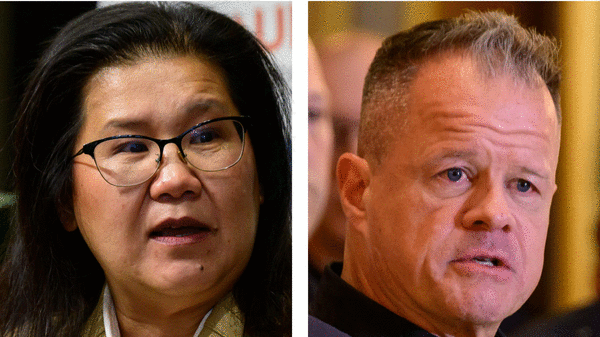
A lawsuit filed Wednesday by St. Paul Police Chief Axel Henry says Mayor Kaohly Her overstepped bounds in other ways beyond sexual harassment.
While the harassment allegations are attention-grabbing, the lawsuit also describes the backdrop to Her’s interactions with the department since she became mayor, working conditions after Henry made a sexual harassment complaint and other apparent power struggles, including:
—Her bringing up that the fire union endorsed her mayoral campaign while the police union did not — and “you are going to need to be extra nice to me.”
—Her and an assistant mayor saying they could override Henry’s personnel decisions, which he disputed.
—Henry saying he learned that Her requested and was being provided confidential law enforcement information.
The outside investigation of Her did not substantiate allegations that she “engaged in sexual harassment of any city employee,” but found she “engaged in offensive and inappropriate behavior,” according to a summary released Sept. 18 by the mayor’s office.
Henry filed a lawsuit against Her on Wednesday, alleging sexual harassment, reprisal and violation of the Minnesota Whistleblower Act.
In response to Pioneer Press questions Friday about working-condition allegations in the lawsuit, the mayor’s office issued a statement similar to what they said about the lawsuit on Wednesday.
“An independent investigation did not substantiate allegations of sexual harassment or retaliation against any city employee,” the statement said, adding that Her cooperated fully with the investigation. “The Mayor will continue to lead St. Paul and follow the recommendations of the report. Beyond that, the City of St. Paul doesn’t comment on active litigation.”
The St. Paul City Council is scheduled to have a closed-door meeting Wednesday about the lawsuit, which is common when litigation is underway. The council is likely to hire outside legal counsel to represent the city.
Following are some of the workplace issues alleged in Henry’s 73-page lawsuit complaint:
Endorsement implications
Her was elected in November over incumbent Mayor Melvin Carter. In January, she brought up to Henry that the police department had not endorsed her campaign, Henry’s attorney, Chris Madel, wrote in the lawsuit.
Henry responded that the police department could not endorse any candidate. He explained that the police union, of which he is not a member, could endorse candidates, but had not endorsed anyone in the 2025 mayoral election.
The lawsuit said that’s when Her made the comment about the fire department, whose union had endorsed her, and the need for Henry “to be extra nice to me.”
“This concerned Chief Henry because now the inappropriate comments and advances were tied to his department’s funding, including SPPD salaries,” Madel wrote. “Chief Henry was also concerned because he didn’t know what ‘being nice to (Mayor Her)’ would entail.”
Pay issues raised
The lawsuit raised pay issues. In late 2025, then-Mayor Carter “agreed to give Chief Henry and his leadership team a notable, but modest, pay raise with some backpay,” the lawsuit said.
Early this year, the Minnesota Public Employees Retirement Association notified the department’s deputy chiefs that the way the city made their backpay payments were “incorrect and would negatively impact” their pensions. They tried to point out the error to city staff, who “pushed back and communicated that they would not change the process,” the lawsuit continued.
When Her asked Henry to meet him at a bar on a Saturday night in February, Henry told the mayor at the meeting that the city “had not processed his employees’ backpay correctly, including his own, and it was now beginning to feel retaliatory because the deputy chiefs had chosen to organize and seek union representation.”
“Mayor Her responded that the City had addressed the issue, so Chief Henry asked why the backpay for SPPD (police department) and SPFD (fire department) were being paid out differently,” Madel wrote. “Mayor Her smiled, shrugged and said she didn’t know why that was happening. Chief Henry understood her gesture and smile to mean she did know but she wasn’t planning on doing anything about it. Chief Henry recalled the mayor’s comments about the SPFD endorsement and him needing to be nice to the mayor.”
Her said Henry needed to make a choice to be her friend, be “just an employee/colleague, or ‘go,’” the lawsuit continued. “Chief Henry understood that to ‘go’ meant resign.”
Personnel decisions
Henry was in a June 16 meeting that included Erica Schumacher, first assistant mayor-safety and justice, City Attorney Irene Kao and St. Paul Human Resources Director Kamaria Kassim.
The lawsuit said the “mayor and Schumacher consistently asserted they had the power to override Chief Henry’s personnel decisions,” Madel wrote. “Numerous times, verbally and in writing, Chief Henry had disputed this but added, if that was their position, they would need to get legal clarity.”
At the meeting, Kao informed them, “Mayor Her had final say on personnel decisions generally, including but not limited to who would drive Mayor Her,” which is typically a St. Paul police officer. “Chief Henry said he didn’t understand how that was possible, so he wanted Kao to put that in writing.”
The city attorney said she would do more legal research about the question.
Kao did not send Henry information in writing, “including who would drive her, let alone a (St. Paul police officer) driver that would be paid 16 hours a day, seven days a week,” the lawsuit said. “Chief Henry has wondered if the Mayor and her staff desired to provide her SPPD driver with excessive overtime pay to ensure that he would provide testimony favorable to Mayor Her in this matter.”
At a July 2 meeting, “City staff acknowledged that Mayor Her and Schumacher had been wrong, and that neither had the authority to dictate the personnel decision regarding Mayor Her’s driver in the manner they had,” Madel wrote.
Confidential information
Her’s travel protocol came up earlier, in a May 8 meeting that included Her, Schumacher, Assistant Chief Paul Ford and Henry.
Each St. Paul mayor is typically assigned a St. Paul police officer who serves as the elected official’s driver and executive protection officer.
The meeting topic shifted to the SPPD driver potentially providing confidential law enforcement information to Her and her team, which could be a violation of state law.
Henry told Schumacher that if this was happening, the driver would need to be removed from his position as driver, the lawsuit states. Schumacher stated that the driver “might overshare” “at times” because Her was “probably asking him.”
Henry later learned that Her requested, and was being provided, confidential law enforcement information “in violation of Minnesota law,” according to the lawsuit. The information allegedly shared with Her was not included in the lawsuit, but will be included during pretrial discovery, according to the complaint.
“The SPPD driver’s role is limited to protection and logistics, so straying into substantive policy, political discussions, or personal issues risks blurring the line between a neutral security function and an advisory one, while also raising concerns about political impartiality, confidentiality, and conflicts of interest,” Madel wrote.
During the June meeting with Schumacher, Kao, Ford and Kassim, Henry said he felt the driver issue “was another avenue for Mayor Her to harass him and is retaliation against him for not reciprocating her advances. It had also caused the city to spend a large amount of money unnecessarily, which created another burden on the police department,” Madel added.
The mayor’s office notified the police department Sept. 9 that Her no longer wanted to have a sworn officer as part of her security detail, according to the police department. The Ramsey County sheriff’s office is now providing security to Her.
Paid media campaign
The lawsuit also said that rather than address the allegations made against Her, the mayor’s administration directed a paid media campaign through a public relations firm and others to attack Henry. The lawsuit does not name the public relations firm it is referring to.
This campaign aimed to cast doubt on Henry’s motives for reporting Her’s conduct, including implying Henry filed his sexual harassment complaint against Her because he was upset about the SPPD budget, Madel wrote.
“Mayor Her’s representatives, including her paid media consultants, found willing reporters … to spin that Chief Henry made his sexual-harassment complaint against Mayor Her because of some vague budget-related disagreements with the Mayor,” the lawsuit alleges.
Her, however, said in a Sept. 18 statement that she was “deeply disappointed that during the course of a confidential HR investigation allegations and information were shared with the media. Those actions caused real harm to my family and the public trust.”
Summary of investigation’s findings
On April 1, Madel wrote in a letter to the city attorney that Henry had decided “to designate himself as a formal complainant against Mayor Her for illegal employment practices against city employees, including himself.”
The city hired a St. Cloud-based law firm to conduct an investigation. The report has not been publicly released.
Kassim wrote in a Sept. 17 letter to Her that the investigation substantiated that the mayor “engaged in offensive and inappropriate behavior with City employees,” “created and shared offensive material” and “created an uncomfortable work environment for city employees.”
Kassim wrote that the investigation did not substantiate allegations that she “engaged in sexual harassment of any City employee,” that she “sent inappropriate text messages to City employees, other than with two employees” or that she “retaliated against any City employee.”
Her said in the Sept. 18 statement that, “as reflected in the summary of investigative findings, at times, I became too informal in my communications and crossed lines that are not consistent with the standards set forth in the City’s Workplace Conduct Policy. I apologize for any discomfort I caused.”
Her also said she intended to comply with the recommended action steps and was “gratified that the report finds that the allegations of sexual harassment and retaliation were unsubstantiated.”
_____
(Frederick Melo contributed to this report.)
_____
©2026 MediaNews Group, Inc. Visit at twincities.com. Distributed by Tribune Content Agency, LLC.




Comments