Baltimore residents sue city over $900 million Harborplace redevelopment plan
Published in News & Features
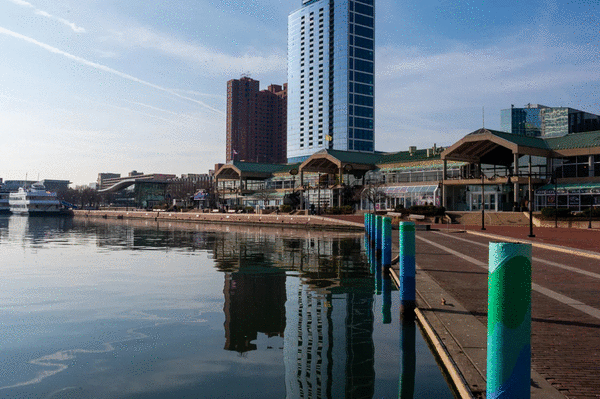
BALTIMORE — A group of Baltimore residents accused top city officials of violating city and state laws and regulations by approving a $900 million Harborplace redevelopment plan, according to a lawsuit filed Monday.
Plaintiffs, mostly residents who live downtown near the Inner Harbor, said in the complaint that Mayor Brandon Scott and the City Council disregarded procedures to push ahead with MCB Real Estate’s vision of replacing waterfront pavilions with apartment and office towers.
Supporters expect the plan to jump-start downtown Baltimore, while critics have questioned whether it will deliver on those promises.
“Redevelopment is clearly needed,” the lawsuit said, but city officials “have embarked upon an unduly rushed, behind-the-scenes plan to privatize land within the Inner Harbor and hand it over, along with large areas of public parkland, to a favored developer.”
The lawsuit, filed late Monday in Baltimore Circuit Court, accuses the city, including the Board of Estimates, of ignoring city charter, code and zoning provisions as well as state law.
A mayor’s representative did not immediately respond. City Council President Zeke Cohen could not be reached.
MCB, also named in the lawsuit, acquired Harborplace out of court-ordered receivership in April 2022, after years of tenant losses amid lack of investment and the pandemic. An MCB spokeswoman said Monday the developer has declined to comment on the project, and she did not respond to a request for comment on the lawsuit.
P. David Bramble, managing partner of MCB, previously told The Sun he expects the first new apartments, shops and offices to open along the waterfront within five years and remain true to the firm’s original vision.
The lawsuit is the latest public objection to MCB’s planned overhaul. Baltimore developer David Tufaro, also a lawsuit plaintiff, applied last Thursday through the Maryland Historical Trust to place Harborplace’s twin pavilions on a list of historic properties, hoping the move will stop or at least delay demolition.
The Harborplace project is expected to need about $400 million in public money for roads, parks and waterfront improvements, with nearly $100 million committed by the state. MCB has said it is working to secure another $500 million in private financing.
In a more recent development, MCB stands to get an as-yet-undisclosed property tax reduction of as much as 95% through a PILOT, or “payment in lieu of taxes.” That deal, proposed by the Baltimore Development Corporation, requires Board of Estimates approval.
The lawsuit said it aims to challenge “special laws” that give special treatment to “the privileged few.” The city council violated a Maryland prohibition against such laws when it passed three bills on a single day designed to accommodate MCB’s plans, the lawsuit alleges. That legislation allowed residential development and other new uses, removed height restrictions and expanded both private and public space along the Inner Harbor.
Plaintiffs also are challenging what they describe as a private sale of Harborplace to MCB as a “done deal long before the Court approved it in December 2022.” In April 2022, eight months earlier and five months before the receiver’s private sale motion, Scott announced that MCB had already struck an agreement with the receiver, the lawsuit said.
“Today, West Baltimore’s very own, David Bramble, announced that he has the rights to bring private investment for a revitalized Harborplace,” the suit quotes the mayor as saying. “Today, we start a new chapter for Harborplace — bringing Baltimore vision, Baltimore community investment, and Baltimore style to transform Harborplace into a landmark destination where residents can go to enjoy the best that we have to offer.”
He said at that time, “Dave has my full support and the support of my entire administration as he navigates the receivership process and works to bring hundreds of millions of dollars of investment into this part of our city,” the lawsuit said.
Plaintiffs said they seek to “ensure that the much-needed effort to restore the Inner Harbor and protect its use as a public park is undertaken openly and fairly, with due process, and in strict compliance with all applicable laws and regulations.”
Besides Tufarro, plaintiffs include William John Pencek, Anirban Basu, Eleanor M. Carey, Anthony Ambridge, Barbara L. Valeri and David Benn. The plaintiffs have standing to file suit as taxpayers and because their personal interests will be harmed due to their proximity to Harborplace, the lawsuit said.
The Inner Harbor coalition supports the lawsuit, said Michael Brassert, a Federal Hill resident and one of the group’s founders, but not a plaintiff. The coalition was formed three years ago to oppose apartment development in a public park, Brassert said.
“It’s a long time coming,” Brassert said. “It’s really obvious that a lot of corners were cut by the Mayor and the City Council to get this development of Harborplace approved. In that process, they’ve violated many longstanding laws in the state of Maryland. It’s about time that someone has stood up and had some accountability for this.”
Others have supported the idea of housing as part of a necessary mix of uses to make projects economically viable in downtowns that were once the center of commerce but are struggling to redefine their roles.
“It’s much more imperative for downtowns to become mixed-use places with more housing,” Dena Belzer, president of Strategic Economics, a Berkeley, California, firm that has done urban planning work in cities around the United States, including Baltimore, told The Sun in June.
Tufaro, founder of Terra Nova Ventures, which has repurposed properties in the city, and an Inner Harbor Coalition founder, argued in his petition to the Maryland Historical Trust that Harborplace is historically significant to Baltimore’s 1980s renaissance as the centerpiece of Inner Harbor’s transformation. It was a symbol of urban waterfront rejuvenation not only in Baltimore, but nationally and internationally, he said, and can be viewed as an example of well -planned architecture and design that set the stage for the “festival market” concept.
Tufaro said he hopes the petition will help raise awareness about Harborplace’s history and prevent “premature demolition.”
“You’re going to have a long road ahead before anything happens, if anything happens,” he said, citing the example of how the Morris A. Mechanic Theatre demolition left a hole in downtown for more than a decade. “It would be much worse at Harborplace and more visible. Certainly our expectation is the city council and mayor would not allow the pavilions to be torn down unless there’s a full demonstration of financing for what’s been proposed.”
-----------
©2026 The Baltimore Sun. Visit at baltimoresun.com. Distributed by Tribune Content Agency, LLC.






Comments